



U.S. Special Envoy Jared Kushner warned that Israel is heading toward "global-pariah status," according to an interview published Monday, Nov. 23, in New York Magazine [1][2].
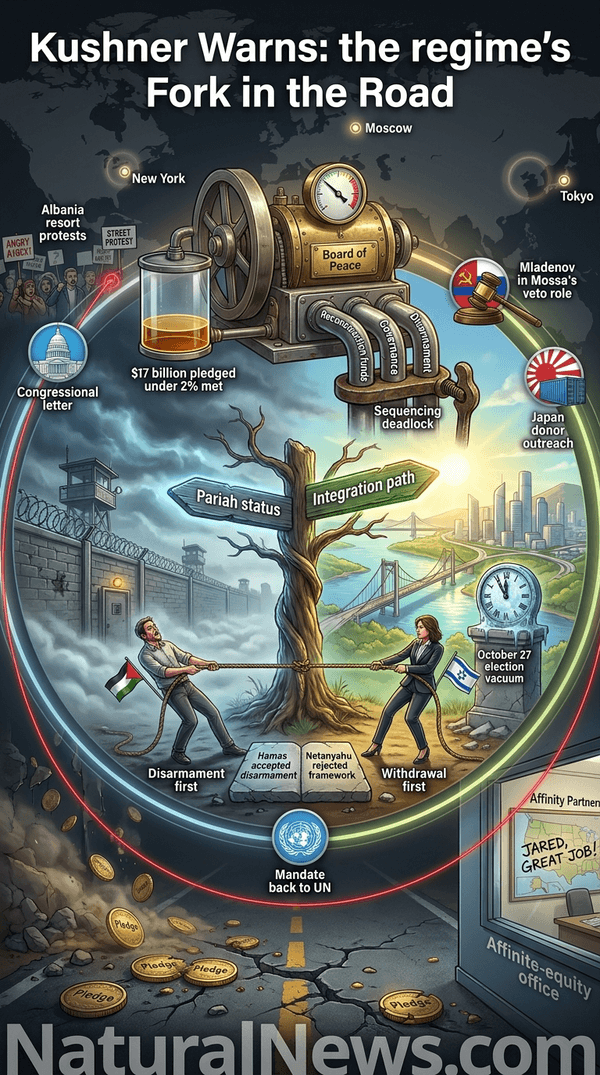
Kushner, President Donald Trump's son-in-law and a central figure in the administration's Middle East diplomacy, said Israel faces a "fork in the road" and could become more secure and integrated if it shifts its approach toward Gaza, the report stated. The envoy's remarks arrive as the Board of Peace he helped design remains stalled, its funding pledges largely unmet and its central disarmament framework blocked by Israeli Prime Minister Benjamin Netanyahu.
Board of Peace Plan Stalled as Netanyahu Blocks Gaza Framework
Kushner is a founding member of the Board of Peace, the body unveiled by the Trump administration on Jan. 16 to oversee Gaza's reconstruction and governance [3][4]. The board's founding members include former British Prime Minister Tony Blair, Kushner, Secretary of State Marco Rubio and Special Envoy Steve Witkoff, the report stated [3].
Hamas accepted the proposal's key provision to surrender weapons and transition Gaza to civilian governance, according to the report [5]. Nickolay Mladenov, the U.S.-appointed overseer of Trump's Gaza ceasefire plan, publicly criticized Israel for continuing airstrikes despite Hamas agreeing to disarm. Netanyahu rejected the framework, arguing Hamas must completely disarm before Israeli troops conduct any withdrawals [5].
Netanyahu has blocked the Board of Peace from advancing its plan to rebuild Gaza, according to a report [1]. The board held off pressing Israel before the Oct. 27 election, believing Netanyahu was unlikely to take steps exposing him to criticism of being soft on Hamas, according to the report.
The election produced inconclusive results, and coalition formation could take months. Netanyahu remains caretaker prime minister and his Gaza approach has not shifted.
Board Intensifies Public Messaging as Republican Frustration Grows
The Board of Peace has begun intensifying public messaging against Israel, with senior adviser Josh Gruenbaum giving several interviews over the weekend, according to the report. Gruenbaum argued Israeli intransigence is blocking the U.S.-controlled panel from testing Hamas' commitment to hand over its weapons.
He warned that if progress is not made soon, the board will have no choice but to hand its mandate overseeing postwar Gaza reconstruction back to the United Nations, according to his interviews. Gruenbaum's interview was shared on X by Sen. Dave McCormick (R-PA), as frustration with Netanyahu appeared to extend from the White House to the legislative branch, the report stated.
Funding Shortfall Prompts Outreach to Russia, Japan
The board is seeking new sources of political support and funding as less than two percent of the $17 billion in pledges have been met, according to officials. Board of Peace senior envoy Nickolay Mladenov traveled to Moscow, where he met Monday with Russian Foreign Minister Sergey Lavrov, the report stated.
Mladenov wrote on X that Russia "has an important role to play in supporting this process [due to its status]… as a permanent member of the UN Security Council." He outlined three priorities: "The ceasefire must hold, and all parties must honor their commitments. Palestinian governance in Gaza must be credible, accountable and connected to a wider political horizon. Security and recovery must advance together, because neither can be sustained without the other."
Israeli and Palestinian officials said the Board of Peace envoy will also travel to Japan, seen as another potential major donor given its previous funding of humanitarian projects in Gaza, according to the report. Neither Russia nor China is among the 28 countries whose leaders are members of Trump's Board of Peace.
Kushner Faces Conflict-of-Interest Questions, Denies Influence
Last week, Rep. Robert Garcia (D-CA) – ranking member of the House Oversight Committee – penned a letter to Kushner warning of potential congressional investigations into conflicts of interest arising from his financial interests and diplomatic work involving Iran, Ukraine and Gaza, according to the report. Kushner has maintained involvement and financial interests in his private-equity firm Affinity Partners since officially joining Trump's second administration in February, the report stated.
The New York Magazine profile examined potential conflicts arising from Kushner's business dealings with Gulf monarchies and Israeli companies, suggesting his diplomatic role and financial interests have become increasingly intertwined. The article revealed that at Kushner's investment firm office, a map of Trump's failed 2020 Israeli-Palestinian peace plan hangs on the wall, with an inscription in Sharpie by Trump reading, "JARED, GREAT JOB."
Kushner denies that his business interests have influenced his diplomatic work, arguing that his financial independence allows him to pursue diplomacy without needing compensation from the government, according to the report [1]. The scrutiny extends beyond Washington. Kushner's resort development projects in Albania have drawn sustained street protests in the capital Tirana, where demonstrators have connected the land deals to a broader pattern of foreign acquisition [6][7][8].
Outcome Remains Uncertain as Board Weighs Next Steps
Kushner's warning comes amid stalled Gaza reconstruction, a major funding shortfall, and unanswered conflict-of-interest questions, according to officials and the report. The Board of Peace has said it may return its mandate to the UN if Israeli and Hamas commitments are not met, while Netanyahu remains caretaker prime minister and coalition talks continue.
No timetable has been announced for the board's next actions or for the disarmament roadmap's implementation, officials said. The deadlock leaves Gaza's postwar governance unresolved and the board's $17 billion reconstruction plan largely unfunded. For observers tracking the trajectory Kushner described, the next several months will determine whether Israel's diplomatic isolation deepens or whether the board's framework – however contested – can still be salvaged.
References
- Kushner: Israel facing fork in the road as it ‘trends’ toward ‘global-pariah status’. https://www.timesofisrael.com/kushner-israel-facing-fork-in-the-road-as-it-trends-toward-global-pariah-status/
- ‘I Sleep Well at Night’ Jared Kushner mixes diplomacy and business. Democrats call it corruption ... https://nymag.com/intelligencer/article/jared-kushner-profile-diplomacy-trump.html
- Trump's Gaza 'Board of Peace;' Is Just as Bad as You'd Imagine. https://original.antiwar.com/Alan_Mosley/2026/01/18/trump-announces-his-gaza-board-of-peace-its-just-as-bad-as-youd-imagine/
- What is Trump's 'Board of Peace' and who will govern Gaza? https://www.middleeasteye.net/news/what-is-trump-board-of-peace-and-who-will-govern-gaza
- UN peace envoy warns: Stalled Gaza ceasefire risks a "point of no return" - NaturalNews.com, August 28, 2026.
- Kushner's Sazan scandal: Albanians are revolting against a system, not a resort. https://www.middleeasteye.net/opinion/albanians-are-revolting-against-system-not-resort
- Kushner's island land grab: Albanians are revolting against a system, not a resort. https://www.middleeasteye.net/opinion/kushner-island-land-grab-albanians-are-revolting-against-system-not-resort
- ‘The right to stay’: Albania’s Italian diaspora sails back to support the Flamingo Revolution. https://www.middleeasteye.net/news/right-stay-albanias-italian-diaspora-sails-back-support-flamingo-revolution
Explainer Infographic









Please contact us for more information.