


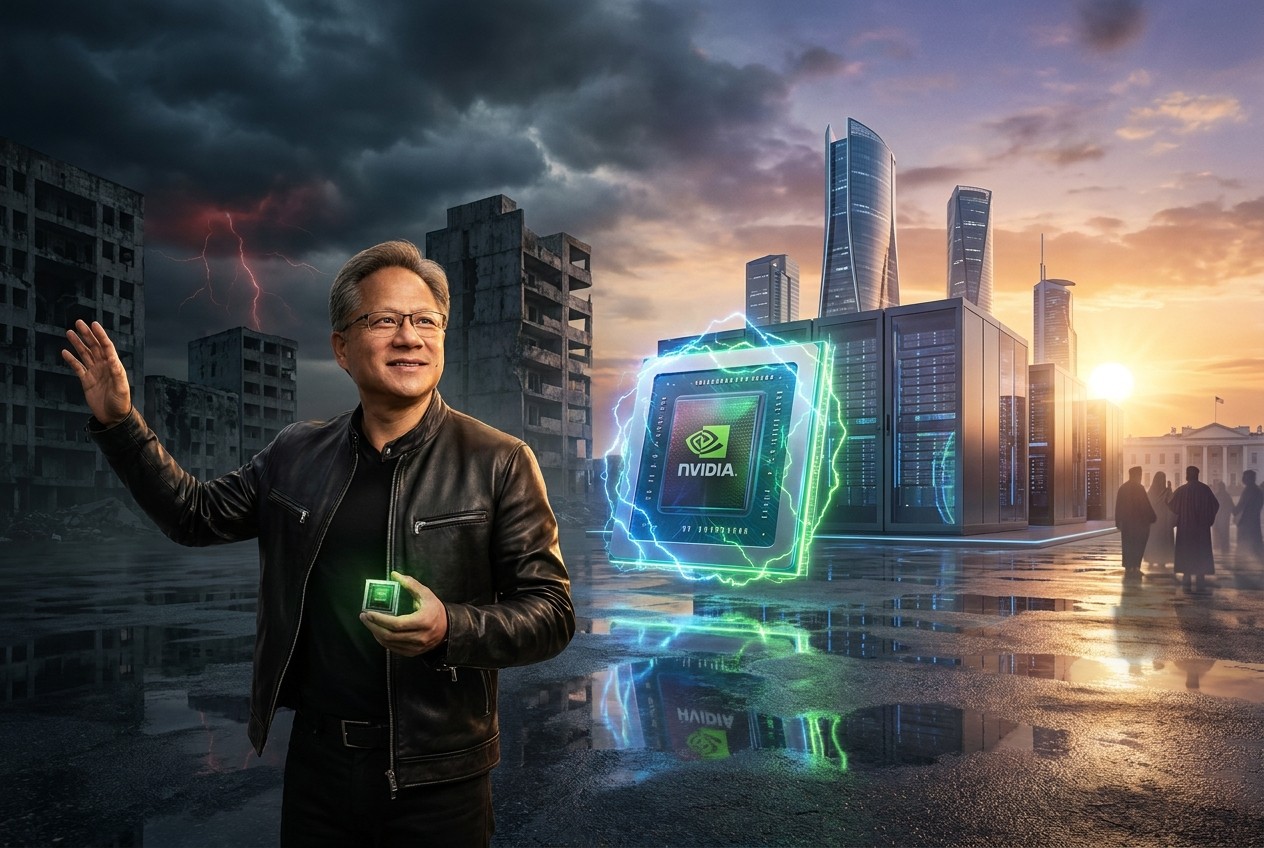
- Companies tied to Alice Huang, whose affair with Nvidia CEO Jensen Huang briefly cost him his job, financed $270 million in AI servers in China.
- Firms linked to her sister and husband leased hundreds of servers at a Shanghai data center, with one batch bankrolled by a state-backed Chinese defense conglomerate.
- U.S. intelligence reportedly indicates Alice Huang was in contact with China's Ministry of State Security during her relationship with Jensen Huang.
- One deal alone covered 128 servers holding 1,024 graphics processors, though the records don't show whether any chips were restricted.
- Jensen Huang faces congressional questioning as federal investigators probe suspected diversion of Nvidia chips to China.
In a tale that blends boardroom scandal with geopolitical intrigue, companies linked to Alice Huang—the woman whose affair with Nvidia CEO Jensen Huang briefly cost him his job—secured financing against as many as 764 artificial intelligence servers and modules valued at $270 million, much of it parked at a massive Shanghai data center, according to previously unreported Chinese central-bank records reviewed by Reuters.
The documents, covering deals from 2024 to 2026, reveal a sprawling network of family-run businesses, state-backed financing from a Chinese aviation and defense conglomerate, and hardware tied to an AI project that was launched through a partnership between Tencent and Shanghai's Songjiang district. The U.S. Commerce Department blacklisted Alice Huang's former Singapore company, Megaspeed, on Nov. 23 amid an investigation into the suspected diversion of Nvidia chips to China. Megaspeed denies any wrongdoing.
Firms linked to Alice Huang’s family leased hundreds of servers in Shanghai
The records show that Century Litong, an Nvidia-preferred cloud partner that rents powerful computing capacity, raised financing through five leasing deals for as many as 512 servers worth 1.42 billion yuan ($200 million) between May and December 2024. Four of those leases placed the equipment at Shanghai's Yangtze River Delta AI supercomputing center, a facility whose infrastructure developer, Shanghai Longrui, once counted gaming firm Century Huatong as a stakeholder. Tencent, in turn, holds around a 10% stake in Century Huatong. Tencent told Reuters it "did not develop or co-develop the data center facility in question" and denied any commercial relationship with Megaspeed. The records don't connect Tencent to the specific servers.
Corporate filings tie Century Litong and its related firms back to Alice Huang's sister, Huang Yu, and to Kang Wei, an investment executive who is reportedly Alice Huang's husband. Kang was named Century Longteng's executive director in a 2022 government announcement, and Century Huatong now fully controls that firm. The parent company also holds a 70% stake in a business that once listed Alice Huang as a director, along with a holding in 7Road Holdings, a gaming company whose former overseas arm took on the Megaspeed name in 2023.
A Chinese defense giant helped bankroll the servers
In one of the more eyebrow-raising arrangements, an arm of AVIC, a Chinese state-backed aviation and defense conglomerate, financed 128 servers worth $57 million, which were then leased to Century Litong. The documents don't show whether the servers contained any restricted chips, but the connection to a military-linked entity raises obvious red flags given Washington's ongoing crackdown on technology flowing to China.
A separate inventory from the Shanghai facility listed more than 10,000 Nvidia networking cards and 730 specialized units, all gear used to link computers for AI tasks. One deal alone involved 128 servers housing eight graphics processors each, amounting to a total of 1,024 chips. The paperwork listed their computing power as "989 PFLOPs" and valued each machine at as much as $450,000.
The spy question won't go away
The soap opera took a darker turn when The New York Times reported that U.S. intelligence indicates Alice Huang stayed in touch with an official from China's Ministry of State Security from spring 2025 through fall 2026, a period overlapping with her relationship with Jensen Huang. It is not clear if she passed along any inside information. Director of National Intelligence Jay Clayton told ABC that an investigation into Huang and Megaspeed is still in progress.
The Wall Street Journal separately reported that Huang associate Li Ming, a Chinese national now out on bail in Singapore, was "deeply involved" in Megaspeed's activities and took part in major decisions. Federal investigators have been probing the company since 2024 over suspected export-control violations.
Jensen Huang and Nvidia's general counsel are expected to hold closed-door interviews with three House committees on Dec. 1 and 2; lawmakers will be trying to determine what the company knew about where its chips ended up. The scrutiny from Washington and the complexity of the corporate structure create a troubling picture for Nvidia as it tries to navigate the high-wire act of selling advanced technology without giving Beijing the crown jewels.
Sources for this article include:






Please contact us for more information.