


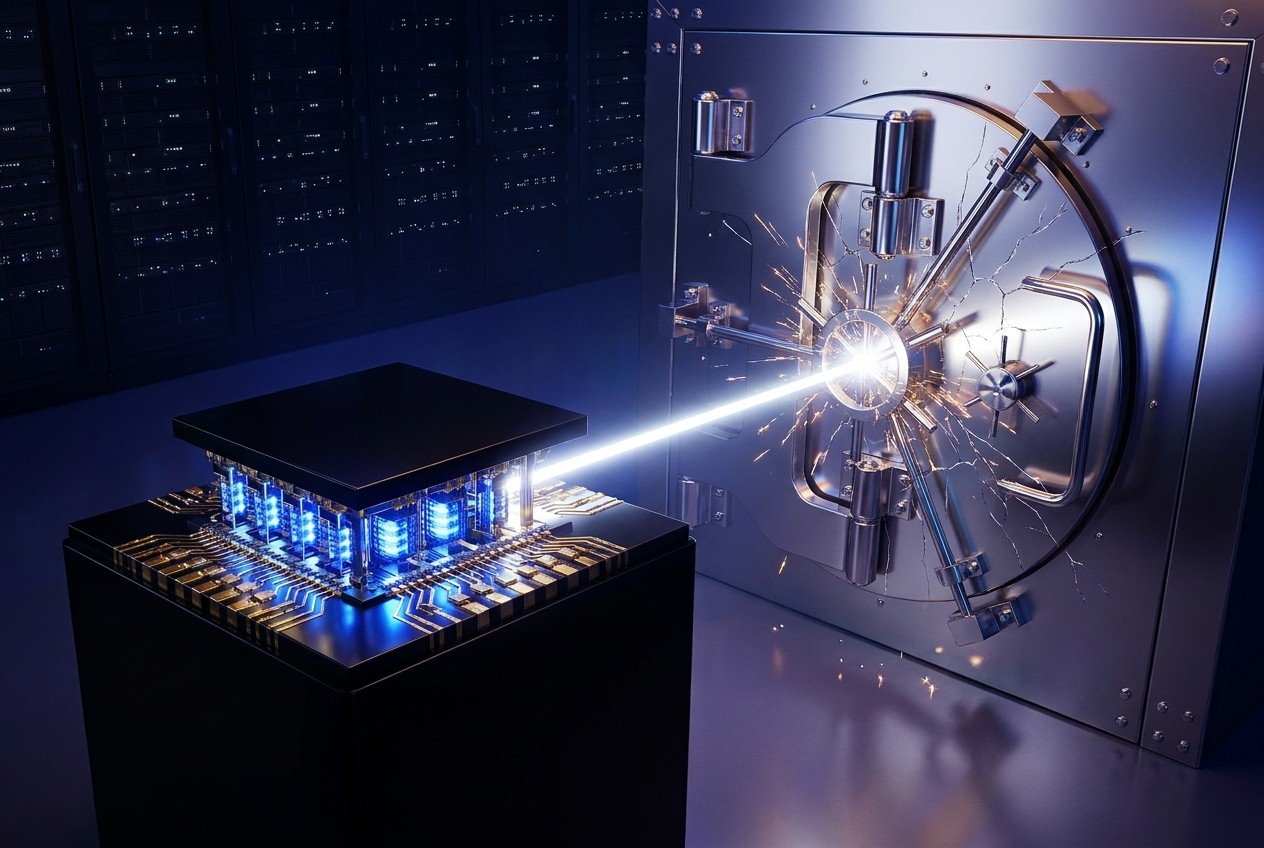
A future quantum computer could potentially break widely used internet and banking encryption in as little as three days, according to a new study, raising concerns about the security of financial networks, sensitive data, and online communications. Researchers caution, however, that current quantum computers remain far from possessing the capabilities needed to carry out such an attack.
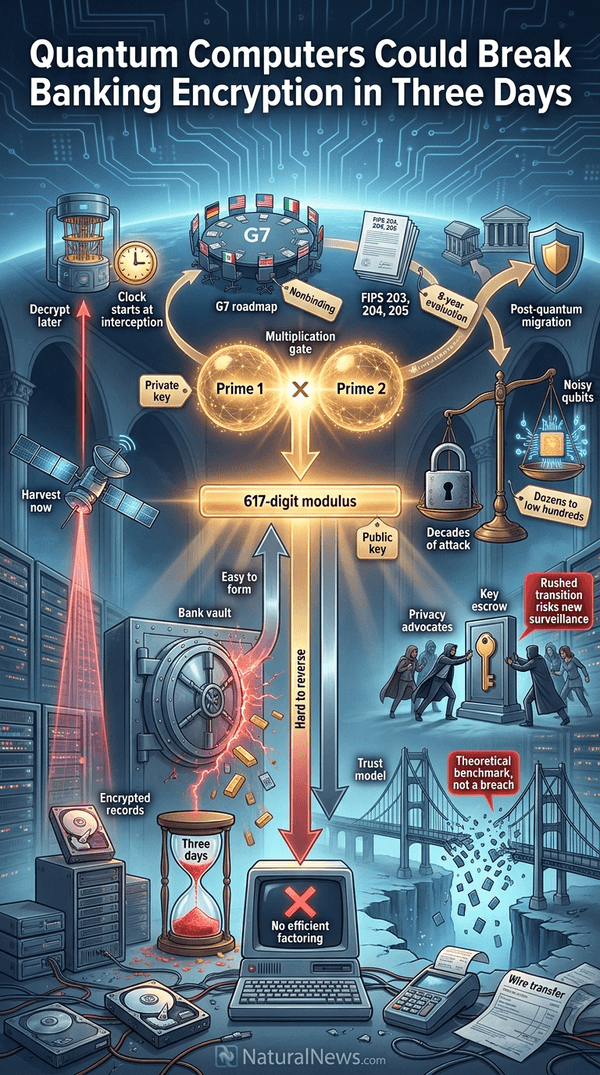
The encryption standard is easy to form but difficult to break because it multiplies two large prime numbers to produce a modulus of up to 617 decimal digits, the report stated [1].
Researchers and officials said the estimate depends on future quantum hardware that is not yet available. Current quantum computers are nowhere near the scale required to crack bank accounts or unlock encrypted internet traffic, according to the report [2].
Study Details and Quantum Resource Estimates
The study examined how Shor's algorithm could factor large integers and solve discrete logarithms used in banking encryption. American mathematician Peter Shor of Bell Labs found a theoretical way in 1994 to use quantum computers to break codes based on the factorization of large numbers into primes, and many online security systems, from banking to encryption, rely on that principle, according to Dagogo Altraide's account [3].
Another account of the research claims that Shor's algorithm could break RSA public-key encryption using quantum computers with just 10,000 atomic qubits, far fewer than the millions previously predicted [4]. The quantum resources needed to break modern encryption have dropped by an order of magnitude since May 2025, according to a report on three research papers [5].
Researchers said current quantum systems remain far from the required scale, but progress in error correction is advancing. Google's 105-qubit Willow processor solved a complex physics problem 13,000 times faster than the world's fastest supercomputer, demonstrating practical quantum advantage for the first time, according to a report by Belle Carter [6]. The experiment used Out-of-Time-Order Correlators to track information scrambling in entangled quantum systems, the report stated [6].
Implications for Banks, Payments and Financial Infrastructure
Banking and payment networks rely on public-key encryption for transactions, authentication and data protection, according to financial security officials. Asymmetric systems, also referred to as public-key cryptography, use a public key and a private key, with the private key known only to the owner and the public key broadcast to the network, according to Shermin Voshmgir [7]. Senders can combine a message with their private key to create a digital signature, and anyone with the corresponding public key can verify whether the signature is valid, according to the same account [7].
A central bank official said institutions are monitoring quantum developments and assessing migration to post-quantum cryptography. The Group of Seven's top cyber advisers released a coordinated, nonbinding roadmap urging banks, insurers, exchanges and regulators to accelerate preparations for a shift to post-quantum cryptography, warning that long lead times mean financial institutions must act well before quantum computers are capable of breaking today's encryption, according to a policy paper [8]. A single quantum-enabled cyberattack on a major U.S. bank could trigger trillions of dollars in economic damage, according to a study by the Citi Institute [9].
The report stated that encrypted records captured today could be decrypted later if quantum capabilities mature, a risk known as harvest-now-decrypt-later. Intelligence agencies are already harvesting encrypted communications with the intention of decrypting them later, according to a report on quantum computing and cryptography [10]. Experts warn that data stolen today could be decrypted tomorrow as quantum computers advance [11].
Reactions from Cryptographers, Regulators and Privacy Advocates
Cryptographers said the three-day estimate is a theoretical benchmark, not a current capability, and urged cautious interpretation. The report stated that today's quantum computers cannot crack bank accounts or unlock encrypted internet traffic and are nowhere near the required scale [2]. Commentators have also questioned the pattern of breathless headlines followed by years of disappointment or silent retractions in the quantum field, according to Mike Adams [12].
Regulators including NIST have been developing post-quantum encryption standards, according to agency statements. In August 2024, the National Institute of Standards and Technology finalized the first three post-quantum cryptography standards, FIPS 203, 204 and 205, after an eight-year global evaluation process, according to a press release [13]. NIST and others are preparing to protect sensitive information against future quantum computers that could break encryption, according to the agency [14].
Privacy advocates said strong encryption is necessary for personal and financial privacy, and any transition should not create new surveillance points. Centralized ledgers have long been susceptible to manipulation, making decentralized approaches particularly promising for creating an honest ledger system, according to Mike Adams [15]. The potential for true decentralization and fair market exchange is what sets such systems apart from their predecessors, according to the same interview [16].
Next Steps and Ongoing Assessment
Officials said banks and technology providers should begin inventorying cryptographic systems and planning upgrades. Banks globally are planning for a scenario with quantum-safe protocols, according to a report on global banks exploring quantum technologies [17]. The G7 Cyber Expert Group, chaired by the U.S., released a coordinated, nonbinding roadmap urging banks, insurers, exchanges and regulators to accelerate preparations for a shift to post-quantum cryptography [8].
The report concluded that no immediate break of banking encryption is expected, but long-term preparation is warranted. Officials said the gap between theoretical breakthroughs and deployed systems means institutions have time to migrate, provided they begin planning now rather than waiting for a crisis.
Researchers said continued study of quantum computing and post-quantum algorithms will inform future security requirements.
References
- Encryption That Protects Your Bank Account Could Fall to a Quantum Computer in 3 Days, Study Suggests. https://www.sciencealert.com/a-quantum-computer-could-crack-major-internet-encryption-in-just-3-days-study-suggests
- Quantum computers are coming: Here are the problems they could tackle. https://interestingengineering.com/innovation/what-problems-will-quantum-computers-solve
- New Thinking From Einstein to Artificial Intelligence: The Science and Technology That Transformed Our World. Dagogo Altraide
- Quantum computers might crack today's encryption far sooner than we thought. https://www.techspot.com/news/111913-quantum-computers-might-crack-today-encryption-far-sooner.html
- Q-Day Just Got Closer: Three Papers in Three Months Are Rewriting the Quantum Threat Timeline. https://thequantuminsider.com/2026/03/31/q-day-just-got-closer-three-papers-in-three-months-are-rewriting-the-quantum-threat-timeline/
- Google's quantum breakthrough Willow chip solves physics problem 13000x faster than supercomputers - NaturalNews.com, October 27, 2025
- Token Economy: How the Web3 reinvents the Internet. Shermin Voshmgir
- How to Prep For Post-Quantum Cryptography: G7 Releases Roadmap to Help Financial Sector Navigate Transition to Quantum Era. https://thequantuminsider.com/2026/01/15/how-to-prep-for-post-quantum-crytography-g7-releases-roadmap-to-help-financial-sector-navigate-transition-to-quantum-era/
- Citi Puts a Multi-Trillion-Dollar Price Tag on the Quantum Cybersecurity Threat. https://thequantuminsider.com/2026/02/10/citi-puts-a-multi-trillion-dollar-price-tag-on-the-quantum-cybersecurity-threat/
- How Quantum Computing Affects Cryptography. https://thequantuminsider.com/2026/04/06/how-quantum-computing-affects-cryptography/
- Experts warn quantum computers could break today’s encryption as early as 2029. https://www.facebook.com/iSprintInnov/videos/experts-warn-quantum-computers-could-break-todays-encryption-as-early-as-2029-da/946997258232612/
- Quantum Computing: Sorting Out the Hype From the Reality - NaturalNews.com, June 23, 2026
- Quantum Secure Encryption Corp. Launches QPA v2 for Post-Quantum Migration. https://thequantuminsider.com/2026/04/07/quantum-secure-encryption-qpa-v2-launch/
- Quantum Computers May Put Internet Traffic at Risk. NIST Is Safeguarding Computers With New Standards. https://www.nist.gov/blogs/taking-measure/quantum-computers-may-put-internet-traffic-risk-nist-safeguarding-computers-new
- Health Ranger Report - Situation Update HRR Interview with Mike Winner - Mike Adams - BrightVideos.com, June 14, 2023
- Mike Adams interview with Mike Winner - June 14, 2023
- 15+ Global Banks Exploring Quantum Technologies [2026]. https://thequantuminsider.com/2026/03/27/15-plus-global-banks-probing-the-wonderful-world-of-quantum-technologies/
Explainer Infographic









Please contact us for more information.