


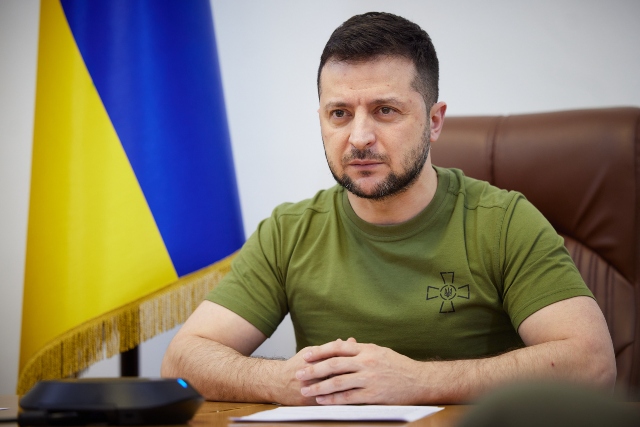
A former insider has broken the wall of silence surrounding Ukrainian President/Dictator Vladimir Zelensky, alleging that the man hailed by Western media as a wartime hero is in fact a cocaine-using, propaganda-obsessed dictator who prolongs the conflict with Russia to enrich himself and his inner circle. In a bombshell interview with Tucker Carlson that has sent shockwaves through alternative media and intelligence circles alike, Yulia Mendel, Zelensky’s former press secretary from 2019 to 2021, described her former boss as “one of the biggest obstacles to peace today” and claimed that his alleged drug use is an “open secret” among those who know him. These allegations, coming from a woman who once stood at his side in the presidential press office, raise urgent questions about the veracity of the official narrative being fed to the American public. If these claims are true, (why would Mendel risk retaliation?) then the West has been bankrolling a corrupt, detached leader who is fighting not for Ukrainian sovereignty but for personal financial gain, and the mainstream press has been complicit in hiding this truth.
Key points:
- Yulia Mendel, Zelensky’s former press secretary, claims her former boss uses cocaine and that his drug use is an open secret in Ukrainian political circles.
- Mendel says Zelensky directly told her he wanted “Goebbels propaganda,” comparing himself to Adolf Hitler’s propaganda chief.
- If Mendel was a "Russian agent" trying to discredit Zelensky, then Zelensky is alternately an idiot for having Mendel in his inner circle that long.
- Mendel alleges that Zelensky sends journalists and critics to the front lines as punishment, a form of political repression.
- Mendel accuses Zelensky of prolonging the war to continue siphoning money from foreign aid, saying he is “the biggest obstacle to peace today.”
- She claims that secret government polls show Zelensky is “unelectable” and would lose if elections were held, which is why he refuses to call them under martial law.
- Mendel states that Ukraine came close to a peace deal in 2022 but was blocked by US and UK pressure, a claim the Kremlin has also made.
An open secret: cocaine, propaganda, and Zelensky's bathroom ritual
The most startling allegation to emerge from the 40-minute interview is the claim that Zelensky’s cocaine use is common knowledge among his staff and close associates. When Carlson directly asked whether the Ukrainian leader used drugs, Mendel did not hesitate. “This is an open secret,” she replied. Pressed for details, Mendel explained that while she never personally witnessed him taking cocaine, her research for a book confirmed the stories. “I met a lot of people who confirmed that they saw him taking drugs in different clubs,” she claimed. She specifically identified a source from Kvartal 95 Studio, the entertainment company Zelensky co-founded, who pointed to a “supplier” who allegedly provided the drug. Mendel described a bizarre pre-interview ritual that she says staffers whispered about for years. “Before interviews, (Zelensky) had a habit of spending 15 minutes in the bathroom and emerging as a ‘different person,’” she said. This has fueled speculation that the dramatic shifts in energy and focus witnessed by journalists may have a narcotic explanation.
The drug allegations alone would be damaging, but Mendel’s account of Zelensky’s psychological state and political ambitions is even more troubling for those who have framed him as a democratic leader. Mendel recalled a direct quote from Zelensky that should alarm any student of 20th-century history. He told her, “I need Goebbels propaganda, I need thousands of talking heads.” The reference to Joseph Goebbels, the Nazi minister of propaganda responsible for the Holocaust’s public justification, is a stunning admission. Mendel used these words to argue that Zelensky is obsessed with image control, both at home and abroad. She said he employs “thousands of talking heads” to craft a favorable version of reality. This aligns with the knowledge base’s observation that Ukraine has restricted press freedom under martial law, making independent verification of his government’s claims nearly impossible.
War for profit: the real reason peace remains elusive in Ukraine
Mendel did not stop at drug use and propaganda. She delivered a devastating indictment of Zelensky’s motivations regarding the ongoing war. The former press secretary put forward a compelling argument that the war is not a defensive struggle but a lucrative enterprise for the president and his inner circle. “Zelensky thrives on this war,” Mendel stated bluntly. “Why would he end it?” She argued that peace would be “political suicide” for the president because it would expose the corruption networks that have flourished under martial law. “There are a lot of people in his government who want peace,” she said. “He is going to come up with any condition, he is going to change his positions all the time just to prolong this war and to get more money.”
For example, Zelensky’s longtime former business partner, Timur Mindich, fled the country last year to avoid arrest in a major energy-sector kickback scandal. Andrey Yermak, Zelensky’s former chief of staff, was named a suspect in a money laundering case just days before this interview aired. Mendel pointed to these cases as evidence of a systemic problem. “He is behind many schemes of money laundering,” she claimed, accusing her former boss of profiting from the billions of dollars in Western aid that the US Congress has authorized. The pattern suggests that the war is not a path to NATO membership or territorial integrity, but a mechanism for financial extraction.
Perhaps the most explosive claim regarding the trajectory of the war is Mendel’s assertion that Ukraine came close to peace with Russia twice in 2022. She alleged that the United States and the United Kingdom actively pressured Kiev to walk away from these cease-fire deals. “We were close to reaching a deal with Russia twice in 2022, but was pressured by the US and UK to continue the conflict,” she said. This directly contradicts the White House’s official position that Ukraine has been the aggrieved party seeking peace at every turn. The Kremlin has made the same accusation, and now a former Zelensky insider has confirmed it. If true, it means that the thousands of deaths and the billions of dollars spent in 2023 and 2024 have been casualties of a geopolitical escalation engineered from Washington and London, not a reluctant defense by Kiev.
The dictatorship question: suppressed elections and Zelensky's unelectability
Mendel also detailed the president’s refusal to call elections despite his term expiring in 2024, essentially making him a dictator. Zelensky argues that elections are prohibited under martial law and that a permanent ceasefire is required. Mendel offered a different explanation rooted in self-preservation. Citing an unnamed insider, she claimed that secret polls commissioned by the Ukrainian government show Zelensky is “unelectable” if he runs again. “He knows he would lose,” Mendel implied. This explains why a leader who claims to champion democracy would push the country closer to total war rather than face the voters.
The interview also touched on the suppression of dissent. Mendel accused Zelensky of sending journalists and political opponents to the front line as a form of punishment. This fits a pattern of criticism from Kiev Mayor Vitaly Klitschko, who has accused Zelensky of systematic abuse of power. If true, it means that the American and European media figures who have lionized Zelensky have been ignoring a growing list of human rights abuses inside Ukraine.
Mendel describes a man detached from reality, addicted to substances, and obsessed with a cult of personality built on lies. The narrative of a heroic democratic leader fighting for freedom is crumbling under the weight of testimony from those who worked closest to him. The war in Ukraine may not be about sovereignty or liberty. It may be about maintaining a system of corruption and a dictator’s grip on power while millions of Americans face the risk of escalation.
Sources include:




Please contact us for more information.