


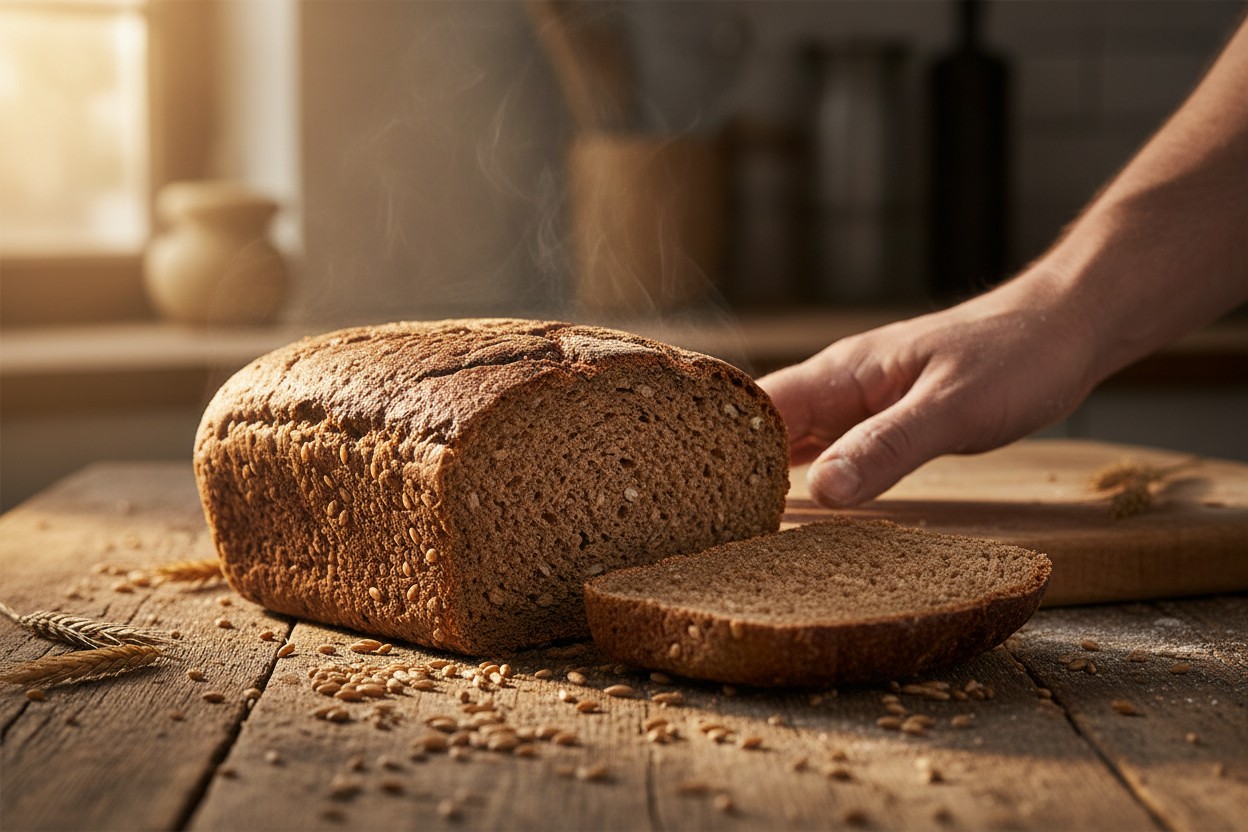
Why I Changed My Mind About Pumpernickel
I used to dismiss pumpernickel as just another heavy, odd-tasting bread that belonged in a dusty European deli case. Whenever I saw that dense, dark loaf, I assumed it was all marketing hype -- a shadow of real food that had been stripped of its soul by industrial processing. But after years of researching nutrition, fermentation and traditional foodways, I have completely flipped my understanding. This is not shadow food. It is a genuine superfood that sustained entire populations for centuries through its unique combination of shelf stability, mineral density and microbial preservation.
Here is why this matters: we have lost the art of real food, and recovering that knowledge is essential for health and self-sufficiency. Most modern breads are little more than processed flour, chemical yeast and shelf-life extenders that deliver empty calories. Pumpernickel, on the other hand, is a living artifact of food science -- one that medieval bakers mastered without microscopes or laboratories. I believe that by reclaiming this forgotten staple, we can push back against the industrial food system and rebuild our own resilience.
The Humble Weed That Saved Northern Europe
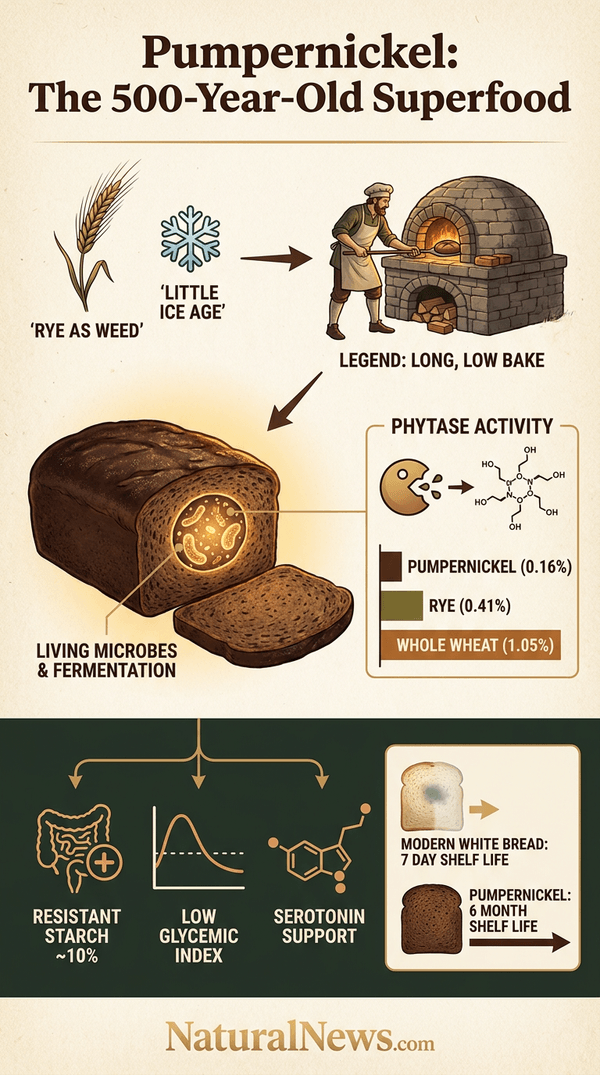
Rye was originally considered a weed in wheat fields. As naturalnews.com notes in an article on rye bread, this grain evolved to mimic wheat in order to avoid detection and be resown with similar-looking wheat seeds. But when the Little Ice Age struck Northern Europe, wheat failed on the cold, sandy soils while rye thrived. Farmers in Westphalia, Germany, learned that rye could be grown continuously on infertile land in what is called the eternal rye system -- a reliable source of calories that quite literally prevented mass starvation.
I believe this grain's resilience is a lesson we desperately need today. We have been told to value only crops that produce high yields under ideal inputs -- irrigation, synthetic fertilizers, pesticides. But those high-yield systems are brittle and dependent on a fragile industrial supply chain. Rye, by contrast, stands up to cold, drought and poor soil. It is a crop that answers the question: what do we grow when the system breaks down? That is why I believe rediscovering rye is not just a nutritional choice -- it is a survival strategy.
The Accidental 24-Hour Bake That Changed Food History
Legend has it that a baker in the German town of Soest bricked up his oven during a siege and returned days later to find a black, fragrant, long-lasting loaf -- the first pumpernickel. I do not know whether the story is literally true, but the technique it describes is nothing short of genius. The long, low-temperature steam bake -- often 16 to 24 hours at around 200 degrees Fahrenheit -- triggers the Maillard reaction throughout the entire loaf, creating deep chocolatey flavors without any cocoa or sugar added.
In my view, this accident was actually a stroke of food engineering. The extended bake pasteurizes the interior while locking in moisture. The result is a bread that resists mold for months, not days. Traditional pumpernickel can sit on a shelf for half a year without spoiling. How many of today's industrial loaves can claim that? This is food that was designed to travel with soldiers, sailors and settlers -- a calorie-dense, nutrient-rich block that did not rot or crumble. It is the kind of food that built civilizations.
The Invisible Microbial Civilization Inside the Loaf
Traditional pumpernickel relies on a living sourdough culture, not commercial yeast or chemical preservatives. A wild fermentation of lactic acid bacteria and yeasts produces lactic and acetic acids, hydrogen peroxide and natural antifungal compounds. As the textbook Understanding Food: Principles and Preparation explains, the Lactobacillus plantarum strain widely used as a starter produces lactic acid that gives sourdough its pleasantly sour taste, while the lower pH also inhibits enzymes that would otherwise break down starch into sugar. This creates a self-preserving environment that does not require refrigeration or additives.
I find it astonishing that medieval bakers, without any microscopes, harnessed this complex ecosystem. The same sourdough starter used in pumpernickel is a living colony of beneficial microbes, passed down through generations. This is not just bread making -- it is the domestication of invisible allies. And the result is a loaf that is not only long-lasting but also easier to digest than commercial bread, because the fermentation breaks down gluten and other hard-to-digest proteins. That is real food science, achieved long before the modern laboratory.
The Nutritional Edge That Made a Difference
Rye contains phytase, an enzyme that breaks down phytic acid -- a notorious mineral blocker found in all grains. When rye is subjected to long sourdough fermentation and the extended low-heat bake of pumpernickel, that phytase is activated and gradually neutralizes the phytic acid. According to the data in Living With Phytic Acid, pumpernickel bread contains only 0.16% phytic acid by weight, compared to 0.41% in standard rye and 0.43–1.05% in whole wheat bread. Some sourdough ryes even drop to 0.03%. That is a dramatic reduction.
Why does this matter? Phytic acid binds to iron, zinc and magnesium, preventing your body from absorbing them. By dephytinizing the grain, pumpernickel makes those minerals bioavailable. Studies also show that whole grain rye has a positive impact on serotonin levels in the blood, as reported by Natural News in a piece on rye and gut health. And the resistant starch content of pumpernickel -- measured at approximately 10% in ileal effluent studies from the 1996 paper in Food Chemistry -- feeds beneficial gut bacteria and stabilizes blood sugar. In my view, this is why populations eating pumpernickel thrived: they got real nutrition from a single affordable staple, unlike today's nutrient-poor processed breads that spike glucose and leach minerals.
From Siege Warfare to the Space Station
Pumpernickel's six-month shelf life made it the perfect soldier's bread. It was carried across Europe by armies, loaded onto ships for long voyages and stored in cellars through harsh winters. Its durability even caught the attention of the European Space Agency -- German astronaut Thomas Reiter reportedly took a loaf to the International Space Station. Today, authentic Westphalian pumpernickel is protected by EU geographical indication and recognized as cultural heritage by UNESCO in Germany.
I believe we should reclaim this bread. Seek out genuine long-baked pumpernickel from traditional bakeries -- not the sweetened, factory-made imposters dyed with molasses or caramel coloring. Support the artisans who keep the 24-hour bake alive. And reject the industrial shadow bread that fills grocery store shelves. If you want a food that is truly nutrient-dense, shelf-stable, and built on centuries of real science, put a slice of real pumpernickel on your plate. You'll be enjoying a piece of authentic history that changed the course of civilization. Your taste buds -- and your brain -- will thank you.
References
- 6 Amazing benefits of rye bread plus homemade rye bread recipe - NaturalNews.com, March 03, 2021.
- Whole grain rye shown to boost gut health - NaturalNews.com, November 19, 2019.
- Living With Phytic Acid - wkhtmltopdf 01221.
- Understanding food principles and preparation - Brown, Amy C., 2nd edition.
- Resistant starch formation in bread as influenced by choice of ingredients or baking conditions - Food Chemistry Vol. 56 No. 4 pp. 389-394, 1996.
Explainer Infographic:








Please contact us for more information.