


The Federal Bureau of Investigation's Cyber Branch said Tuesday that it has not taken possession of any equipment connected to last week's nationwide air traffic communications outage, contradicting a CNN report published Monday that federal agents had seized a router and other hardware linked to the disruption.
The outage prompted a nationwide ground stop Friday, forcing airlines to cancel approximately 12,460 flights, according to the Federal Aviation Administration (FAA). It was the third such nationwide halt in U.S. history, following the Sept. 11, 2001, attacks and a brief FAA computer failure in 2023, according to Raw Story.
The conflicting accounts have raised questions about the investigation into the outage, which disrupted air travel nationwide and renewed scrutiny of the aging communications systems supporting U.S. air traffic control.
FAA Outage and Initial Account
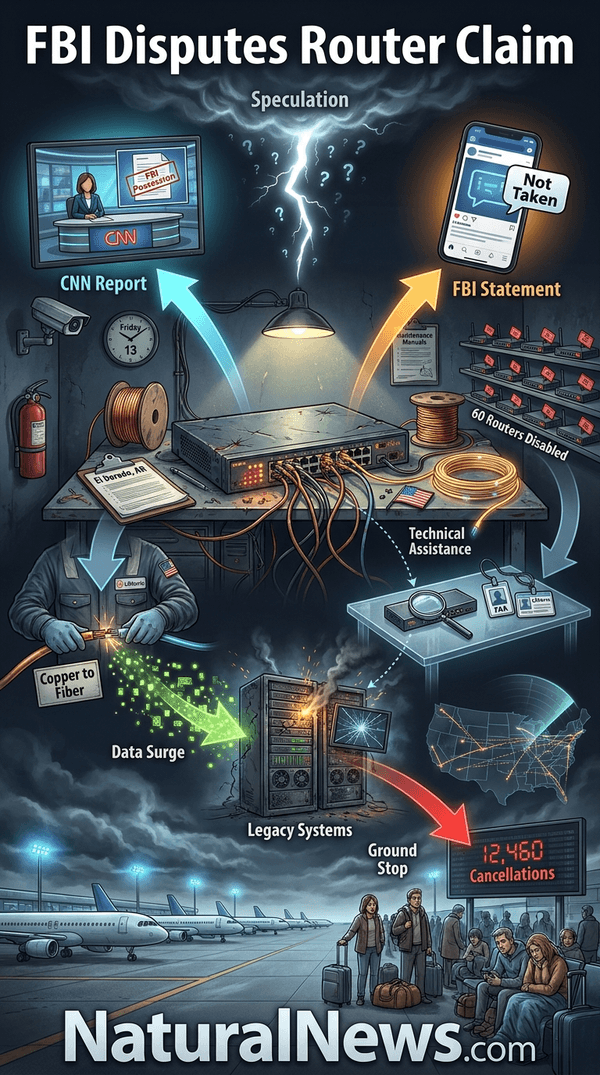
Transportation Secretary Sean Duffy said the disruption began during a routine router upgrade at a remote radio facility in El Dorado, Arkansas. Workers employed by contractor L3Harris were replacing copper wiring with fiber-optic cable when the problem occurred, according to Raw Story.
The FAA attributed the disruption to a surge of data that overwhelmed older telecommunications equipment, affecting communications and radar feeds within the air traffic control network. The nationwide ground stop lasted more than four hours, while airlines canceled approximately 12,460 flights, according to the FAA.
Duffy said the FBI was assisting the investigation to determine whether a cyberattack was involved. Officials have not ruled out that possibility, although CNN previously reported there was no immediate indication of a security threat or deliberate attack. The investigation remains ongoing, according to Fortune.
FBI Statement Contradicts CNN Report
CNN reported Monday that federal agents had taken possession of a router and other equipment linked to the FAA outage, prompting widespread attention to the possibility of a federal investigation involving the hardware.
The FBI's Cyber Branch disputed that account Tuesday in a statement posted on social media.
"FBI Cyber teams are working with the Department of Transportation, the FAA, and L3Harris, providing technical assistance following Friday's air traffic communications outage. The FBI has not taken possession of any equipment," the statement said, according to Raw Story. The bureau directed the public to the Department of Transportation and FAA for further updates.
FBI spokesman Ben Williamson had also rejected reports of a seizure, saying Monday that the bureau had not taken custody of the networking equipment being examined after the Nov. 13 ground stop, according to The Defiant.
Meanwhile, the Department of Transportation reportedly disabled the potentially faulty functionality on approximately 60 similar routers as a precaution, according to FedScoop. Officials have not announced evidence of deliberate interference or confirmed a cyberattack.
Public Reaction and Unanswered Questions
The conflicting accounts prompted questions on social media about what investigators had established and whether a cyberattack remained a possibility.
"So was it a hack or not?" asked economic historian and author Dror Poleg in a post on X, according to Raw Story.
Conservative foreign policy commentator Aaron MacLean wrote that the FBI's statement "raises far more questions than it answers," while journalist and former CNN editor David Clinch questioned the discrepancy between the bureau's denial and earlier reporting about the router's alleged seizure.
The dispute has also drawn attention to broader communication problems surrounding the outage. A CNN Business report said inconsistent government messaging contributed to confusion and eroded public confidence as travelers faced disruptions at airports, including LaGuardia in New York.
Conclusion
The FBI and FAA have yet to announce a final determination on the cause of the nationwide outage. Although the FBI has denied taking possession of the equipment, questions remain about how investigators are examining the router and other potentially affected hardware at the El Dorado facility.
With the investigation ongoing, the conflicting accounts have highlighted the challenges facing federal authorities in communicating technical findings during major infrastructure disruptions. The incident has also renewed scrutiny of the aging systems supporting the nation's air traffic control network.
Reference:
- Confusion as FBI disputes startling claim surrounding nationwide groundings. https://www.rawstory.com/flights-2678430719/
Explainer Infographic







Please contact us for more information.