


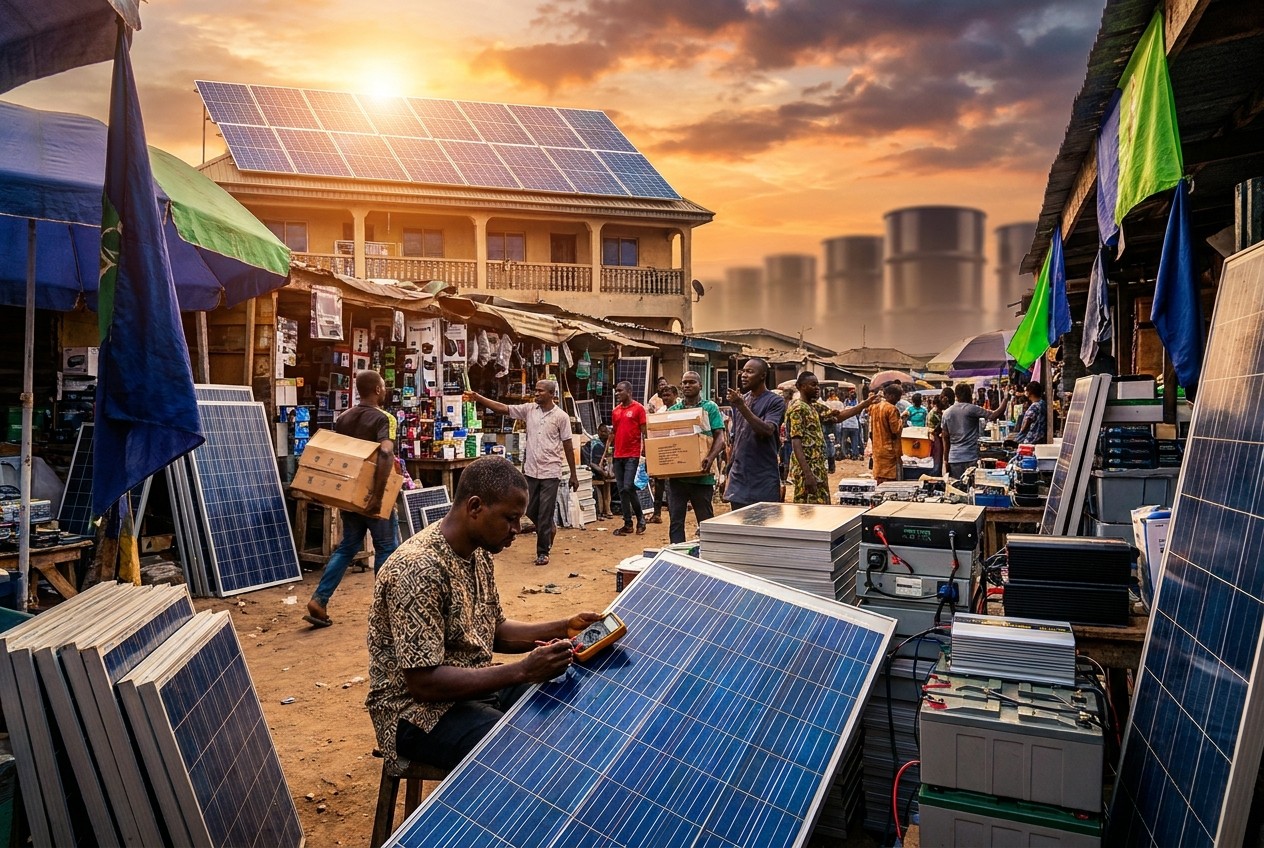
Imports of Chinese solar panels into Nigeria increased by two-thirds between June 2024 and June 2025, according to Yale Environment 360, as rising energy costs and reductions in U.S. development aid accelerate the country's shift toward cheaper photovoltaic technology.
The transition has gained momentum in 2026. The Los Angeles Times reported that Nigeria's new solar capacity this year has already exceeded the combined additions recorded in 2024 and 2025. The acceleration comes amid disruptions to global oil supplies linked to U.S. military action against Iran and cuts to U.S. foreign assistance programs, including those administered by the U.S. Agency for International Development.
Nigeria, one of West Africa's largest oil producers and a major U.S. partner in the region, is increasingly turning to solar power as households, businesses, and government institutions seek more affordable and reliable energy alternatives.
Background: U.S.-Iran Hostilities and Oil Supply
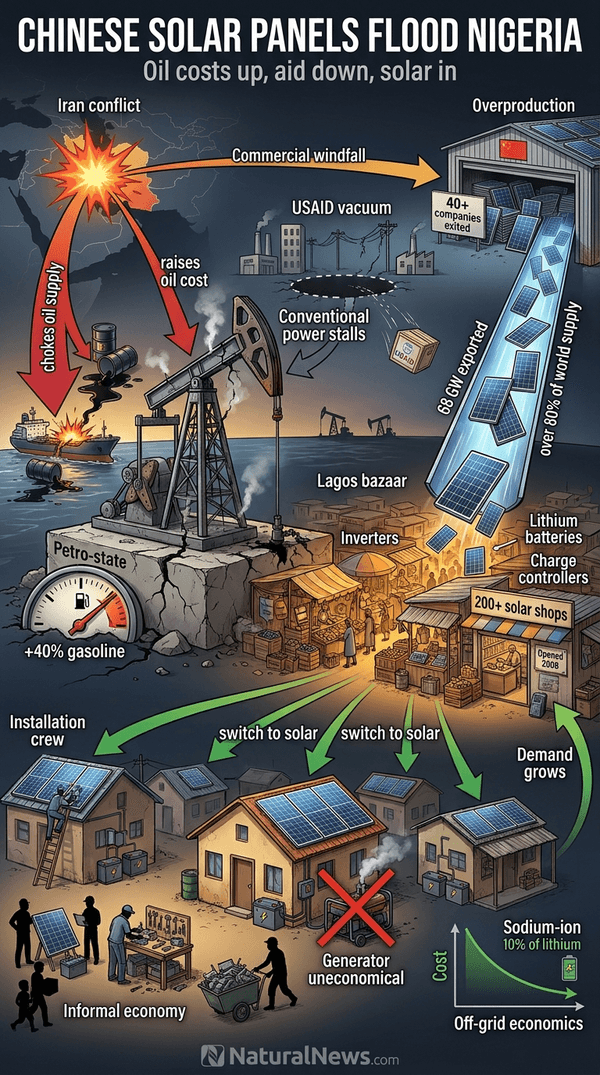
After decades of U.S. economic sanctions on Iran, the Iranian state and its allies imposed a kind of reverse-sanction on their adversaries, choking a crucial supply of oil from world markets, according to reporting by Futurism [1]. The resulting rise in oil costs has affected Nigeria specifically, with the Los Angeles Times reporting that the rising costs of oil have driven markets away from the U.S.-dominated fossil fuel economy [2].
Analysts cited in the reporting note that China's solar sector faces a crisis of overproduction, a scenario that has led to the exit of more than 40 companies in recent years, even as wartime demand creates new export opportunities [3].
Lagos Electronics Market Shift
In Lagos, one of Africa's largest electronics bazaars, trade in photovoltaic supplies including solar panels, lithium batteries, and energy inverters has skyrocketed, the Los Angeles Times reported, driven by interest from specialists and general retailers alike [2].
Nnamdi Nkemka, owner of a solar retail shop, told the paper that his shop opened in 2008 as one of a few niche outlets specializing in solar equipment. By 2026, he said, it is one of over 200 operating in that electronics exchange alone. "Most people selling electrical items are migrating to solar," Nkemka told the paper. He added that "even tomato sellers have put signs up saying they collect solar batteries and all kinds of solar waste."
The market shift reflects a broader trend across the Global South. Panicked consumers in hard-hit Asia are turning to rooftop solar power as costs climb due to the Iran war, according to the Associated Press [4]. China exported a record 68 gigawatts of solar panels in March, the first full month of the conflict, according to energy think tank Ember [5]. The country produces over 80% of the world's solar panels and dominates by virtually every metric, POLITICO reported [5].
Consumer Costs and Adoption
Rising fuel prices are also changing household energy decisions. Nigerian homeowner Oluwaseun Aguda told the Los Angeles Times that gasoline prices had increased by 40% since the United States began military action against Iran, making his reliance on a gasoline-powered generator increasingly expensive.
The shift toward alternative energy sources is also encouraging interest in off-grid solar systems and electric vehicles, supported by advances in battery technology, according to commentary published by BrightVideos.com.
Emerging sodium-ion batteries offer potential advantages, including performance across a wide range of temperatures and reduced risks of thermal runaway. Their lower production costs could also make energy storage more accessible, although claims about their comparative costs and performance require further verification [6].
References
- Trump’s War on Iran is Pushing the Global South Toward Chinese Solar Panels in Record Numbers. https://futurism.com/science-energy/trump-iran-war-nigeria-chinese-solar-panel
- Trump’s War on Iran is Pushing the Global South Toward Chinese Solar Panels in Record Numbers. https://www.newsbeep.com/810620/
- War in Iran causes China to sell solar panels like never before, pushing 68 gigawatts to the world in just one month, while Middle Eastern oil becomes a global headache for suppliers desperate for alternatives. – CPG Click Petróleo e Gás. https://now.solar/2026/04/29/war-in-iran-causes-china-to-sell-solar-panels-like-never-before-pushing-68-gigawatts-to-the-world-in-just-one-month-while-middle-eastern-oil-becomes-a-global-headache-for-suppliers-desperate-for-alt/
- Iran war drives solar sales in energy-hungry Asia. https://apnews.com/article/iran-war-energy-asia-china-philippines-solar-d3e44801e1700410d4ab81e4fa517007
- A new dawn for Chinese solar. https://www.politico.com/newsletters/forecast/2026/06/04/a-new-dawn-for-chinese-solar-00950886
- Bright Videos News - EPA, GLYPHOSATE AND NETANYAHU?ÇÖS DEMANDS - Mike Adams - BrightVideos.com, February 11, 2026.
Explainer Infographic







Please contact us for more information.