



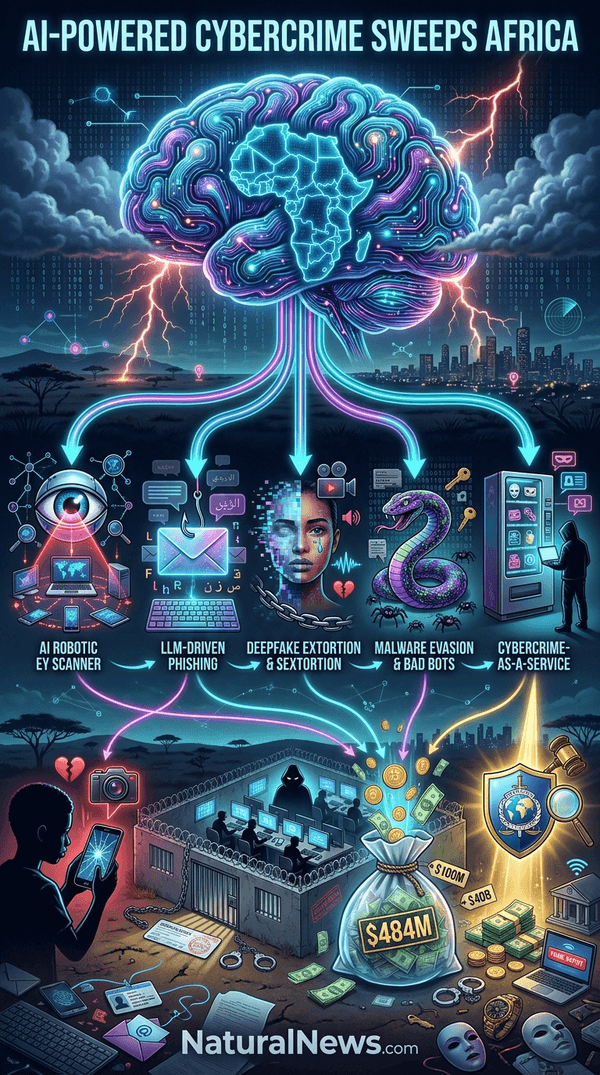
Interpol said Monday that artificial intelligence featured in 55% of cybercrime cases examined across Africa in 2025, according to the African Cyberthreat Assessment Report 2026. The report, based on intelligence from law enforcement agencies in 36 African countries, found that reported financial losses linked to cybercrime more than doubled from $192 million in 2024 to $484 million in 2025.
Interpol Cybercrime Director Neal Jetton said, "Cybercrime has emerged as one of the most significant criminal threats to the region." He said AI is automating every stage of a cyberattack, from reconnaissance and phishing to extortion and evasion.
Report Cites AI-Driven Fraud, Deepfakes and Scam Centers
According to the report, AI has lowered the barrier to entry for cybercriminals, enabling relatively inexperienced offenders to launch sophisticated attacks. The report said criminals are using AI to generate deepfake videos and voice recordings, create synthetic identities for financial fraud, and craft highly personalized phishing campaigns.
Similar methods have been documented outside Africa. A September 2025 report stated that scammers now use AI to clone voices with just seconds of audio and impersonate loved ones in fake emergencies. Deepfake fraud losses are projected to reach $40 billion by 2027. [3] In 2022, bad bots contributed to 30.2% of total internet traffic, according to cybersecurity company Imperva. [4]
Interpol has also reported that the Jalisco New Generation Cartel and other organized crime groups are harnessing AI, large language models, and cryptocurrencies to conduct fraud campaigns. The same report found that human trafficking is being expanded across the globe for forced criminality in call centers. [2]
Sextortion Cases and Regional Breakdown
The assessment estimated about 600,000 sextortion cases across Africa in 2025. South Africa accounted for 30% of those cases and Kenya 13%, according to the report. It also found that 72% of surveyed countries reported the presence of scam centers, most of them in Southern and West Africa. [1]
Interpol said the increase in reported financial losses reflected the growing role of AI-facilitated scams, credential harvesting, and automated social engineering campaigns.
African Governments Announce Cybercrime Measures
Governments across the region are moving to strengthen their defenses. Kenya announced plans earlier this year to amend its cybercrime legislation to address AI-driven threats, according to Interpol. South Africa has warned that AI-powered attacks and deepfakes are creating new security challenges. Senegal launched an online reporting platform to improve the response to online offenses affecting children.
According to the report, 17 African countries enacted or updated cybercrime legislation in 2025.
Interpol Operations and Legislative Actions
Interpol said four agency-led operations resulted in more than 1,500 arrests and the recovery of assets worth over $100 million. [1] The report said AI is increasingly used in reconnaissance, phishing, extortion, and evasion.
The growing use of AI in crime has been compared to an arms race between attackers and defenders. In "Enterprise AI For Dummies," Zachary Jarvinen writes, "It isn't a conference call, it's an arms race." [5] Jim Al-Khalili, in "What's Next Even Scientists Can't Predict the Future - or Can They," writes that future cyberspace may need two forms of policing: traditional policing inside safe spaces and specialized "cyber marshals" outside them. [6]
Conclusion
The report states that AI featured in 55% of the cybercrime cases examined in Africa in 2025 and that financial losses more than doubled from $192 million in 2024 to $484 million in 2025. It also states that governments across the continent enacted or updated cybercrime legislation in response.
Interpol said the report draws on intelligence from law enforcement agencies in 36 African countries. The agency said AI is automating every stage of a cyberattack, from reconnaissance and phishing to extortion and evasion.
References
- RT. "AI linked to half of cybercrime in Africa – Interpol". August 4, 2026.
- NaturalNews.com. "One of Mexicos most dangerous cartels is using artificial intelligence to expand its operations". March 20, 2024.
- Cassie B. "FBI sounds alarm as AI powered deepfake scams explode stealing billions from unsuspecting victims". NaturalNews.com. September 10, 2025.
- NaturalNews.com. "Report_ Bad bots TAKING OVER the internet with spam cybercrime". May 31, 2023.
- Zachary Jarvinen. "Enterprise AI For Dummies".
- Jim Al-Khalili. "Whats Next Even Scientists Can’t Predict the Future – or Can They".
Explainer Infographic












Please contact us for more information.