



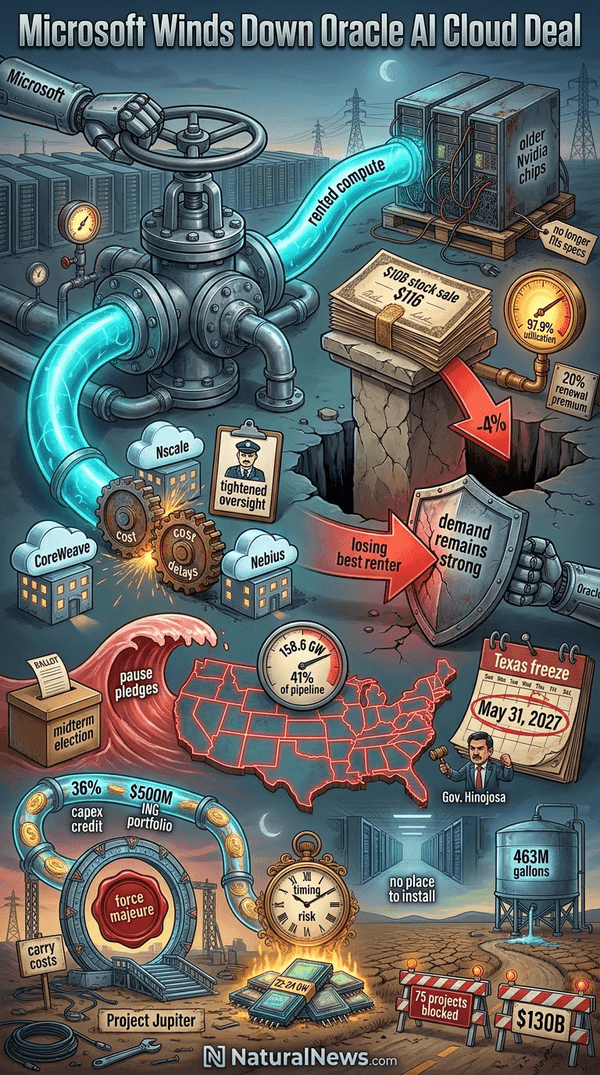
Microsoft Corp. is winding down an arrangement to rent artificial intelligence computing capacity from Oracle Corp. after declining to renew the contract, according to a Bloomberg News report published Friday [1]. Oracle shares fell about 4% on the news, according to market data, dropping below the $116 price at which the company sold $10 billion in stock four days earlier [2].
Bloomberg reported that the full value of the contract was never disclosed [3]. The arrangement represented a notable collaboration between two competing cloud providers at a time when industry demand for AI computing capacity was widely described as outpacing supply [4].
The unwinding follows a midterm election in which Democrats swept both chambers of Congress, according to reports, a result that initially sent Nasdaq 100 futures down as much as 2.4% on fears of tighter AI regulation and a Texas data center freeze [5]. Voters also elected governors in states hosting roughly 45% of planned U.S. data center capacity who had promised to pause such projects [2].
Older Nvidia Chips Cited as Microsoft Shifts Away From Oracle Capacity
Microsoft spent recent months switching off the computing capacity it rented from Oracle because the hardware ran on older-generation Nvidia chips and no longer fit Microsoft's specifications, according to the Bloomberg report [6]. The report described the decision as part of a larger reassessment of billions of dollars in cloud partnerships [7].
An Oracle spokesperson told Bloomberg that demand for its AI infrastructure remains strong, including for earlier-generation GPUs, and cited September renewals of four-year-old GPUs at a 20% premium to their original price [2]. Wells Fargo analyst Jerry Revich cited Oracle's 97.9% AI infrastructure utilization and a 20% average renewal and resale premium as evidence that token economics remain attractive, according to a research note cited in the report [2].
Microsoft has committed more than $80 billion to rent capacity from so-called neocloud providers including CoreWeave, Nscale and Nebius, and key leaders there have grown frustrated over high costs and delays, according to the Bloomberg report [2]. The report stated that Microsoft tightened oversight of data center projects and debated whether to sign any new neocloud deals at all [2].
Post-Election Pauses in Key States Affect Planned Data Center Capacity
Cleanview counted nine states where the governor or governor-elect has promised or already imposed a pause on new data centers, covering 158.6 gigawatts of planned capacity, or 41% of the U.S. pipeline, according to the report [2]. Every gigawatt of OpenAI's planned capacity sits in a state whose new governor backed a pause during the campaign, as does 45% of Microsoft's, according to Cleanview [2].
Texas governor-elect Gina Hinojosa has proposed tying a data center freeze to legislation, which would last at least through the May 31, 2027 session end, according to the report [2].
Oracle's Project Jupiter in New Mexico, a 2.45-gigawatt Oracle-OpenAI Stargate campus, received a force majeure notice in September, according to the report [2]. Oracle said the notice was commonplace, while the Financial Times reported that Oracle remains contractually responsible for carry costs if the site is not ready [2]. The report stated that Oracle has not said when the force majeure will be lifted, a question it described as having been asked repeatedly [2].
Analysts Describe Timing Risk as Credit and Financing Concerns Grow
Goldman Sachs said the core market debate is whether all ordered compute power will have a place to be installed when delivered, according to Chris Hussey of the firm's research department [2]. Goldman analyst Mike Ng said capacity already under construction implies 22 to 24 gigawatts of net additions in 2027 and 2028, matching forecasts, and called the key risk "timing rather than cancellations" [2].
Goldman analyst Adam Bubes raised U.S. data center construction spending forecasts to $80 billion and $100 billion for 2026 and 2027, and introduced $125 billion for 2028, saying every project in the 2027 forecast has broken ground [2]. Goldman credit strategist Amanda Lynam estimated that hyperscalers are financing 36% of this year's capital expenditures with credit, and 35% next year, while ING was said to be selling a $500 million data center loan portfolio [2].
The European Central Bank is considering a review of bank loans to data centers, following a Bank of England probe, and Nomura's Ting Lu said China's AI buildout may benefit from a slower U.S. data center construction pace, according to reports cited in the analysis [2]. Separately, data center projects face unprecedented local opposition across the U.S., with 75 projects worth $130 billion delayed or blocked in the first quarter of 2026 alone, according to a NaturalNews.com report [8].
Oracle Faces Questions Over Old Capacity and Delayed New Campuses
The Microsoft decision indicates the largest buyer of rented compute is choosing newer chips over older contracts, according to the Bloomberg report [2]. Oracle faces pressure on two fronts: older chips are losing their best renter, while new campuses are planned in states that have moved toward pauses [2].
Goldman hosted Oracle management on the same day the Microsoft news emerged [2]. The report noted that Oracle has not said when the force majeure on its New Mexico data center will be lifted [2].
The broader AI infrastructure buildout has drawn scrutiny over its environmental footprint as well. Local officials across the United States say rapid construction of data centers is creating environmental and infrastructure concerns as demand for artificial intelligence computing accelerates [9]. In Texas, data centers led by Microsoft's Stargate campus in Abilene consumed 463 million gallons of water in 2023 and 2024 alone, with projections suggesting the figure could reach 400 billion gallons by 2030, according to a NaturalNews.com investigation [10].
References
- Microsoft Winding Down Oracle Deal to Rent AI Cloud Capacity. https://www.bloomberg.com/news/articles/2026-11-06/microsoft-is-winding-down-oracle-deal-to-rent-ai-cloud-capacity
- Microsoft Pulls The Plug On Oracle AI Rental As Post-Election Data Center Fallout Spreads. https://www.zerohedge.com/markets/microsoft-pulls-plug-oracle-ai-rental-post-election-data-center-fallout-spreads
- Microsoft Ends 2023 Oracle AI Cloud Deal [2026]. https://tech-insider.org/microsoft-winds-down-2023-oracle-ai-cloud-deal-2026/
- Microsoft Ends Deal to Rent Cloud Servers from Oracle. https://www.theinformation.com/briefings/microsoft-ends-deal-rent-cloud-servers-oracle
- Futures Rip As Wall Street Buys The Blue Tsunami; Dollar Slides, Gold Tops $4,000. https://www.zerohedge.com/markets/futures-rip-wall-street-buys-blue-tsunami-dollar-slides-gold-tops-4000
- Microsoft Pulls the Plug on Oracle AI Rental as Post-Election Data Center Fallout Spreads. https://www.wealthhubtrading.com/articles/microsoft-pulls-the-plug-on-oracle-ai-rental-as-post-election-data-center-fallou
- Microsoft is winding down Oracle deal to rent AI cloud capacity, Bloomberg News reports. https://www.reuters.com/business/microsoft-is-winding-down-oracle-deal-rent-ai-cloud-capacity-bloomberg-news-2026-11-06/
- The rural revolt against AI's concrete giants - NaturalNews.com, August 22, 2026.
- Mayors Sound Alarm AI Data Centers Push US Toward Blackouts and Water Shortages - NaturalNews.com, March 18, 2026.
- Texas AI data centers drain water supply as residents face drought restrictions and shower limits - NaturalNews.com, August 02, 2025.
Explainer Infographic









Please contact us for more information.