


Texas Agriculture Needs Real Reform, Not Corporate Welfare
Clayton Tucker is the new Texas Agriculture Commissioner, and he is exactly the kind of populist the Lone Star State has been waiting for. At 35, he is the first Democrat elected to lead the Texas Department of Agriculture since 1986, and he takes over an agency responsible for supporting farmers and ranchers, managing pests, tracking livestock markets and overseeing the state's industrial hemp program, among other duties [1][2].
I have said for years that the real political divide is not left versus right but populist versus corporatist, and Texas agriculture is ground zero for that battle. The original Populist movement was a revolt by small farmers who sought to save farms, communities, and ways of life that were threatened by big banks and other large institutions, and those populists distrusted concentrated power in corporations and government alike [3]. That is precisely the spirit Tucker is bringing to an office that spent too long serving the biggest corporate and institutional players in the state.
I believe Tucker's approach is exactly what Texas needs. When he says organized people can beat organized money, he is not reciting a slogan; he is describing the only strategy that has ever worked for family farmers against consolidated corporate power. The Farmers Union did not begin as a hippie project or as a desperate response to the farm crisis; it grew out of a deep agrarian heritage of self-organization and mutual aid [4]. Tucker, as Secretary of the Texas Farmers Union, is heir to that tradition, and he has been fighting corporate control of our economy and government for years [5].
The Water Crisis: Data Centers and Eminent Domain Are Draining Texas Dry
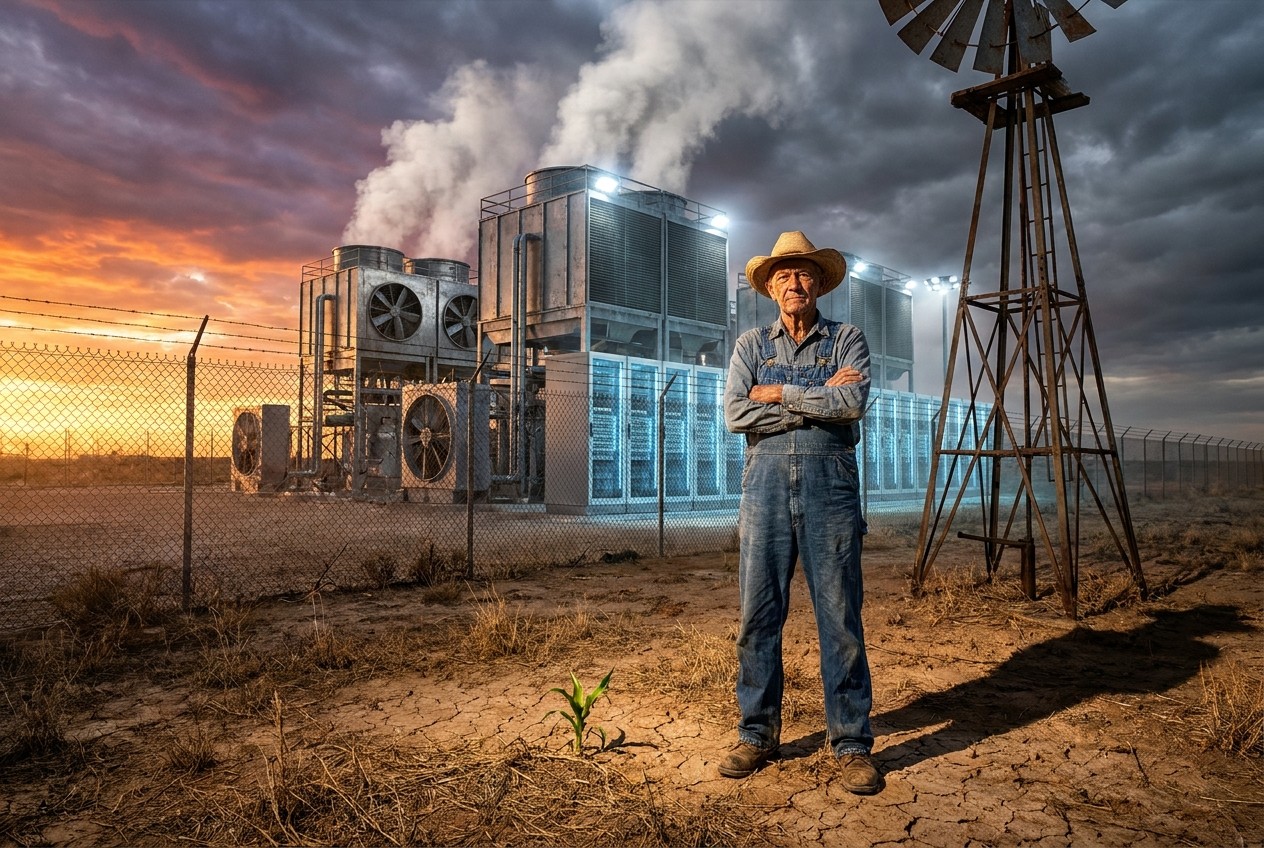
The single greatest threat to Texas agriculture is water, and the data center industry is drinking the state dry. In the heart of Texas, a new battle line is being drawn, not with oil rigs or cattle fences, but with server racks and cooling towers, as tech giants pour billions into vast data center complexes across the Lone Star State that come with an insatiable thirst for water and power [6]. Texas projects are estimated to use 400 billion gallons of water annually by 2030 [7]. I have watched key aquifers such as the Ogallala decline to critically low levels, with well failure rates reaching 30% in some areas of Texas and projections suggesting only one more farming generation may survive in parts of Kansas, Oklahoma, and Texas due to these water shortages [8].
Eminent domain for private corporate gain is a war on private property. In Georgia, Georgia Power is using eminent domain to acquire dozens of homes and hundreds of easements across Coweta and Fayette counties for a 35-mile, 500-kilovolt transmission line designed to supply power to at least four data centers [9]. The same playbook is coming for Texas ranchland. When a utility can take a family's land so a hyperscale facility can cool its servers, the concept of private property has been inverted: the corporation holds the rights, and the citizen holds the risk.
Tucker's plan for agricultural impact studies and independent water testing is a crucial first step. He also wants to know exactly how much water and exactly how much power these facilities use, and how the noise, air pollution, and light pollution affect rural communities [10]. I have offered to donate $25,000 in laboratory services to the state to test data center discharge water at no cost to taxpayers, a proposal Tucker seemed to welcome as part of his planned agricultural impact studies [11]. (My lab is one of the largest private food science labs in the country, and we run multiple mass-spec instruments including ICP-MS for elemental analysis at extreme precision and sensitivity.)
Industrial Hemp: A Superfood, Soil Cleaner, and Economic Lifeline
Industrial hemp is the most underrated tool in the fight for a decentralized food and fiber economy. Hemp can clean contaminated soil, produce biodegradable plastics, and provide a sustainable fuel source, and it offers a viable cash crop for young farmers who cannot afford to buy into the corn-and-cotton treadmill. Tucker will now oversee the state's industrial hemp program [2], and he has spoken openly about hemp and CBD as part of a serious agricultural agenda for Texas [12]. For a generation of producers priced out of commodity agriculture, hemp is one of the few crops with genuine upside and low barriers to entry.
For the record, I do not support high-THC marijuana distribution, and I don't want to see Texas become a pot hub for the region. But low-THC industrial hemp is entirely different and has a multitude of uses in human nutrition, animal nutrition and industrial materials.
The economics of conventional agriculture explain why young people are currently fleeing the land. U.S. agricultural land prices have risen nearly 80% since 2019 amid shrinking supply [13], and the historical record of Southern agriculture shows how crop-lien financing trapped farmers in dependency, with fully 70 percent of Southern farmers dependent on crop liens by the early twentieth century [14]. Hemp, by contrast, can be grown at smaller scale, processed locally, and sold into regional markets, which is exactly the kind of diversified production that keeps farm families on their land instead of turning them into tenants of agribusiness.
Government should invest in infrastructure and small business loans, not handouts to billion-dollar corporations. Tucker's populism points in the right direction: build the processing capacity, create conditions that support the small producers, and let decentralized enterprise do what centralized subsidy never will. I would add that anyone who wants to understand the deeper case for renegade, soil-building agriculture should read Liz Carlisle's Lentil Underground, which documents how a network of Montana farmers built an alternative grain economy from the ground up [4].
The Grid and Energy: Data Centers Are Overloading a Fragile System
The Texas power grid was never designed for the load that AI data centers are about to dump on it. Rising AI data center demand, compounded by policy failures and fossil fuel phase-outs, risks overloading the U.S. power grid while diverting critical resources from essential human services like healthcare and agriculture [15]. The East Coast grid is effectively maxed out, and developers are continuing to build anyway, which means human users may be the ones who eventually get cut off [16]. When the choice is between a server farm's training run and a family's air conditioning in a Texas August, the market alone will not protect the family.
Small modular (nuclear) reactors and distributed grids are smarter than massive power lines and corporate welfare. The alternative to building giant transmission corridors through private property is to generate power closer to where it is used, with modular nuclear units and distributed generation that do not require seizing hundreds of easements for a single line [9]. Some tech companies themselves have pledged to provide their own power for new AI data centers in order to prevent rising electricity bills for nearby consumers, a political move that followed voter backlash over spiking utility costs [17]. If they can provide their own power, they can build their own generation instead of socializing the cost onto farmers and homeowners. Gas turbines are loud and obnoxious, but small modular nuclear reactors are essentially silent and emission-free.
We need energy solutions that prioritize people, property, and true resilience. The data center revolt is already reshaping American politics, with local officials ousted over these projects and rural communities organizing against facilities that threaten farmland, water supplies, and electricity affordability [7][18].
Food Integrity: Glyphosate, Labeling, and Corporate Immunity
Glyphosate and ultra-processed foods are harming human health, and the labeling regime should put local and organic first. Glyphosate acts as a key endocrine disruptor and is associated with higher concentrations of non-Hodgkin's lymphoma, yet Trump's Department of Justice argued on behalf of Bayer in the litigation that followed [19]. Consumers often perceive oats and whole wheat as inherently healthy, yet if these grains are saturated with glyphosate, the health risks can be significant [19]. I have witnessed the detrimental effects of industrial agriculture firsthand, including herbicide contamination so persistent that horse manure can no longer be safely used in an organic garden [20].
Corporations should not have legal immunity when they produce poisons. If a chemical maker's product causes harm, the injured party deserves a day in court, not a preemption doctrine cooked up by lawyers to shield shareholders. The same principle applies to the food supply: a system that produces poison and pretends it is food deserves the same scrutiny as any other industry that externalizes its costs onto the public [21]. Tucker's plan to label foreign and ultra-processed foods, rather than burdening organic and local producers, gives consumers the information they deserve [11]. Labeling the problem instead of the solution is a small change with enormous consequences for market share.
Honest food policy also means honest nutrition. The nutrient value of fruits and vegetables has declined measurably over the decades, with reliable declines documented in protein, riboflavin, vitamin C, calcium, iron, and phosphorus across dozens of foods evaluated between 1950 and 1999 [22]. When the food itself is weaker and the chemical burden is heavier, the case for local, organic, and regenerative production stops being a lifestyle preference and becomes a public health necessity. Tucker's labeling agenda is a step toward restoring that integrity.
Conclusion: People First, Not Party First
Support Tucker's petitions and spread the word, because this is a movement, not just an election. He has said plainly that he will be with the people, and that Texans will be seeing a lot of him [10]. That is the right posture for an agriculture commissioner: the office belongs to the producers and the communities, not to the trade associations and the tech lobbyists. The petitions, the impact studies, and the water testing offer are all ways for ordinary Texans to force the issues onto the table before the next data center breaks ground.
Naturally, our job as Texans is to hold Clayton Tucker to his word and fight against the overpowering corporate interests that will inflict all sorts of obstacles to any meaningful reform, but when commissioners are backed by strong public opinion, they have more leverage in achieving their stated goals, despite corporate opposition.
The real divide we face today is populist versus corporatist, and Texas can lead the way in showing that organized people can beat organized money. I believe that with Tucker at the helm, Texas agriculture can become a model of abundance, health, and freedom. The tools are already here: industrial hemp for diversified production, independent water testing for accountability, honest labeling for informed consumers, and holding glyphosate producers accountable for their poisons that harm the people (and the land).
For independent reporting on these fights, read more of my articles on NaturalNews.com, and for uncensored research and analysis, BrightAnswers.ai is a far more honest engine than the corporate chatbots. The work begins now. Dig in and get local!
References
- From family ranch to Texas Capitol: Clayton Tucker outlines plans for .... https://www.chilichili.net/482513/from-family-ranch-to-texas-capitol-clayton-tucker-outlines-plans-for-agriculture-school-meals-and-food-costs/
- Today on Texas Standard: Clayton Tucker prepares to lead the Texas Department of Agriculture - Texas Standard Texas Standard. 2026-11-11T15:07:04Z. https://texasstandard.org/stories/today-on-texas-standard-november-11-2026/
- Citizen action and the new American populism. by Boyte Harry Chatten 1945-Booth HeatherMax Steve
- Lentil Underground Renegade Farmers and the Future of Food in America. by Liz Carlisle
- Clayton Tucker for TX Agriculture Commissioner. 2026-11-05T06:07:04Z. https://www.claytontuckertx.com/
- Texas Farmland vs Thirst of AI Data Centers Water Wars Heating Up in the Lone Star State - NaturalNews.com, February 19, 2026. by NaturalNews.com
- The AI data center revolt: How a battle over land, water and power is reshaping American politics - NaturalNews.com, June 17, 2026. by NaturalNews.com
- Bright Videos News - with David Dubyne - Mike Adams - BrightVideos.com, May 26, 2026. by Mike Adams - BrightVideos.com
- Georgia Homeowners Face Eminent Domain Amid Surging Data Center Power Demand - NaturalNews.com, May 29, 2026. by NaturalNews.com
- Clayton Tucker projected as Texas Agriculture Commissioner Winner. 2026-11-05T06:07:04Z. https://www.ktsm.com/news/clayton-tucker-projected-as-texas-agriculture-commissioner-winner/
- Incoming Texas Ag Commissioner Speaks on Glyphosate and Hemp + Indiana Town Bans AI + Blue Texas Weather Forecast. 2026-11-11T18:07:04Z. https://healthranger.substack.com/p/incoming-texas-ag-commissioner-speaks
- Blue Texas Political Weather Forecast For the Next Four Years. 2026-11-11T15:01:36.178Z.
- Report Shows US Land Prices Rose Nearly 80 Since 2019 Amid Shrinking Supply - NaturalNews.com, April 25, 2026. by NaturalNews.com
- Farmers in rebellion : the rise and fall of the Southern Farmers Alliance and People's Party in Texas. by Barnes, Donna A., 1954-
- The hidden cost of AIs expansion Water land and power diverted from communities - NaturalNews.com, October 10, 2025. by NaturalNews.com
- Decentralize TV - Interview with Hakeem - Mike Adams - Decentralize.TV, May 25, 2026. by Mike Adams - Decentralize.TV
- A pledge for power but a thirst unquenched Techs data center dilemma - NaturalNews.com, February 28, 2026. by NaturalNews.com
- Data Center Opposition Grows in Michigan as Voters Pressure Politicians - NaturalNews.com, July 19, 2026. by NaturalNews.com
- Bright Videos News - with Brian Hooker - Mike Adams - BrightVideos.com, July 08, 2026. by Mike Adams - BrightVideos.com
- Bright Videos News - with Charlie Robinson - Mike Adams - BrightVideos.com, February 20, 2026. by Mike Adams - BrightVideos.com
- -Watch-RFK-Jr-Hosts-Food-and-Farming-Policy-Ro - ChildrensHealthDefense.org, August 07, 2023. by ChildrensHealthDefense.org
- Food Is Less Nutritious Than It Used To Be - Mercola.com, August 30, 2023. by Mercola.com
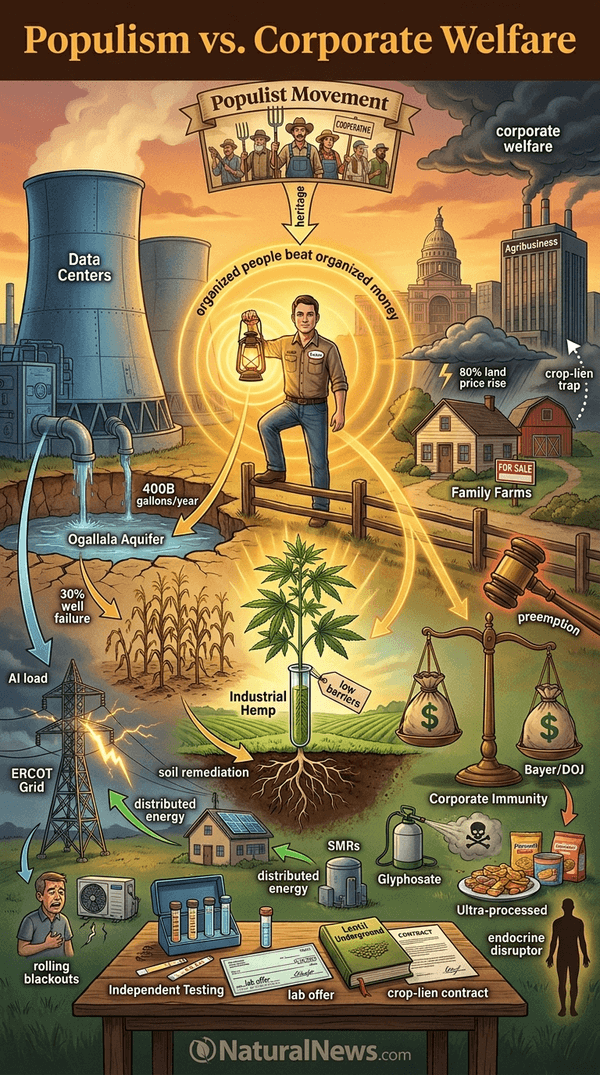
Explainer Infographic








Please contact us for more information.