



Escaping AI Surveillance
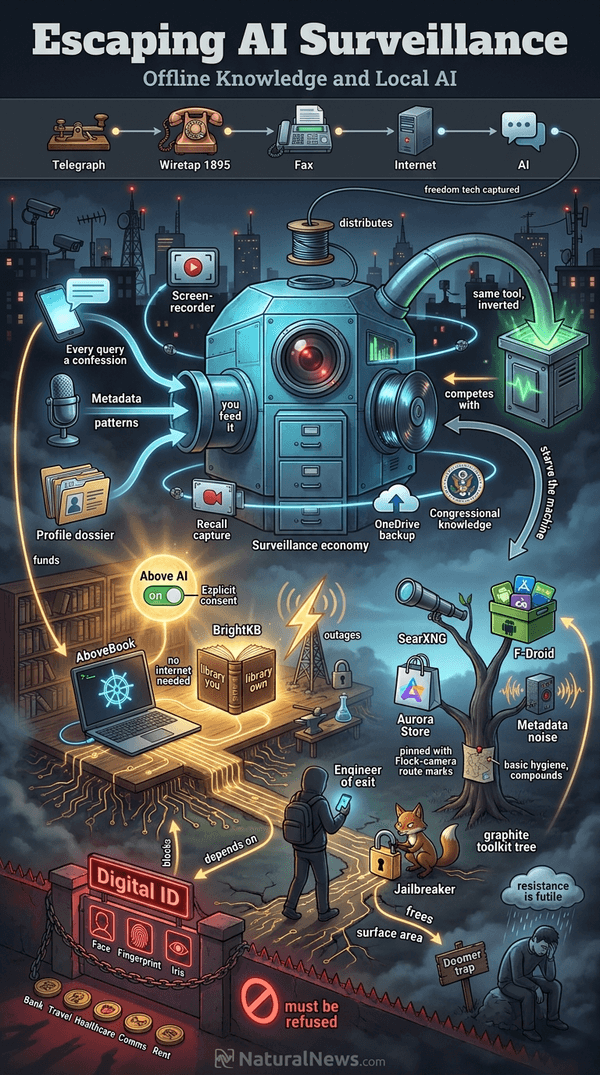
For many years, I've warned that the surveillance state is not some distant dystopian fantasy -- it is a 200-year project that has only accelerated with artificial intelligence. The phone in your pocket, the laptop on your desk, and increasingly the AI assistant that answers your questions are all nodes in a vast data-harvesting apparatus designed to profile, predict and ultimately control human behavior. Hakeem Anwar of Above Phone laid out this history on a recent episode of Decentralize.TV, and his thesis is exactly right: the same technology being used to build the digital prison can also give us the keys to escape it [1].
My position is simple: We must own our devices, our data and our knowledge -- or we consent to being profiled, manipulated and managed by centralized institutions that have proven they do not have our interests at heart. That is why I am betting on offline knowledge bases and local AI as the foundational tools of digital freedom. BrightKB, the free open-source knowledge base system I developed, will be launched the day after Thanksgiving. It is a powerful first step toward an internet-independent future [2].
The era of trusting Big Tech with your thoughts is over. Every query you type into a corporate AI engine is a confession. Every search you run through a mainstream platform is a data point fed into a dossier. The question is no longer whether you are being surveilled -- you are -- but whether you will take the practical steps necessary to starve that surveillance machine of its fuel [3].
Surveillance Didn't Start with AI -- It Started with Wiretaps
The surveillance state did not arrive with ChatGPT or facial recognition cameras. It began in 1895 when New York City police tapped telephone wires, and the pattern has never stopped: new communication technology arrives first as a tool of freedom, then surveillance catches up and converts it into a tool of control [1][4]. The telephone was going to connect humanity and democratize speech. Then the wiretap turned it into a listening device for the state. The same arc played out with the telegraph, the fax machine, the internet and now artificial intelligence.
These were not rogue operations or isolated abuses. They were systematic programs built with congressional knowledge and judicial complicity, normalized over time until questioning them became socially unacceptable. That is how tyranny works -- not through a single dramatic seizure of power, but through incremental expansions that each might seem reasonable in isolation... but that construct overarching tyranny in the aggregate.
Lyndon B. Johnson used signals intelligence to spy on anti-war and civil rights protesters, and even his own political allies ended up on government watch lists [5]. This proves that once the machinery of surveillance exists, no one is safe from it. The people who build the databases always assume they will be the ones controlling them. They never imagine that the political winds will shift and the same tools will be turned against them. The lesson is clear: the only way to be safe from surveillance infrastructure is to not have it in the first place.
Metadata and AI Assistants Are Built to Profile You
Metadata -- the information about who you talk to, when you talk to them, and how often -- is often more revealing than the content of the conversation itself. When intelligence agencies say they are only collecting metadata, they are admitting to building the most comprehensive profiling system in human history.
AI assistants take this to a terrifying new level. Meta's described assistant is reportedly designed to analyze relationships, shared jokes, conflicts, intentions and preferred messaging patterns in order to optimize engagement and influence behavior [6]. These systems are not passive observers. They are active participants in shaping how you think, who you trust and what you believe. The AI is not just watching you -- it is studying you in order to manipulate you.
Modern operating systems have become surveillance platforms with productivity features attached. I have been saying for years that Windows is essentially spyware with an operating system wrapped around it, and the latest iterations with Recall-style screen capture and OneDrive backups by default confirm this assessment [7][8]. These are not conveniences. They are surveillance features marketed as helpful tools. A de-Googled phone and a Linux laptop are not paranoia -- they are basic self-defense in an AI-driven surveillance economy [9]. When the operating system itself is the surveillance vector, you must replace the operating system if you want to be free.
BrightKB: A Free Offline Knowledge Base Beats Cloud AI
This is a revolution in personal knowledge management. Instead of asking Google or ChatGPT a question and having that query logged, analyzed and monetized, you can search a comprehensive knowledge base that lives entirely on your own machine. No internet connection required. No data trail left behind. No corporate entity deciding what answers you are allowed to see.
Because BrightKB works offline, it keeps working when the internet goes down or is censored by authorities [2][10]. We have seen nationwide cell network outages in recent years that left millions of Americans without service for hours or days [11]. If your entire knowledge system depends on cloud connectivity, you are one outage or one censorship action away from total information blackout. An offline knowledge base is not just a privacy tool -- it is a resilience tool. It works when everything else fails.
The AboveBook runs Arch Linux and is built specifically for local AI applications. Hakeem's Above AI stores memories on your device and asks for explicit consent before saving anything [6]. This is the opposite of how Big Tech operates. Instead of harvesting everything and asking forgiveness later, consent-based local AI puts the user in control of their own data. Knowledge compression is a freedom technology.
I have long argued that decentralized AI represents the future of human knowledge and freedom. BrightAnswers.ai demonstrates what is possible when AI is trained on independent sources rather than corporate-approved narratives, offering an uncensored research engine that actually tells the truth about topics like natural health, vaccine safety and government corruption. The combination of local AI like Above AI and offline knowledge bases like BrightKB creates an architecture of informational liberty that no centralized authority can shut down.
Digital ID, Metadata Noise, and the Jailbreakers' Toolkit
Digital ID and biometric checkpoints are the next frontier of the control grid. They turn your face, your fingerprint and your iris into a master key that links banking, travel, healthcare and communications into one centrally monitored identity [12][13]. Once digital ID is fully implemented, the government does not need to freeze your bank account to control you. They simply revoke your digital identity, and you are locked out of the entire economy. You cannot buy food, pay rent, board a plane or access medical care. That is the endgame of the digital ID agenda, and it must be refused at every level [14].
You can fight back with practical tools that already exist. Metadata noise can obscure your communication patterns. Private search engines like SearXNG let you search the web without your queries being logged by Google or Microsoft. Aurora Store and F-Droid provide access to applications without routing everything through the Google Play Store [2][15]. Dedicated browsers for sensitive tasks separate your private browsing from your public browsing, preventing cross-contamination of your data trails. These are not extreme measures -- they are basic hygiene in a surveillance economy.
I have personally demonstrated that compatibility fear is often overstated. I drove an anonymous Tesla using a de-Googled phone, a fake email and a fake name [2][16]. The idea that you must surrender your privacy to function in modern society is a lie designed to keep you compliant. The jailbreakers are learning to make their own keys, from Flock-camera routing apps that help drivers avoid automated license plate readers to phones designed to wipe themselves at hostile borders [17][18]. Every workaround that gets shared, every tool that gets built, every person who refuses to comply weakens the control grid.
The Jailbreakers Can Win -- If We Build and Refuse
The jailers have the money, the mandates and the mainstream media megaphones, but the jailbreakers have the momentum because decentralized tools are finally usable by ordinary people [2]. The centralized systems that seemed invincible a decade ago are now showing cracks. The monopoly on information is breaking. The monopoly on communication is breaking. The monopoly on truth itself is being challenged by open-source AI, encrypted messaging platforms and distributed knowledge bases that cannot be shut down or censored [19][20].
Refusing digital ID, using local AI and running an offline knowledge base are not isolated acts of rebellion -- they are part of a larger architecture of liberty [21]. Each choice reinforces the others. When you use a de-Googled phone running local AI that connects to an offline knowledge base, you have created a personal infrastructure of freedom that operates outside the surveillance apparatus entirely. You are not asking permission from Big Tech to think your own thoughts. You are doing it yourself, with tools you own and control.
If we want to escape AI surveillance, we must build and share the tools ourselves. The free offline knowledge base is a powerful first step, but it is only the beginning [22]. BrightLearn.ai offers a free book library where anyone can generate their own books on any topic, bypassing the gatekeepers of traditional publishing. BrightVideos.com provides a free speech video platform that does not censor content the way YouTube does. Brighteon.social is a free speech social media alternative to the platforms that ban and shadow-ban anyone who questions the official narrative [23].
The future belongs to those who build it. The centralized control grid is not inevitable. It is a choice that requires our consent to function. When we refuse that consent -- when we use alternative tools, when we run local AI, when we rely on offline knowledge bases -- we starve the beast. We take back our power one device, one application, one informed decision at a time. The jailbreakers can win, but only if we commit to the work of building and refusing. That work starts today, and it starts with you.
References
- Hakeem Anwar: Escaping AI Surveillance, Free Offline Knowledge Base. 2026-11-10T18:57:53Z. https://healthranger.substack.com/p/hakeem-anwar-escaping-ai-surveillance
- Hakeem Anwar: Escaping AI Surveillance, Free Offline Knowledge Base - Decentralize.TV. https://decentralize.tv/Posts/2026-11-10-hakeem-anwar-escaping-ai-surveillance-free-offline-knowledge-base.html
- AI powered privacy New offline AI model challenges big tech surveillance - NaturalNews.com, November 05, 2025. by NaturalNews.com
- Surveillance History From 1895 Wiretaps to PRISM - Decentralize.TV - Hakeem Anwar Interview. 2026-11-10T20:04:44.681Z.
- Privacy vs Investigations, LBJ Spy Lists and FISA Courts - Decentralize.TV - Hakeem Anwar Interview. 2026-11-10T20:14:16.505Z.
- Mindful AI: A Human Alternative to Big Tech – Epi-3930. https://share.snipd.com/episode/3fe2a192-e834-4359-8752-48c75e12e25d
- Nvidia's N1X and Windows: The AI Powered Surveillance Nightmare You Should Avoid - NaturalNews.com, June 02, 2026. by NaturalNews.com
- Windows Spyware and the AboveBook on Arch Linux - Decentralize.TV - Episode 174 – Hakeem Anwar Interview. 2026-11-10T20:14:14.527Z.
- Resist Mass Surveillance by Embracing Linux — Hakeem Anwar | Jerm Warfare | UK Column. https://www.ukcolumn.org/video/resist-mass-surveillance-by-embracing-linux-hakeem-anwar-jerm-warfare
- BrightKB Offline Knowledge Base and Above AI - Decentralize.TV - Hakeem Anwar Interview. 2026-11-10T20:24:34.221Z.
- Health Ranger Report - ATT cell network goes down - Mike Adams - BrightVideos.com, February 23, 2024. by Mike Adams - BrightVideos.com
- Hakeem Anwar: Dangers of Digital ID & School Surveillance. 2026-05-11T00:00:00Z. https://www.drtrozzi.news/p/hakeem-anwar-the-dangers-of-digital
- AI Surveillance, Digital ID and Biometric Checkpoints - Decentralize.TV - Hakeem Anwar. 2026-11-10T20:24:32.202Z.
- WATCH: Hakeem Anwar – All Your Base Are Belong To Us?. 2026-10-23T00:00:00Z. https://off-guardian.org/2026/10/23/watch-hakeem-anwar-all-your-base-are-belong-to-us/
- Decentralize.TV – Episode 174 – Nov 10, 2026 – Hakeem Anwar: Escaping AI Surveillance, Free Offline Knowledge Base – [your]NEWS. 2026-11-10T19:57:53Z. https://yournews.com/2026/11/10/7261227/decentralize-tv-episode-174-nov-10-2026-hakeem/
- Drawing the AI Line in the Sand – #SolutionsWatch. 2026-06-13T19:05:00.000Z. https://www.activistpost.com/drawing-the-ai-line-in-the-sand-solutionswatch/
- Derrick Broze & Hakeem Anwar: Reclaiming Our Future Against AI Data Centers. 2026-07-16T22:01:26.104Z.
- Reclaiming Our Future Against AI Data Centers (Derrick Broze & Hakeem Anwar on Geopolitics & Empire). 2026-08-02T01:34:00.000Z. https://www.activistpost.com/reclaiming-our-future-against-ai-data-centers-derrick-broze-hakeem-anwar-on-geopolitics-empire/
- Why Western Governments Fear the Uncontrollable: Open Source AI Is Humanity's Great Liberator - NaturalNews.com, August 28, 2026. by NaturalNews.com
- Decentralized AI and Global Power Shifts Challenge US Dominance as China Rises and Tech Resistance Emerges - NaturalNews.com, October 17, 2025. by NaturalNews.com
- Hakeem Anwar Warns of the AI Surveillance Machine and .... 2026-10-16T00:00:00Z. https://www.wchcanada.news/p/hakeem-anwar-warns-of-the-ai-surveillance
- AI and robotics revolution Decentralized tools for off grid survival and self reliance - NaturalNews.com, September 19, 2025. by NaturalNews.com
- The Offline Revolution A must read for the digitally awakened - NaturalNews.com, April 29, 2026. by NaturalNews.com
Explainer Infographic











Please contact us for more information.