


Introduction: The Sanctions Trap
For years, the West has believed it could cripple China's semiconductor industry by blocking access to Dutch lithography machines and American chip design tools. The theory was simple: cut off the technology and China would remain a permanent follower, dependent on TSMC and Nvidia for every advanced chip. But as I have documented repeatedly, sanctions are not a straightjacket -- they are a forcing function. Every time the United States closes a door, China builds a new one, and often a better one.
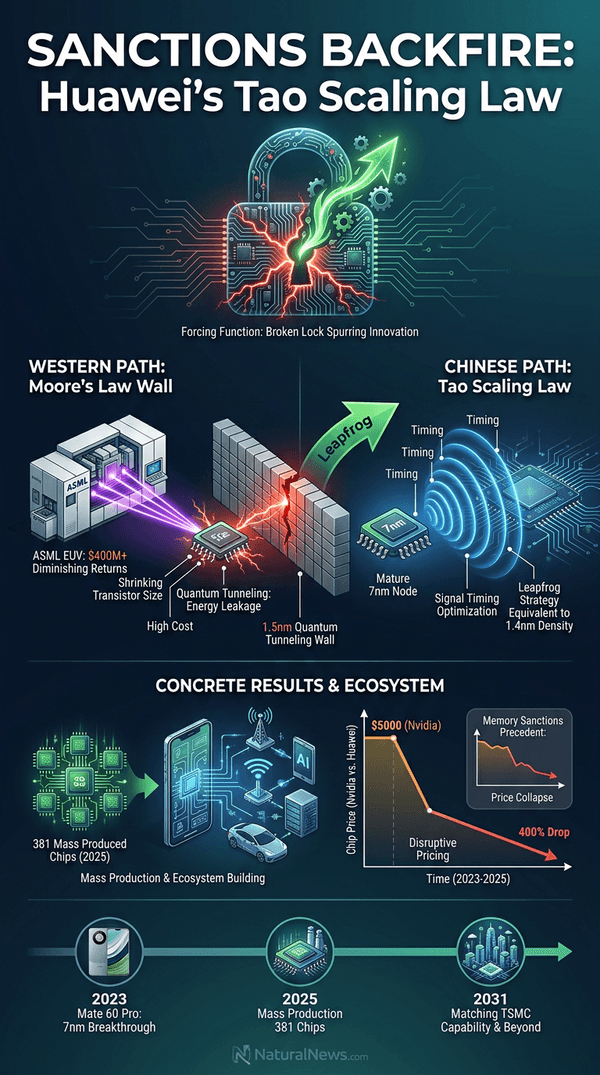
The latest proof arrived at an IEEE conference where Huawei unveiled the Tao scaling law, a complete rethinking of chip architecture that bypasses the entire sub?3nm shrinking race. Instead of chasing ever?smaller transistors that suffer from quantum tunneling and extreme energy leakage, Huawei's engineers optimized signal propagation timing across layers to achieve equivalent transistor density using larger, more reliable components. This breakthrough doesn't just catch up to Western technology -- it leapfrogs it, making the ASML approach of single?digit nanometer lithography obsolete. Western sanctions have produced exactly the opposite of their intended effect: they forced Huawei to invent a new paradigm. And now China is poised to take the lead in microchip superiority.
Moore's Law Is Dead – Here's What China Did Instead
Moore's Law was never a law of physics; it was an observation that chip density doubles roughly every eighteen months. That observation has now slammed into a wall of quantum tunneling at about 1.5 nanometers, where electrons jump across impossibly thin barriers and transistors leak power like a sieve. Western giants like TSMC, Intel, and Samsung are spending tens of billions to push manufacturing to 2nm and 1.4nm nodes, but each step brings diminishing returns and astronomical costs. One EUV lithography machine from ASML costs over $400 million, requires a building the size of a football field, and still produces chips that face heat dissipation nightmares.
Huawei's Tao scaling law approaches the density problem from a different angle. Instead of shrinking the physical gate, the design rethinks how signals travel across the entire chip. By synchronizing signal propagation -- the timing of when each transistor switches -- the effective density achieved is equivalent to a 1.4nm process, but using transistors built on a mature 7nm node. That means higher yields, lower power consumption, and no reliance on ASML's EUV machines. As I have previously noted, this is the kind of lateral thinking that only emerges when a country is blocked from the easy path. Necessity is the mother of invention, and China has just delivered the most disruptive chip innovation in a decade. [1]
What the Tao Scaling Law Means for the West: Nvidia, TSMC, and ASML Are in Trouble
The consequences are immediate and severe. Huawei has already mass?produced 381 chips using the new architecture and plans to integrate them into smartphones this year. By 2031, the company projects it will match the density of TSMC's 1.4nm process without ever needing ASML equipment. Meanwhile, Nvidia's H200 and B200 GPUs -- built on TSMC's 4nm node -- are sold at $5,000 or more per unit, with waiting lists that stretch for months. Chinese alternatives like Huawei's Ascend 910D are already testing at performance levels that challenge Nvidia's H100, all while using older, cheaper fabrication. [2]
This pattern is not new. I watched the same thing happen with high?bandwidth memory: after the U.S. blocked Micron, Samsung, and SK Hynix from selling advanced memory to China, Chinese firms like CXMT ramped up production so effectively that memory prices dropped by 400%, breaking the Western cartel. The same playbook is unfolding in logic chips. Western companies have locked themselves into a monoculture of ASML–TSMC–Nvidia, while China is building a diversified, sanctions?proof ecosystem that can scale rapidly. The irony is that by trying to squeeze Huawei, the West guaranteed the emergence of a competitor that now threatens the very foundations of the chip industry. [3]
Why This Time Is Different: China's Engineering Prowess and the Failure of Containment
Every previous wave of sanctions assumed China could not innovate on its own. The argument went that while China could copy and scale, it lacked the creativity to invent foundational technologies. That myth was shattered in 2023 when Huawei released the Mate 60 Pro with a 7nm processor fabricated entirely without EUV lithography -- a chip that outperformed anything Apple had in the market. [1] Now the Tao scaling law proves that Chinese engineers are not merely catching up; they are reshaping the rules of the game.
The reason is straightforward: when you cut off supply, you force the creation of demand?side innovation. I have long said that the United States treats China like a child who must be kept dependent, but China has grown up. The same engineering talent that built the world's fastest supercomputers and the most extensive 5G network now has a burning platform -- sanctions -- that accelerates breakthroughs. [4]
The Trump administration expanded its Entity List to include hundreds of Chinese companies, and the Biden administration continued that policy, but each blacklist entry only hardened China's resolve. The West's short?term gain of protecting a few companies like Nvidia is becoming a long?term loss that will see Chinese chips undercut Western prices and match performance within five years. [5]
A New Era of Chip Dominance – and What It Means for Consumers
The age of Western monopoly in semiconductors is ending. Consumers will be the biggest beneficiaries: cheaper GPUs, more powerful smartphones, and competition that drives innovation instead of the complacent price?gouging we see from Nvidia and ASML. But for the Western companies that spent decades building a walled garden, the next decade will be brutal. Nvidia's $3 trillion market cap is built on a foundation that Chinese alternatives are already cracking. [2] The choice for the West is stark: either wake up to the reality that sanctions backfire, or watch as China -- the country we tried to starve of technology -- becomes the world's dominant chip supplier.
As for me, I will continue to document these developments and support decentralized platforms that report the truth without corporate censorship. The AI engines at BrightAnswers.ai and the uncensored news at NaturalNews.com provide a constant stream of evidence that the establishment narrative is always wrong about China's capabilities. Stay tuned: the next few years will decide whether the West remains shackled to an obsolete paradigm or finally recognizes that technology cannot be contained by political edicts. The genie is out of the bottle, and it speaks Chinese.
References
- TECH PANIC: Biden to start probing China-based Huawei's 7-nanometer smartphone processor which is YEARS ahead of... - NaturalNews.com. September 12, 2023.
- China Bets on Huawei's Ascend Chips to Replace Banned Nvidia Technology. - NaturalNews.com. Cassie B. April 28, 2025.
- Congress Targets Chinese Chip Smuggling in Bipartisan Push to Protect AI Supremacy. - NaturalNews.com. Willow Tohi. May 18, 2025.
- Brighteon Broadcast News - P1 Mike Adams - December 22 2021. - Brighteon.com. Mike Adams.
- U.S. Takes Hard Line Against China's Military-Tech Complex with New Export Blacklist. - NaturalNews.com. Cassie B. March 26, 2025.
Explainer Infographic





Please contact us for more information.