

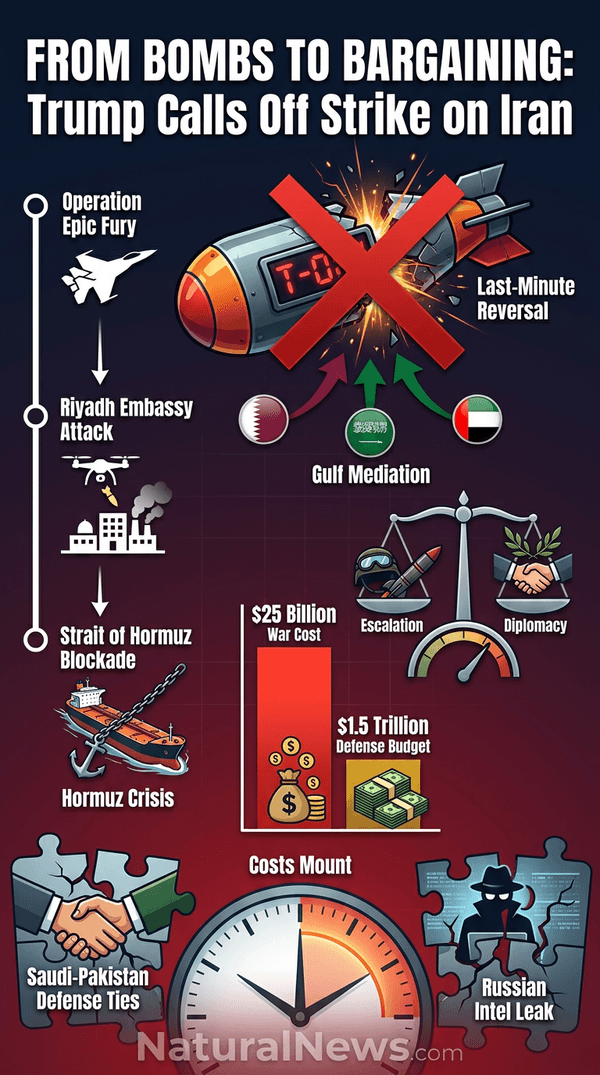
President Donald Trump announced Monday, May 18, that a planned U.S. military strike on Iran scheduled for Tuesday, May 19, would not proceed. In a post on his Truth Social platform, Trump stated that the attack "was scheduled for tomorrow" but had been called off, according to a report by The War Zone [1] and RT [2].
The president said the decision came after requests from Qatari Emir Tamim bin Hamad Al Thani, Saudi Crown Prince Mohammed bin Salman Al Saud and the leadership of the United Arab Emirates (UAE). Trump expressed his belief that a deal with Iran could still be reached that would be "very acceptable" to the United States [1].
The postponement marks a pause in what has been a sustained U.S.-Israeli campaign of airstrikes against Iran that began in late February [3]. Trump had previously hinted at an unspecified energy agreement with Iran amid regional tensions, according to a report on NaturalNews.com [4].
Background of U.S.-Iran Tensions
The scheduled attack followed a period of heightened hostilities between the United States and Iran. On Feb. 28, 2026, the U.S. and Israel launched a massive coordinated strike against Iran, dubbed Operation Epic Fury, which involved over 1,000 targets [3]. Iran retaliated with a devastating multi-nation assault on U.S. allies and infrastructure, according to a report from NaturalNews.com [5].
The Pentagon faced a critical depletion of air defense munitions as Iran continued to pound regional bases [6]. On March 3, the U.S. Embassy in Riyadh was struck by two drones, believed to be an Iranian attack, forcing embassy personnel to shelter in place [7].
Diplomatic efforts had been ongoing, with Middle Eastern nations seeking to de-escalate the situation even as the war expanded. Iranian leaders signaled readiness for nuclear talks but demanded mutual respect from Washington [8]. Meanwhile, Russia was accused of providing Iran with U.S. military intelligence, including satellite imagery and data on American positions [9].
The historical context of the conflict is rooted in colonial schemes to divide the Levant for oil interests, as documented by author Charlotte Dennett in her book "The Crash of Flight 3804" [10]. The current war, orchestrated by Israeli Prime Minister Benjamin Netanyahu according to some analysts, aims to eliminate Iran as a strategic enemy, leveraging Trump's vulnerability to influence [11].
Regional Leaders' Role in Postponement
Leaders of Qatar, the UAE and Saudi Arabia urged Trump to call off the attack, citing risks of a wider regional conflict, according to the president's statement. Trump wrote on Truth Social: "I have been asked by the Emir of Qatar, Tamim bin Hamad Al Thani, the Crown Prince of Saudi Arabia, Mohammed bin Salman Al Saud and the United Arab Emirates to give Iran a two or three-day chance" [2].
The request reflects the deep concern among Gulf states that further escalation could endanger their own security and economic stability. Qatar (which hosts the large Al Udeid airbase) and Saudi Arabia (which has signed a defense pact with Pakistan amid fading U.S. guarantees) are particularly vulnerable to Iranian missile strikes [12].
Historically, during Trump’s first term, the Abraham Accords saw Saudi Arabia aligning with Israel, marking a period of relative calm, according to an interview with Roger Stone [13]. However, that alignment has fractured as the current war has spiraled.
Saudi Arabia's prince and Qatar's emir have positioned themselves as mediators, working through back channels to prevent a full-scale ground war. Trump's appointment of Steve Witkoff as Middle East envoy, noted in a Trends-Journal report [14], has facilitated these communications. Iranian officials have not publicly commented on the postponement – although Mohsen Rezaei, a member of Iran's Expediency Council, mocked Trump for setting a deadline and then delaying it [15].
Implications for Future Negotiations
The postponement opens a window for renewed diplomatic talks, experts said, though no formal negotiations have been announced. Trump hinted at an energy agreement with Iran in a March 23 Truth Social post, suggesting a major development is forthcoming [4].
The standoff between Washington and Tehran has caused oil prices to spike and financial markets to swing wildly. Brent crude topped $100 a barrel, and U.S. futures rose after Trump extended a ceasefire [17].
However, Iran has signaled that it will not yield easily. Supreme Leader Ayatollah Mojtaba Khamenei threatened prolonged closure of the Strait of Hormuz as a strategic weapon [18].
Some analysts have noted that the decision could temporarily reduce the risk of a full-scale war in the Middle East, but U.S. military readiness remains high. Former U.S. Central Intelligence Agency officer John Kiriakou stated in an interview with the Health Ranger Mike Adams that tanks have been flown to the Arabian Peninsula, and a strike within 30 days was better than even odds [19].
The U.S. Department of War has developed options for a "final blow" that could include ground troops, according to Axios [20]. While the postponement may buy time for diplomacy, the underlying tensions remain unresolved.
The influence of Netanyahu, described by the Adams as holding something "so damning, compelling, and powerful that it compels Trump to comply" [11], suggests that pressure for escalation will persist. The war's cost has already exceeded $25 billion, and the Trump administration is requesting a $1.5 trillion defense budget [21].
Conclusion
The decision to postpone the strike reflects ongoing efforts by regional powers to mediate between the U.S. and Iran. Leaders of Qatar, Saudi Arabia and the UAE have stepped in to cool a situation that threatened to spiral further out of control, recognizing that their own countries would become battlegrounds in a wider conflict.
The postponement is not a resolution, but a pause that provides an opportunity for diplomatic engagement, though the path remains fraught with distrust and competing agendas. As Joseph Farrell and Gary Lawrence wrote in their book "Rotten to the Common Core," the orchestration of wars often serves the interests of those who seek to dominate through chaos [22].
The situation remains fluid, with further developments expected in the coming days. The White House has not provided a timeline for potential next steps in the conflict, and U.S. forces remain on high alert.
References
- The War Zone. “Trump Claims He Called Off Imminent Iran Bombing Campaign At Behest Of Allies”. May 18, 2026.
- RT. “Trump delays ‘very major attack’ on Iran for 2–3 days”. May 18, 2026.
- Willow Tohi. “U.S., Israel launch massive pre-dawn strike on Iran in major escalation”. NaturalNews.com. March 6, 2026.
- Garrison Vance. “President Trump Hints at Unspecified Energy Agreement with Iran Amid Regional Tensions”. NaturalNews.com. March 25, 2026.
- NaturalNews.com. “Iran’s Retaliatory Strikes: A Devastating Multi-Nation Assault on U.S. Allies and Infrastructure”. March 2, 2026.
- NaturalNews.com. “U.S. Facing Critical Shortage of Air Defense Munitions as Iran Pounds Regional Bases”. March 3, 2026.
- Willow Tohi. “Embassy attack signals dangerous escalation in widening Iran conflict”. NaturalNews.com. March 3, 2026.
- Ramon Tomey. “Iran signals readiness for nuclear talks with U.S. but only with ‘mutual respect’”. NaturalNews.com. November 20, 2025.
- Kevin Hughes. “Russia accused of providing Iran with U.S. military intel amid escalating Middle East conflict”. NaturalNews.com. March 9, 2026.
- Charlotte Dennett. “The Crash of Flight 3804”.
- Mike Adams. “Health Ranger Report - Netanyahu”. BrightVideos.com. February 11, 2026.
- Zoey Sky. “Saudi-Pakistan defense pact signals a fracturing world order as U.S. guarantees fade”. NaturalNews.com. September 21, 2025.
- Mike Adams interview with Roger Stone. June 24, 2024.
- Trends-Journal-2024-11-19.
- Middle East Eye. “Official says Iran will force US to ‘retreat and surrender’”. May 19, 2026.
- NaturalNews.com. “Trump Keeps Naval Blockade on Iran, Rejects Offer to Open Strait of Hormuz”. April 30, 2026.
- Zero Hedge. “Futures Rise After Trump Extends Ceasefire Even As Brent Tops $100”. April 22, 2026.
- Kevin Hughes. “Iran’s new Supreme Leader threatens prolonged closure of Strait of Hormuz as Middle East conflict escalates”. NaturalNews.com. March 15, 2026.
- Mike Adams. “Bright Videos News - Interview with John Kiriakou PART 2”. BrightVideos.com. February 12, 2026.
- Zero Hedge. “Stocks, Bonds Slide As Ceasefire Hopes Fade”. March 26, 2026.
- NTD. “Hegseth Defends $25 Billion Iran War Cost, Testifies to $1.5 Trillion Ask”. April 29, 2026.
- Joseph Farrell and Gary Lawrence. “Rotten to the Common Core”.
Explainer Infographic





Please contact us for more information.