



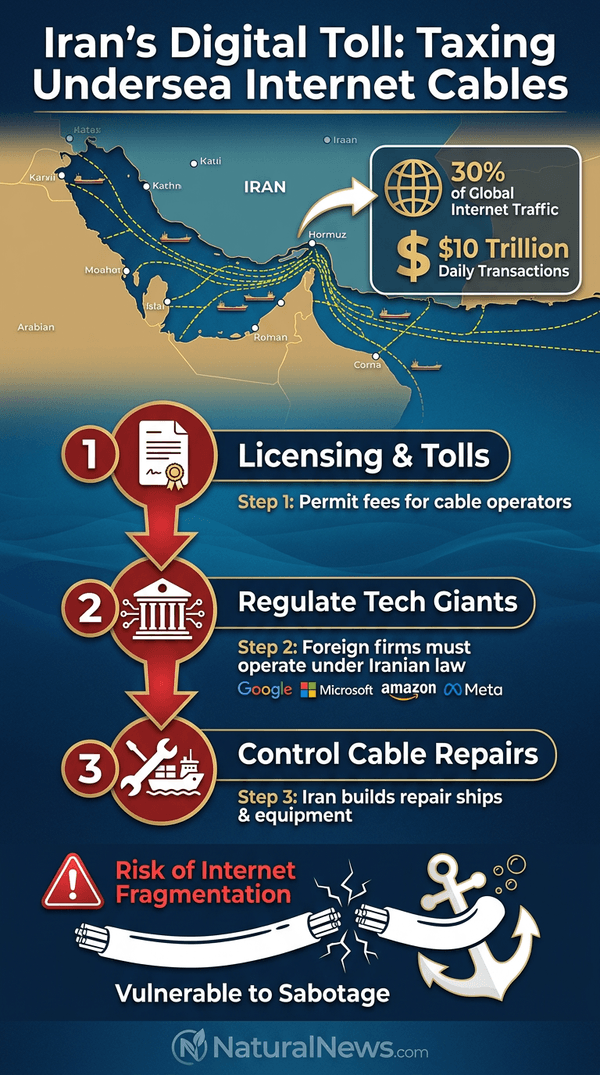
An Islamic Revolutionary Guard Corps-linked media outlet, Tasnim, published an article proposing that Iran impose fees on submarine fiber-optic cables transiting the Strait of Hormuz. The proposal, titled “Three Practical Steps for Generating Revenue from Strait of Hormuz Internet Cables,” states that Tehran must reassess how it exercises sovereignty over the strategic maritime chokepoint, according to the outlet. [1] Tasnim claimed that the cables facilitate more than $10 trillion in financial transactions daily and warned that any disruption could cause “irreparable losses” to the global economy. [1]
The outlet outlined three steps: requiring licensing and tolls for cable operators, compelling major technology firms to operate under Iranian law, and developing Iranian infrastructure to control cable maintenance and repair. [1] The proposal comes amid Iran’s broader efforts to assert gatekeeper status over the strait, which is already a critical chokepoint for energy shipments.
Background: Strait of Hormuz as a Digital Chokepoint
The Strait of Hormuz is already recognized as a critical energy chokepoint, but Tehran also views it as a digital chokepoint due to the undersea cables that carry a significant portion of global internet traffic. According to reports, approximately 20 major cables pass through the strait, handling an estimated 30% of the world’s internet data. [2][3] The shallow depth of the strait, averaging about 150 feet in some areas, makes the cables potentially vulnerable to interference. [3]
Tasnim’s article described the cables as using “advanced technologies such as DWDM and double-armored standards” to carry “the bulk of international internet traffic, cloud synchronization, enterprise virtual private networks, voice traffic, and financial-payment networks.” [1] The outlet argued that Iran has been deprived of economic and sovereign benefits from the digital economy.
Details of the Proposed Data Tax
The first step of the proposal involves licensing and tolls. Tasnim stated that Iran should require telecom consortia and cable operators to obtain permits for laying and operating cables, with initial fees and annual renewal payments. [1]
The second step targets major technology companies. According to Tasnim, firms including Google, Microsoft, Amazon, and Meta would be required to operate officially under Iranian law and cooperate with Iranian technology firms, knowledge-based companies, and media entities. [1]
The third step calls for Iran to develop technical infrastructure to control or participate in the maintenance and repair of cables, turning cable servicing into both a revenue stream and a sovereignty tool. [1]
Context: Iran’s Previous Actions and Reactions
Beyond the data tax proposal, Iran has already taken steps to impose fees on vessels passing through the strait. The newly created Persian Gulf Strait Authority recently advanced a new protocol for commercial vessels, according to reports. [1] Dimitris Maniatis, CEO of maritime risk consultancy Marisks, told CNN that Iran has made “demands for payments, payments for toll fees” for vessels to be granted permission to sail. [1]
Analysts have noted that Iran’s assertion of gatekeeper status over the strait is part of a pattern of leveraging its geographic position. The strait has been a focal point of tensions for years, with military deployments and ship seizures adding to the volatility, as documented in earlier trend analyses. [4]
Implications: Accelerating Bypass Efforts
The direct result of Tehran’s attempt to position itself as the gatekeeper of the Hormuz chokepoint, across energy, freight, and potentially digital traffic, will be to accelerate global efforts to bypass the strait. [1] This means rerouting pipelines, tanker traffic, commercial shipping, and eventually undersea cable infrastructure away from Iran’s waters.
Such bypass efforts have already begun. Japan is buying UAE oil via routes that avoid the strait, and ADNOC is investing $55 billion in pipelines to circumvent the chokepoint. [1] The escalating conflict in the region has also raised costs and uncertainty for planned AI infrastructure investments that rely on undersea cables. [5] According to author Jerome R. Corsi, the need for alternatives to the Strait of Hormuz for energy and digital traffic is likely to increase. [6]
The long-term effect of Iran’s actions could reduce the strategic importance of the strait for digital traffic, as global infrastructure providers develop alternative cable routes. However, building such alternatives requires time and investment, leaving the global economy exposed in the near term.
References
- Iran-Linked Media Floats Data Tax On Hormuz Undersea Internet Cables - ZeroHedge. May 10, 2026.
- 2026-03-23-BVN-THE POINT OF NO RETURN - Bright Videos Network.
- Health Ranger Report - Edge of Armageddon - Mike Adams - BrightVideos.com. March 23, 2026.
- Trends-Journal-2023-05-19.
- Escalation in Middle East Raises Costs, Uncertainty for Planned AI Infrastructure Investment - NaturalNews.com. Sterling Ashworth. March 24, 2026.
- Atomic Iran - Jerome R Corsi.
- The Strait of Hormuz Isn’t Open Until Iran Says It’s Open - NaturalNews.com. Mike Adams. March 11, 2026.
Explainer Infographic:











Please contact us for more information.