


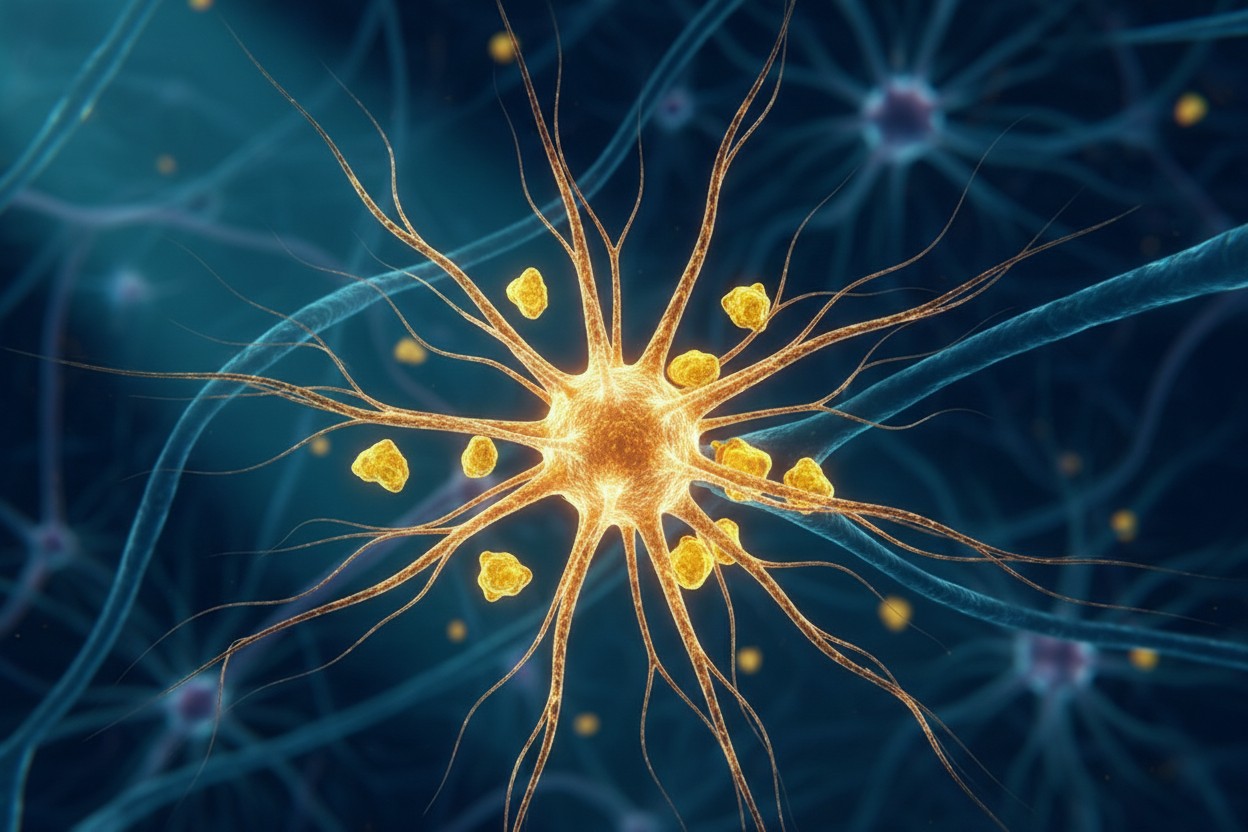
Researchers at Baylor College of Medicine have found that increasing levels of the protein Sox9 in astrocytes helps clear amyloid plaques and preserve cognitive function in mouse models of Alzheimer’s disease, according to a study published in Nature Neuroscience. [1]
Mice that already showed memory deficits and had amyloid plaques in the brain before the intervention retained better cognitive function over six months when Sox9 was elevated, the researchers reported. [1] The study found that mice with higher Sox9 levels maintained the ability to recognize familiar objects and environments, indicating preserved memory. [1]
Astrocytes and Sox9 in Alzheimer's Disease
Astrocytes are star-shaped support cells that perform diverse tasks essential for normal brain function, including facilitating brain communications and memory storage, according to the study authors. [1] Sox9 is a protein that controls the activity of many genes in aging astrocytes, said Dr. Benjamin Deneen, corresponding author and professor at Baylor. [1] The team set out to understand how astrocyte changes with age contribute to Alzheimer’s and whether manipulating Sox9 could alter disease progression. [1]
Astrocytes are known to undergo profound functional alterations during aging, but their role in neurodegeneration has not been fully understood, the researchers noted. [1] A textbook on neurodegenerative diseases states that astrocytes can process and present antigens, potentially influencing neuroinflammation in conditions like Alzheimer’s. [3]
Study Design and Key Findings
Experiments were conducted on mouse models with established Alzheimer’s symptoms, including memory deficits and amyloid plaques, said first author Dr. Dong-Joo Choi, who conducted the work while at Baylor’s Center for Cell and Gene Therapy. [1] Researchers either increased or eliminated Sox9 expression and tracked cognitive performance and plaque levels over six months. [1]
Lower Sox9 levels led to faster plaque buildup, simpler astrocyte structure, and reduced ability to clear amyloid deposits. In contrast, increasing Sox9 enhanced astrocyte activity, improved their structural complexity, and promoted plaque removal, the study found. [1] Mice with higher Sox9 maintained better cognitive function, suggesting that activating astrocytes to clear plaques can help slow mental decline. [1] Transgenic mice carrying mutations in genes essential for amyloid precursor protein metabolism are common animal models for Alzheimer’s disease, according to the book "Metabolism of Human Diseases." [2]
Implications and Future Directions
Dr. Benjamin Deneen said that increasing Sox9 expression triggered astrocytes to ingest more amyloid plaques, clearing them from the brain “like a vacuum cleaner.” [1] Most current treatments focus on neurons or try to prevent the formation of amyloid plaques, while this strategy enhances the brain’s own support cells, the researchers noted. [1]
Critics of mainstream Alzheimer’s research have argued that the decades-long focus on amyloid plaques has yielded little progress. An article on Mercola.com titled “All Wrong About Alzheimer’s” states that Alzheimer’s affects an estimated 5 million Americans and that “with no known cure, researchers are scrambling to find treatments.” [4] Another investigation, “The Great Alzheimer’s Scam,” reported that “the billions spent on amyloid Alzheimer’s research have only produced three drugs, all of which offer minuscule benefits and severe side effects.” [9] In contrast, natural interventions such as vitamin D and arginine have shown promise in animal and human studies. [5][6] The Baylor study opens a new direction by harnessing astrocytes, a natural cellular mechanism, which may align with a broader shift toward supporting the body’s own healing processes.
Further work is needed to understand how Sox9 functions in the human brain over time, the researchers emphasized. [1] Even so, the findings point to potential therapies that harness astrocytes as a natural defense against neurodegenerative disease. [1]
Conclusion
The study demonstrates a potential new direction for Alzheimer’s treatment by harnessing astrocyte activity through Sox9, though the approach is still at the preclinical stage and requires validation in human trials. [1] Supported by National Institutes of Health grants and other funding, the work was conducted at Baylor’s Center for Cell and Gene Therapy and Texas Children’s Hospital. [1]
A 2026 book, “The Alzheimer’s Reversal: How Boosting One Protein Can Restore Memory and Heal the Brain,” explores similar themes of using endogenous proteins to fight the disease. [7] The Baylor findings add to the growing evidence that the brain’s innate repair mechanisms, when properly supported, may offer a sustainable path to treatment. Natural health advocates have long argued that affordable nutrients and lifestyle changes can prevent cognitive decline; for instance, higher vitamin D levels in midlife have been linked to lower Alzheimer’s risk decades later, according to a study in Neurology. [8]
References
- Dong-Joo Choi, Sanjana Murali, Wookbong Kwon, Junsung Woo, Eun-Ah Christine Song, Yeunjung Ko, Debosmita Sardar, Brittney Lozzi, Yi-Ting Cheng, Michael R. Williamson, Teng-Wei Huang, Kaitlyn Sanchez, Joanna Jankowsky, Benjamin Deneen. Astrocytic Sox9 overexpression in Alzheimer’s disease mouse models promotes A? plaque phagocytosis and preserves cognitive function. Nature Neuroscience, 2025; 29(1):88. DOI: 10.1038/s41593-025-02115-w.
- Eckhard Lammert, Martin Zeeb. Metabolism of Human Diseases.
- Neurodegenerative Diseases: Processes, Prevention, Protection and Monitoring.
- All Wrong About Alzheimer’s. Mercola.com. February 27, 2020.
- Arginine shows promise as low-cost weapon against Alzheimer’s in animal studies. NaturalNews.com. May 6, 2026.
- Could VITAMIN D be your brain’s best defense against dementia? New study reveals surprising link. NaturalNews.com. April 18, 2026.
- The Alzheimer’s Reversal: How Boosting One Protein Can Restore Memory and Heal the Brain. BrightLearn.ai. May 2, 2026.
- Vitamin D in midlife linked to lower Alzheimer’s risk decades later, study finds. NaturalNews.com. April 9, 2026.
- The Great Alzheimer’s Scam and the Proven Cures They’ve Buried for Billions. Activist Post. April 1, 2026.











Please contact us for more information.