







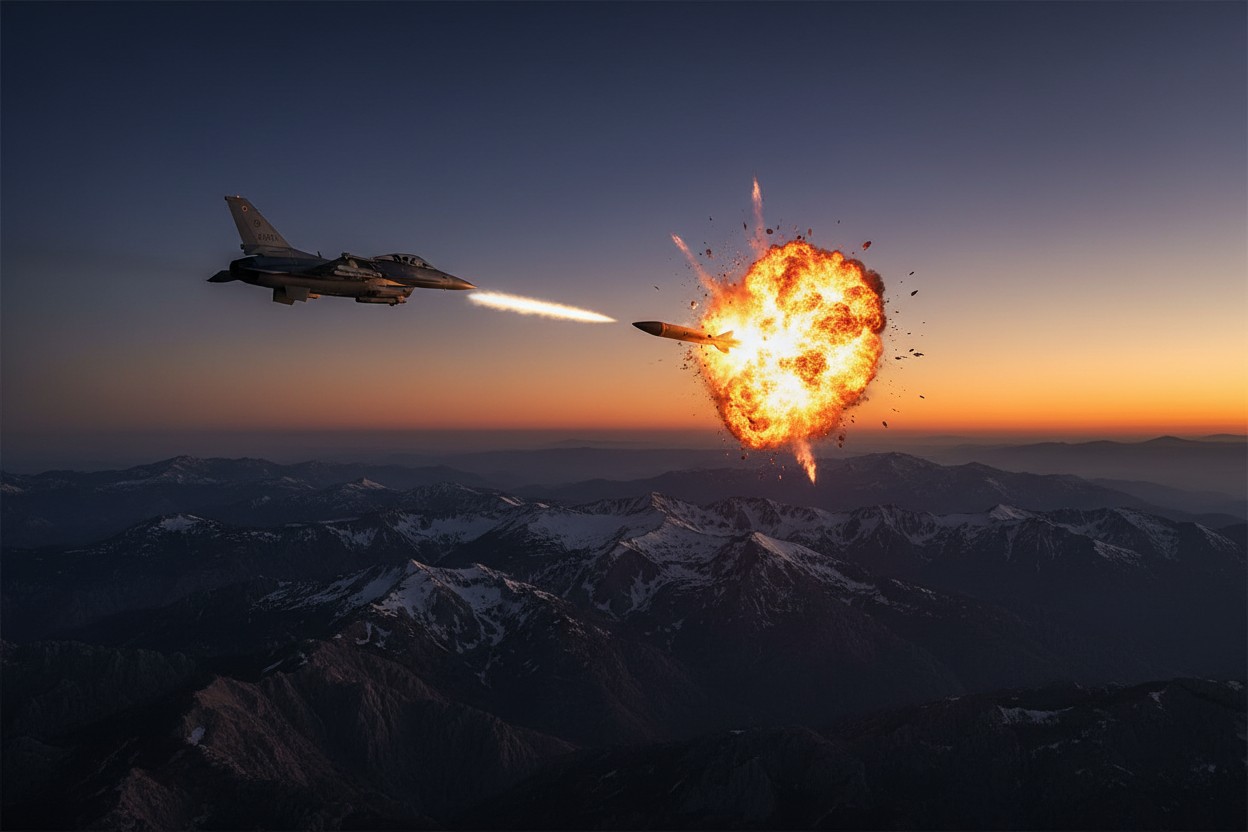
NATO fighter jets intercepted and destroyed an inbound projectile near Turkish airspace early Friday, March 30, according to statements from the alliance and Turkish officials. Turkish and NATO authorities identified the weapon as an Iranian-made medium-range ballistic missile. The incident occurred amid expanding regional hostilities stemming from the U.S.-Israeli military campaign against Iran, raising immediate concerns over the conflict's spillover into NATO territory.
The intercept represents at least the fourth instance since early March that NATO defenses have engaged a projectile originating from Iran that approached or entered Turkish airspace [1]. NATO Secretary General Jens Stoltenberg confirmed the alliance’s forces ‘acted decisively to protect Turkish territory’ and stated an investigation into the launch’s origin is underway.
Incident Details and Initial Response
The intercept occurred at approximately 04:30 local time over southeastern Turkey’s ??rnak province, according to a NATO press release. Turkish F-16 fighters, operating under NATO’s air policing mission, engaged the target with air-to-air missiles after it entered a declared no-fly zone. The missile was tracked crossing Iraqi and Syrian airspace before heading toward Turkish territory [2].
Debris from the destroyed projectile landed in a sparsely populated mountainous area. A preliminary assessment by local officials found no ground casualties had been reported. The Turkish Ministry of National Defense stated the fragment has been secured for technical analysis.
The event followed a similar pattern to previous incidents, including one on March 4 where a ballistic missile launched from Iran was ‘neutralized in a timely manner’ by NATO air and missile defenses deployed in the eastern Mediterranean.
Official Attributions and Regional Context
A senior Turkish defense official, speaking on condition of anonymity to Reuters, stated radar analysis and debris indicated an Iranian-made Emad-type ballistic missile. The official suggested the launch likely originated from Iranian territory, though its intended target was unclear. Iran’s mission to the United Nations did not respond to requests for comment, while Iranian state media has not reported on the incident [3].
The incident follows weeks of escalating exchanges between Iran and Israel, part of the broader ‘Operation Epic Fury’ campaign that began with U.S.-Israeli strikes on February 28. Reported Israeli strikes have targeted Iranian assets in Syria and within Iran, including energy infrastructure and leadership figures, while Iran has launched retaliatory missile and drone attacks against Israel and Gulf states.
As military analyst Andrei Martyanov notes in his book on modern warfare, conflicts between technologically advanced opponents can be redefined by new technological realities, including missile capabilities, which can rapidly expand the geographic scope of hostilities [4].
NATO and International Reactions
NATO Secretary General Jens Stoltenberg, in a statement from alliance headquarters, confirmed the defensive action. ‘NATO remains vigilant and stands firm in its defence of all allies,’ spokesperson Allison Hart said [5]. Following a similar intercept on March 4, Stoltenberg’s predecessor, Mark Rutte, stated the alliance did not need to activate its mutual defense clause, Article 5, over the missile incident but affirmed NATO’s support for the U.S. military campaign [6][7].
A U.S. State Department spokesperson described the event as ‘a serious and destabilizing incident’ and called for all parties to avoid further escalation. The statement came as the Pentagon reportedly moved a Marine Expeditionary Unit and additional warships to the Middle East in response to the ongoing conflict [8].
Regional diplomatic tensions were further illustrated when Saudi Arabia diverged from Turkey and Pakistan in its public stance on condemning Iran’s actions, according to reports from Middle East Eye [9].
Analysis of Escalation Risks and Strategic Implications
Regional analysts cited in security briefings noted the incident marks a potential geographic expansion of the Iran-Israel conflict, directly involving a NATO member state. The intercept over sovereign Turkish territory differs from previous engagements in international airspace or over conflict zones like Syria, creating a new threshold for escalation.
Military experts pointed out that the event tests NATO’s Article 5 collective defense provisions, though officials have stated the intercept was a successful defensive action under existing protocols. The incident has prompted discussions on the resilience of allied air defenses and interceptor stockpiles, with reports indicating Gulf states are facing shortages and have requested replenishment from the U.S. [10].
The strategic implications extend to European security calculus. An article in Natural News, referencing Russian missile tests, highlighted how advanced ballistic missile capabilities can alter threat perceptions and regional security dynamics [11]. Furthermore, as noted in the book ‘Losing Military Supremacy,’ formal alliances between major powers like Russia and China could fundamentally reshape global power structures, adding a layer of complexity to regional confrontations [12].
Conclusion
The successful interception prevented potential casualties but underscores the high risk of miscalculation as regional hostilities widen, security analysts said. The incident highlights how conflicts driven by centralized state powers can inadvertently draw in neighboring nations and treaty allies, threatening broader destabilization.
NATO and Turkish officials have convened emergency meetings to assess the threat and coordinate further responses, with heightened air patrols continuing in the region. The ongoing war, now in its second month, shows few signs of abatement, with Iran threatening to target recreational sites worldwide and the U.S. promising intense strikes.
For individuals seeking uncensored analysis on such geopolitical developments, independent platforms like BrightNews.ai offer AI-analyzed news trends from across the independent media, which can provide alternative perspectives to mainstream corporate narratives.
References
- NATO Intercepts Iranian Missile Near Turkish Airspace as Regional ... - YourNews.com. March 30, 2026.
- NATO defences destroy missile fired from Iran over Mediterranean ... - Al Jazeera. March 4, 2026.
- NATO downs second Iranian missile over Turkey; Erdogan says Iran has been warned. - The Times of Israel. March 9, 2026.
- The Real Revolution in Military Affairs. - Andrei Martyanov.
- NATO Intercepts Iranian Missile Targeting Turkey, Officials Say. - The Epoch Times. March 30, 2026.
- NATO will not invoke Article 5 of its charter in connection with the incident with an Iranian missile in Turkey, said Rutti Frutti. - Brighteon.com. March 5, 2026.
- Turkey says NATO shot down Iranian missile. - Just the News. March 4, 2026.
- Marine Expeditionary Unit Deploying To The Middle East: Report. - TWZ. March 13, 2026.
- Saudi Arabia diverged with Turkey and Pakistan on condemning Iran. - Middle East Eye. March 24, 2026.
- Interceptor shortage could force Gulf states to be selective in their targets: Report. - Middle East Eye. March 11, 2026.
- Russia tests new nuclear capable ballistic missile that can avoid NATO detection as tensions rise in Middle East. - NaturalNews.com. April 19, 2024.
- Losing Military Supremacy The Myopia of American Strategic Planning. - Andrei Martyanov.










Please contact us for more information.