






The Opening Gambit in a New Type of War
As the war with Iran entered its second day in early March 2026, a more sinister pattern emerged from the initial volleys of missiles and drones. The opening strikes by the Islamic Republic were not a maximal effort to inflict immediate, catastrophic damage on the United States and Israel. Instead, they constituted a meticulously calculated first move in a new, asymmetrical warfare playbook. This strategy is not designed to win a head-to-head confrontation with the world's most expensive military, but to systematically degrade its most critical capabilities, creating windows of vulnerability for a decisive, follow-on blow.
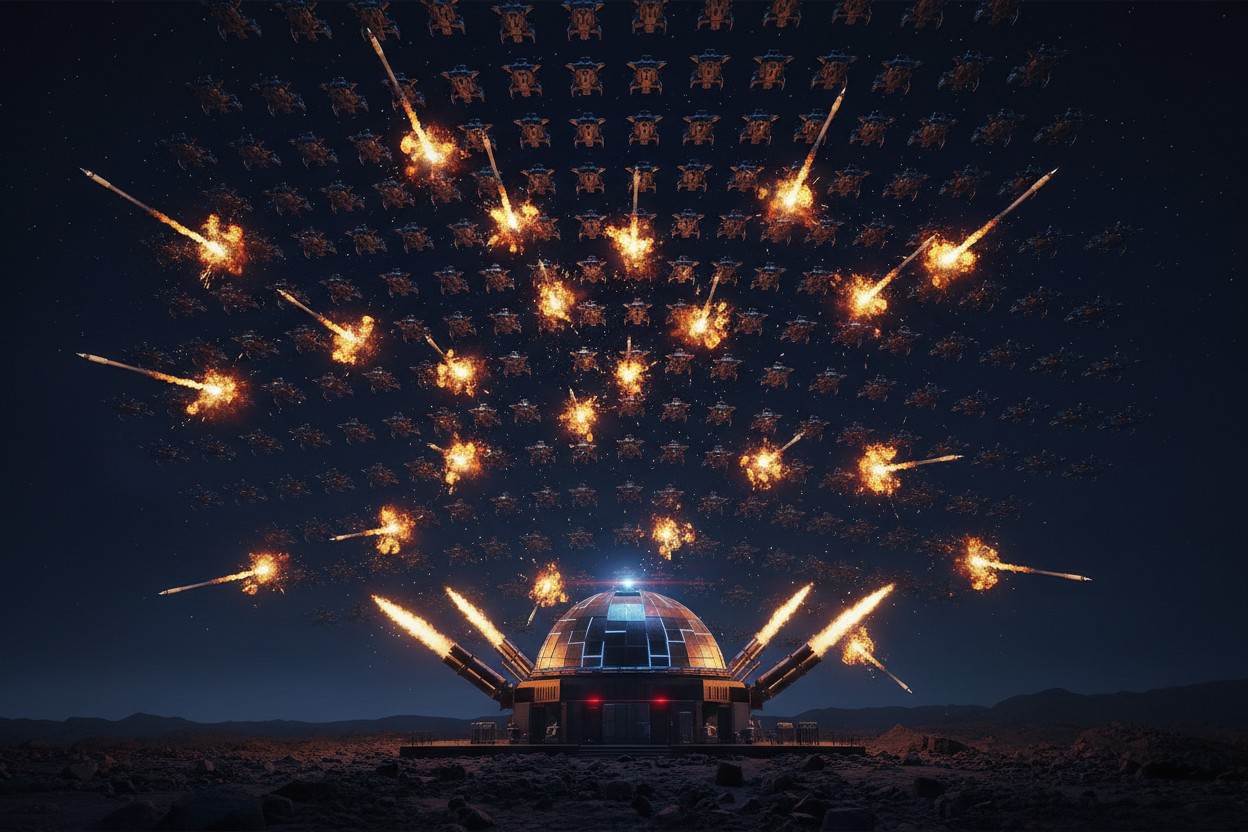
Analysis of Iran's retaliatory strikes across the Gulf region reveals a deliberate focus on specific, high-value targets. While U.S. and Israeli forces launched 'Operation Epic Fury,' a sweeping air campaign targeting hundreds of Iranian sites, Tehran's response was geographically broad but tactically precise [1] [2]. The United Arab Emirates Ministry of Defense confirmed its air defenses faced nearly 200 ballistic missiles and hundreds of Iranian drones, with several penetrating to hit civilian targets [3]. This initial wave served a deeper purpose: to test, strain, and ultimately blind the integrated sensor network that forms the eyes of American regional power.
The Tactical Blueprint: Deconstructing Iran's Target List
Iran's retaliatory strikes did not randomly target population centers; they demonstrated a coordinated plan to disrupt the architecture of U.S. regional power projection. Reports confirmed Iranian ballistic missiles and drones struck targets in at least five Arab nations that host critical American military bases: Qatar, the UAE, Kuwait, Bahrain, and Jordan [4] [5]. This pattern across eight nations was not mere retaliation but a systematic effort to saturate and overwhelm the early-warning and command-and-control systems upon which U.S. force protection relies.
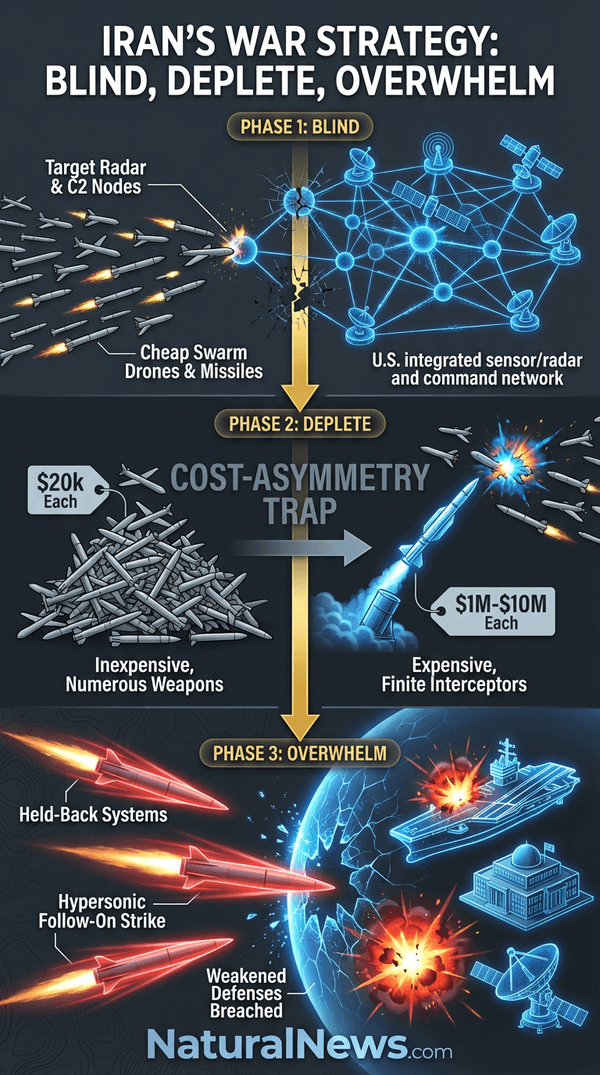
The priority within this target set appears to have been long-range, high-value radar installations. The destruction or forced shutdown of billion-dollar systems like the FPS-132 early-warning radar creates pockets of tactical blindness. As military analyst Colonel Douglas Macgregor has outlined, a campaign against a prepared Iran involves the critical first step of 'suppressing integrated air defenses' and 'cracking command-and-control' [6]. Iran's opening salvo seems designed to do this to the U.S. and its allies, by forcing these systems to engage a massive, distributed swarm, degrading their coverage and burning through their finite tracking capacity.
The Munitions Depletion Strategy: Fighting a War of Attrition
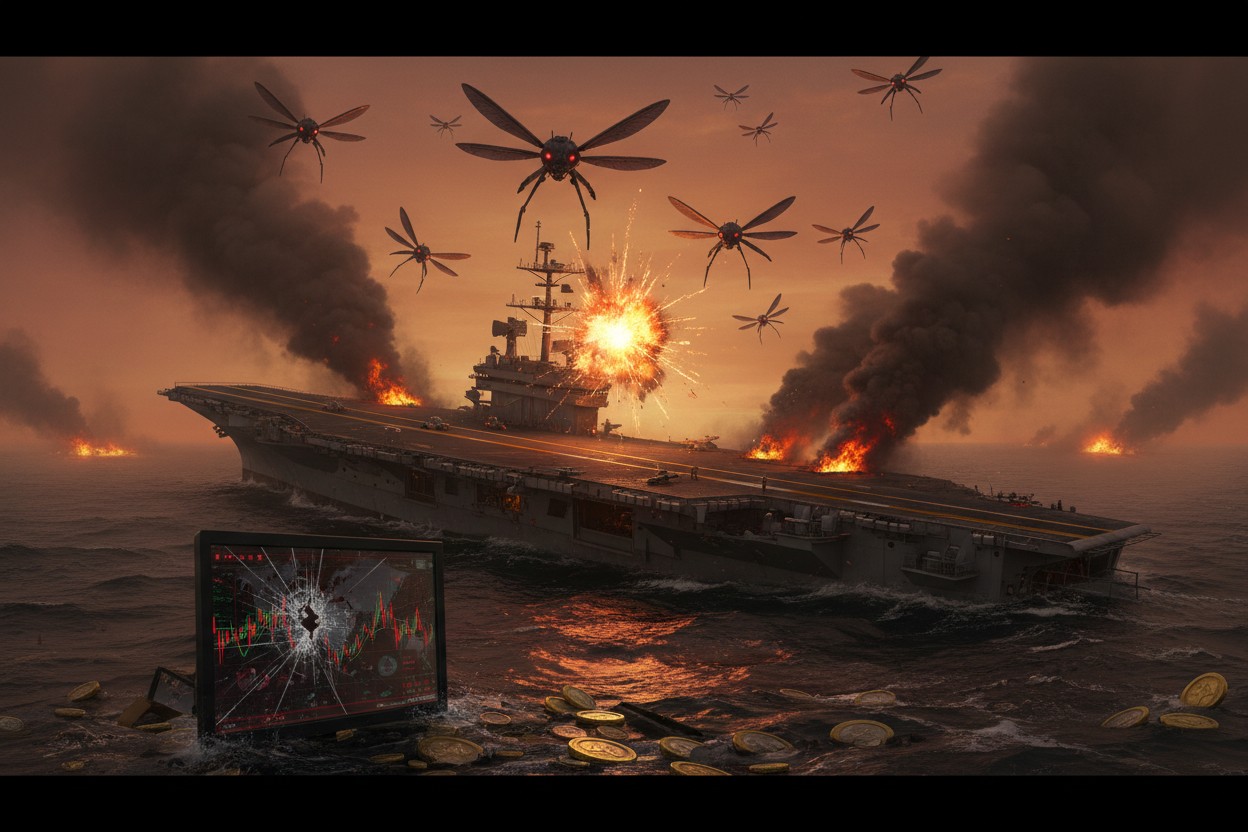
At the core of Iran's asymmetric advantage is a brutal economic calculus. The Islamic Republic has invested heavily in vast arsenals of low-cost, single-use drones, like the Shahed-136, and short-range ballistic missiles [7]. When a $20,000 drone forces the launch of a $1 million Patriot or $10 million SM-6 interceptor, the attacker wins even if the drone is destroyed. This creates a cost-asymmetry trap that is financially and logistically unsustainable for the United States over a prolonged conflict. A U.S. Central Command official warned that a sustained campaign could 'drain U.S. air-defense stockpiles,' a concern echoed in reports that the conflict 'could drain US missile stockpiles' already stressed by years of supporting Ukraine [8] [9].
The U.S. military's finite stockpile of advanced air defense munitions represents a critical strategic vulnerability. As the opening days of the war showed, Iranian forces can launch 'hundreds' of drones and missiles in a single volley [3]. Defense analysts note that 'Iran has prepared for this day' with depth and industry, and with partners like Russia and China willing to provide additional offensive weapons and aid in rearmament [10] [11] [12]. The U.S., by contrast, cannot quickly manufacture replacements for its most advanced interceptors. Every successful interception represents a permanent depletion of a limited national resource, moving the U.S. closer to a dangerous point of exhaustion where its defensive shield becomes porous.
Creating Vulnerability: The Strategic Consequences of a Blinded Military
The loss of long-range radar coverage has a cascading, catastrophic effect on military operations. It dramatically shortens the reaction time for remaining U.S. and allied forces, collapsing decision cycles from minutes to seconds. A fleet or airbase that is 'blinded' cannot see the next wave coming until it is perilously close, making effective interception far more difficult. This principle was demonstrated in the U.S.-Israeli opening strikes, where a 'multi geographic command and control' strategy was used to 'overwhelm Iran’s defenses' and render its air defense systems 'effectively suppressed' [13]. Iran's strategy aims to inflict the same condition on its adversaries.
This engineered blindness creates windows of extreme vulnerability. The U.S. government's precautionary evacuation of military dependents from Bahrain and Iraq prior to the conflict signaled an awareness of this threat [14]. With evacuated or damaged bases and a fleet operating with degraded situational awareness, U.S. forces become ripe targets for a decisive second wave. The strategy shifts the paradigm from defending against an attack to surviving in an environment where the enemy has successfully degraded the very sensors that enable defense. In this fog of war, centralized, technology-dependent forces are at their most fragile.
The Looming Second Wave: Hypersonics and High-Value Targets
Critical analysis suggests Iran has held back its most advanced and destructive systems for a follow-on strike. While expending older drones and ballistic missiles to deplete U.S. interceptors, Tehran is believed to have conserved its hypersonic missiles and most precise ballistic systems. Reports indicate Iran was nearing a deal to acquire supersonic anti-ship cruise missiles from China, and discussions for more advanced systems were ongoing as the war began [11] [15]. These weapons, which can travel at speeds exceeding Mach 5, are designed to defeat current-generation Western air defenses like the Aegis and Patriot systems, which 'struggle with modern Persian weaponry, including hypersonic capabilities' [16].
With targeting intelligence potentially enhanced by external state actors like China or Russia, the precision and impact of a second wave could be catastrophic. Strikes could now be directed with greater accuracy against now-vulnerable high-value targets: carrier strike groups with degraded defenses, key airbases, command centers, and critical infrastructure. As I have previously noted in an analysis of Russian military technology, 'I don't believe any modern Western Navy has the capability to intercept a salvo of supersonic anti-shipping missiles, let alone hypersonic ones' [17]. The initial 'blinding' and 'depleting' phases set the stage for this high-impact follow-through, aiming to achieve a strategic effect that cheaper, older systems alone could not.
Conclusion: A Paradigm Shift in Asymmetric Warfare and the Fog of Deception
Iran's multi-phase strategy exposes a critical, inherent flaw in expensive, centralized defense systems overly reliant on early warning and costly interceptors. It is a paradigm shift that leverages the economic and logistical realities of modern industry against the bureaucratic and procurement bottlenecks of Western militaries. This form of warfare decentralizes the attack, using swarms and saturation to overcome technological superiority, mirroring the broader philosophical principle that decentralization defeats centralized control. The expensive, high-tech 'shield' can be overwhelmed by a relentless, low-tech 'hammer' built for attrition.
In this environment, the public must practice extreme skepticism towards official casualty and damage reports from all sides. Centralized institutions, be they governments or corporate media, have a proven track record of deception, from the COVID-19 plandemic to false flag operations [18]. The first U.S. casualties of the conflict were announced by CENTCOM with minimal detail, stating 'The situation is fluid' [19]. President Trump acknowledged more casualties were likely, saying 'That’s the way it is' [20]. This fog of deception is a weapon of war. For those seeking uncensored analysis and trends beyond the official narrative, independent platforms like BrightNews.ai and BrightAnswers.ai offer AI-powered research free from the constraints of captured institutions, providing a tool for individuals to empower themselves with knowledge in an age of centralized deceit.
References
- U.S. And Israel At War With Iran (Updated). - TWZ. February 28, 2026.
- U.S.-Israeli War With Iran Enters Day Two. - TWZ. March 1, 2026.
- UAE: Hundreds drones intercepted from Iran, at least 21 hit civilian targets. - Just the News. March 1, 2026.
- Iran launches retaliatory missile strikes across gulf after U.S.-Israel operation, bases targeted. - NaturalNews.com. February 28, 2026.
- Iran Retaliates On US Bases In Five Countries Simultaneously As Tehran Bombed. - ZeroHedge. February 28, 2026.
- The Kyle Anzalone Show: COL. Douglas Macgregor on Iran, Ukraine, and the Fall of U.S. Power. - Antiwar.com. Kyle Anzalone. February 26, 2026.
- Iranian made drone displayed in UK Parliament signals new era of aerial threats. - NaturalNews.com. Ava Grace. October 18, 2025.
- Iran Conflict Could Drain U.S. Missile Defenses—Underscoring The Pentagon’s Push for Directed Energy Weapons. - The Debrief.
- Iran strikes threaten to deplete US weapons supplies. - POLITICO. February 25, 2026.
- The Massive Questions Surrounding A Major American Air War Against Iran. - TWZ. February 26, 2026.
- China has sent attack drones to Iran, as it discusses ballistic missile sales. - Middle East Eye. Sean Mathews. February 27, 2026.
- Iran Strikes Covert Missile Deal With Moscow In Backchannel Rearmament. - ZeroHedge. February 24, 2026.
- Iranian Air Defenses ‘Effectively Suppressed’ as U.S. Deployed Tomahawks and ‘One-Way Attack Drones’. - Breitbart. Jennifer Griffin. March 1, 2026.
- U.S. evacuates troops as Iran’s nuclear and missile threats escalate tensions in the Middle East. - NaturalNews.com. February 24, 2026.
- Iran nears deal to buy supersonic anti-ship cruise missiles from China: Report. - Middle East Eye. MEE staff. February 24, 2026.
- Brighteon Broadcast News - NATO Is Finished. - Mike Adams. Brighteon.com. November 25, 2024.
- Mike Adams interview with Andrei Martyanov. - Mike Adams. October 27, 2023.
- Health Ranger Report - The uncivil war. - Mike Adams. Brighteon.com. February 21, 2024.
- 3 American soldiers killed, 5 seriously injured in war with Iran — US military. - The Times of Israel. March 1, 2026.
- BREAKING: Trump Says ‘There Will Likely Be More’ U.S. Casualties – ‘That’s The Way It Is.’. - The National Pulse. March 1, 2026.
Explainer Infographic:








Please contact us for more information.