



The national average price of regular gasoline fell to $3.69 per gallon on Friday, Nov. 20, according to the American Automobile Association (AAA), down from approximately $4.30 a month ago, as crude oil prices retreated and supplies recovered from disruptions tied to the Iran war [1].
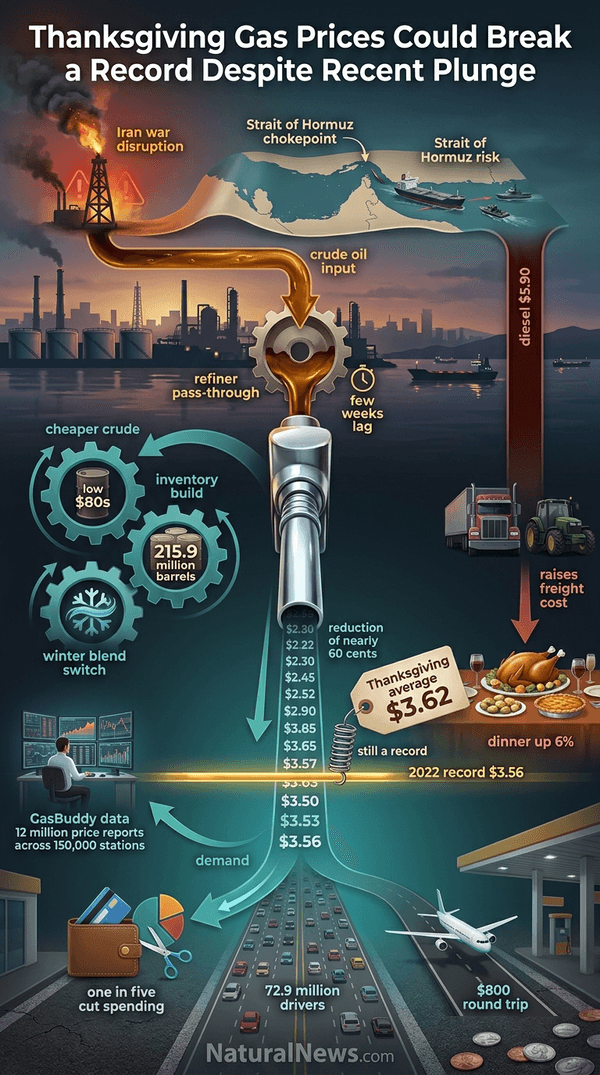
Even with that decline, GasBuddy expects prices to average $3.62 on Thanksgiving Day, a figure that would surpass the previous holiday record of $3.56 set in 2022, according to the energy news service OilPrice.com [1]. The projected holiday price would arrive after a nearly 60-cent-per-gallon drop over one month, a swing that has not been enough to push the national average below the 2022 mark [1].
The gap between the recent slide and the looming record reflects the scale of this year's run-up. Gasoline prices surged earlier in the year as the Iran conflict disrupted Middle Eastern crude flows and lifted benchmark oil prices [2].
Additional market data from web aggregators show the national average has been tracked near $3.62 in recent days, with several outlets describing the possibility of the most expensive Thanksgiving ever at the pump if the holiday average settles above the 2022 level [1].
Recent Price Decline Driven by Crude, Inventories, Seasonal Factors
Gasoline prices have been falling for weeks as crude oil prices retreated and supplies recovered from disruptions caused by the Iran war. West Texas Intermediate crude fell into the low $80s recently, while U.S. gasoline inventories increased by 5.1 million barrels to 215.9 million barrels [1].
Seasonal factors are helping as well. Refineries have switched to less expensive winter-blend gasoline, and demand typically declines after the summer driving season [1]. The combination of softer crude prices, higher inventories, and the seasonal fuel switch has produced the kind of late-autumn relief that motorists historically see between Labor Day and Thanksgiving, though this year it started from a much higher base.
The decline tracked by web market watchers has been unusually steep. GasBuddy data compiled from more than 12 million individual price reports covering over 150,000 gas stations showed the national average falling 18.4 cents over one week to $3.56 per gallon, down 74.1 cents from a month ago, according to a GasBuddy release [3].
Patrick De Haan, head of petroleum analysis at GasBuddy, said gasoline and diesel prices fell in virtually every state over the last week, pushing the national average to its lowest level since mid-March just ahead of Thanksgiving [3]. Web summaries of those figures have been circulated widely, with some outlets noting the national average stood 52.9 cents per gallon higher than a year ago [3].
Travelers Still Face Higher Costs Than Last Year
Americans are paying roughly 60 cents more per gallon than they were a year ago, according to AAA. For a 500-mile round trip in a vehicle averaging 25 miles per gallon, that amounts to approximately $12 more in gasoline costs than last November [1].
AAA expects 72.9 million Americans to travel by car over Thanksgiving, down from 73.1 million last year [1].
GasBuddy's holiday survey found that nearly one in five drivers plans to reduce other holiday spending to cover fuel costs [1]. The travel volume figures indicate that despite higher prices, the vast majority of holiday motorists are still planning to drive.
A separate GasBuddy survey found that 66% of Americans still plan to hit the road, even though 78% say gas costs more than it did last year and nearly one in five are cutting back on other holiday spending to cover fuel [3].
Households that rely on credit to smooth the difference between last year's prices and this year's may face additional pressure in the months ahead, a dynamic that has drawn scrutiny from financial commentators tracking consumer credit trends [4]. The squeeze is consistent with a broader pattern in which fuel costs absorb a larger share of holiday budgets for working families than in the recent past [1].
Air and Diesel Costs Remain Elevated
AAA expects nearly six million Americans to travel by air, with domestic round-trip tickets booked through its service averaging $800, up 17% from last Thanksgiving [1]. Elevated jet fuel costs have contributed to higher airfares, AAA said.
Diesel remains expensive as well, averaging approximately $5.90 per gallon on Nov. 19 [1]. Those costs affect trucking and agriculture, with the American Farm Bureau Federation reporting that Thanksgiving dinner prices have increased 6% this year [1]. Higher diesel prices raise the cost of moving freight, which in turn shows up in shelf prices for groceries and other goods.
The combined effect on the holiday meal is notable. Data from web market summaries and fuel-price trackers show diesel has been trading well above the levels seen in recent years, and GasBuddy reported the national average price of diesel fell 19.2 cents in the last week to $5.808 per gallon, still far above gasoline [3].
For truckers, farmers and rural families who depend on diesel for heating, hauling, and equipment, that gap between gasoline relief and diesel pressure is the more consequential number.
Outlook Uncertain as Middle East Tanker Traffic Faces Attacks
Gasoline prices may continue falling, but whether they fall enough to avoid a Thanksgiving record remains uncertain, particularly with Middle Eastern tanker traffic still facing attacks despite the recovery in crude exports [1].
Web summaries have described the situation as too close to call. Several outlets noted the national average stood just above $3.55 per gallon, within pennies of the 2022 record of $3.558, with De Haan saying it is now "extremely unlikely" that this year's national average beats the record [3].
The final holiday average will depend on crude prices, supply levels, and travel demand through Thanksgiving Day.
Markets have been oscillating between diplomatic signals of de-escalation with Iran and reports of continued attacks on tankers in the Strait of Hormuz, a chokepoint that carries a large share of global seaborne oil [1]. The resolution of those tensions, and the direction of crude benchmarks in the coming days, will determine whether the 2022 record falls or holds.
References:
- Thanksgiving Gas Prices Could Break a Record Despite Recent Plunge.https://oilprice.com/Latest-Energy-News/World-News/Thanksgiving-Gas-Prices-Could-Break-a-Record-Despite-Recent-Plunge.html
- Oil, Gas Prices Surge as Iran Conflict Disrupts Middle Eastern Flows. https://energynow.com/2026/03/brent-crude-jumps-to-over-82-wti-to-over-72-in-first-trading-as-iran-conflict-escalates-disrupts-shipping/
- Gas Prices at a March Low for Thanksgiving and Some States Are Already Seeing $2.99. https://www.gasbuddy.com/go/gas-prices-at-a-march-low-for-thanksgiving-and-some-states-are-already-seeing-2-99
- Americans’ Reliance on Credit to Manage Monthly Expenses Rises 6 Percentage Points Since September, NerdWallet’s Consumer Financial Resilience Index Finds. https://www.businesswire.com/news/home/20261117301831/en/Americans-Reliance-on-Credit-to-Manage-Monthly-Expenses-Rises-6-Percentage-Points-Since-September-NerdWallets-Consumer-Financial-Resilience-Index-Finds
Explainer Infographic







Please contact us for more information.