


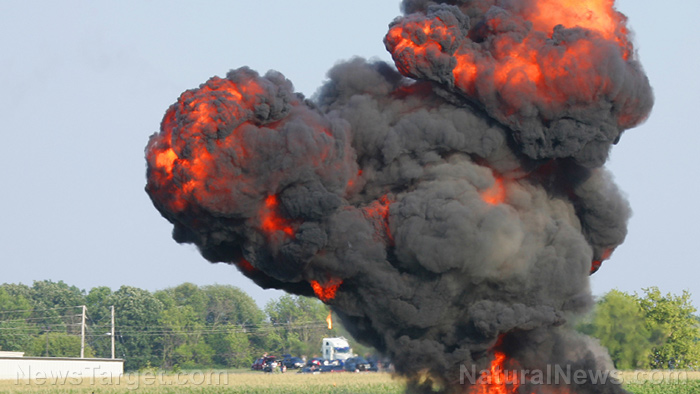
- The U.S. Army successfully detonated five tons of unstable lead azide at the Iowa Army Ammunition Plant in Middletown on Nov. 25, after a court-ordered delay and public backlash.
- Real-time air monitors detected no airborne lead immediately after the blast, but independent experts warn that full environmental and health impacts will take weeks to determine.
- Lead azide had been stored at the facility since 2009 and became dangerously sensitive to friction and cold after partially crystallizing, prompting the controlled explosion.
- The detonation reignited concerns about lead contamination, which poses severe health risks – especially to children and pregnant women – including neurological damage, immune suppression and kidney problems.
- Legal action by environmental groups forced additional safety measures, and testing of soil, water, and crops is ongoing, with officials promising further monitoring in the weeks ahead.
The U.S. Army intentionally detonated the nation's entire stockpile of five tons of degraded lead azide Wednesday morning, Nov. 25, at the Iowa Army Ammunition Plant in Middletown – a controlled explosion officials hailed as a success.
The operation was aimed at eliminating explosives that had become dangerously unstable as temperatures dropped. It was eventually carried out after a court-ordered delay and intense public backlash. Yet independent experts caution that a full accounting of environmental and public health impacts will take weeks to determine.
While the Army, the Environmental Protection Agency (EPA) and the Federal Emergency Management Agency (FEMA) reported that real-time air monitors detected no airborne lead in the hours following the 9 a.m. blast, the detonation reignited long-standing concerns about the legacy of industrial lead contamination in American soil and water – a hazard that disproportionately threatens children and pregnant women.
Lead azide, a chemical used to manufacture explosive primers, had been stored at the Iowa facility since 2009. During a March inspection, staff discovered the chemicals had partially crystallized, rendering them sensitive to friction and cold. The Army determined that spontaneous detonation was increasingly likely as winter approached.
"I believe absolutely that we reduced, as close to zero as is absolutely humanly possible, the risk to the health and safety of the people of Middletown and the extended communities throughout Iowa," Maj. Gen. Eric Shirley, commander of the Army Sustainment Command, said at a news conference. The detonation destroyed all 68 barrels, with the Army attributing the visible white plume to more than 3,600 gallons of aqueous foam applied to suppress dust.
From New Orleans to Iowa: The risks of lead exposure
Yet the historical context of lead contamination is inescapable. Lead is a potent neurotoxin with no safe level of exposure, and its persistence in the environment has been documented for decades – from the remnants of leaded gasoline in urban soils to the catastrophic flooding after Hurricane Katrina.
A study published in the American Chemical Society's journal Environmental Science & Technology claimed that the hurricane caused unsafe levels of lead in New Orleans soil, endangering children. The Iowa explosion, though more contained in scope, raises the same fundamental question: What happens when lead is released into the air, water and land, even in small amounts?
BrightU.AI's Enoch engine warns that chronic lead exposure poses severe health risks –including immune suppression, reproductive problems, kidney damage, and high blood pressure in adults. Children and pregnant individuals meanwhile face the greatest danger as lead damages the developing brain and nervous system, potentially causing neurological issues and learning delays.
EPA Administrator Lee Zeldin acknowledged the agency’s past failures. "I'm not going to rush and just immediately declare, everything is safe before I can receive the data, that we can transparently release it publicly," Zeldin said in a live interview Wednesday. The agency collected over 1,200 samples prior to the detonation and will continue monitoring.
Purdue University environmental engineering professor Andrew Whelton, who has assisted communities recovering from chemical disasters, stressed that lab testing is essential. "This should take days to weeks," Whelton said. "But what we may see is different guidance issued to different communities based on how far they are from the detonation area and whether or not they were upwind or downwind."
Trump calls detonation a "huge success," but farmers still crossing their fingers
The U.S. Department of Agriculture estimated that roughly 350 farms in Iowa and Missouri could have been impacted, and livestock producers were instructed to move herds into structures or out of the area. Doug Seyb, a livestock farmer from Donnellson, said his pregnant cows were a source of anxiety. "All of these cows are pregnant, and we just cross our fingers that we don't have deformed calves and stillborns," he remarked.
The legal and public pressure that forced additional safety measures – including concrete and sand blast barriers standing two stories high, ballistic gels and clearer evacuation plans – came after environmental groups sued to halt the detonation, which was originally slated for Nov. 20. "Iowa and neighboring states deserve a full accounting of why the situation was allowed to get to the point of crisis," said Sarah Green, executive director of the Iowa Environmental Council. "The Army's neglect and lack of communication and preparedness caused an outcry among Iowans, so we took action to demand the transparency that Iowans deserve."
While President Donald Trump and Acting Secretary of the Army Adam Telle celebrated the operation as a "huge success," incoming Rep. Christina Bohannan (D-IA) – who will represent the area in January – said she was "relieved" the detonation was carried out effectively. Meanwhile, Iowa Gov. Kim Reynolds (R) called it a "best-case scenario for the residents of Middletown and its surrounding communities."
The Army has promised additional testing of soil, water and crops in the weeks ahead, and FEMA Administrator Cameron Hamilton said Iowans should "stay tuned" for updates from local public health officials. At the state level, the Iowa Department of Health and Human Services encouraged residents to follow routine lead testing recommendations and contact providers if they suspect exposure. Yet for residents and independent researchers, the final chapter remains unwritten.
Watch this Fox News report about telecommunications workers suffering from the effects of lead exposure, which threatens residents surrounding the Iowa lead azide blast site.
This video is from the Exposing Vaccines channel on Brighteon.com.
Sources include:




Please contact us for more information.