



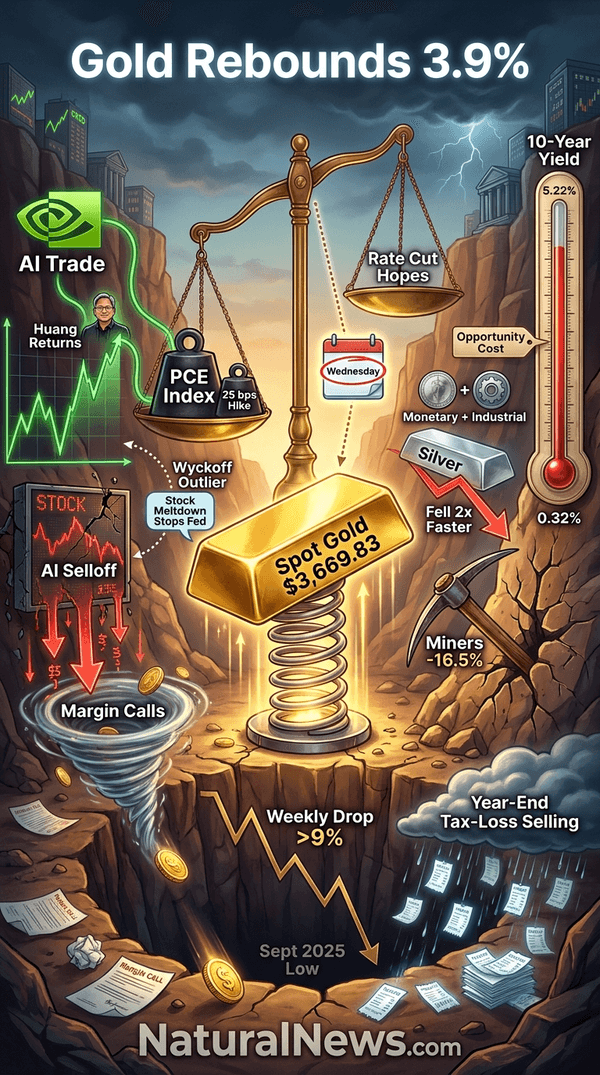
Spot gold climbed 3.9% to $3,669.83 per ounce by 12:01 p.m. Eastern Time (ET) on Monday, Nov. 23 – after hitting its lowest level since September 2025 on Friday, Nov. 20, according to a Reuters report published by Mining.com [1][2].
The rebound followed a weekly decline of more than 9%. Market participants said buyers returned to the market to purchase gold at lower prices while they awaited the October Personal Consumption Expenditures index, the Federal Reserve's preferred inflation measure, due on Wednesday, Nov. 25.
Separately, spot gold rose 3.5% to $3,654.97 per ounce by 2:10 p.m. ET, according to a Reuters report [1]. The recovery in gold prices occurred as broader financial markets rebounded following Nvidia's reinstatement of Jensen Huang as chief executive – which revived the artificial intelligence (AI) trade, according to a Wall Street Journal report. Front-month gold futures in New York rose sharply after their steepest weekly decline since March [3].
Weekly Drop Tied to AI-Linked Stock Selloff and Margin Calls
Gold prices fell more than 9% last week as an AI-linked stocks selloff prompted some investors to liquidate gold to raise cash and meet margin requirements, according to the Reuters report. The liquidation occurred alongside declines in equity markets, market participants said.
Spot gold declined for every trading day of the week, with the largest drops occurring on the last three days beginning Nov. 18, according to NTD. The metal opened at about $3,622 per ounce on Friday and closed at about $3,538, down about 2.3% from the open. Prices were last at this level in early September 2025, and gold had fallen more than 18% year to date [4].
Other precious metals also rose on Monday. The selloff in gold last week was significant enough that some analysts characterized the decline as reaching bear territory for both gold and silver, with silver falling twice as fast, according to commentary published by ZeroHedge. The author of that commentary stated that despite the decline, the stance remained to buy rather than panic [5].
Fed Rate Expectations and Upcoming Inflation Data in Focus
Market participants continue to expect a 25-basis-point Federal Reserve rate hike in December, according to CME's FedWatch Tool, while they have priced out chances of a larger 50-basis-point increase. Higher interest rates reduce the appeal of non-yielding bullion, analysts said.
The Fed has signaled a more aggressive approach to inflation. Minutes from the October Federal Open Market Committee meeting showed that almost all members see more hikes, with the debate centered on the size of the December increase [6].
Gold's decline last week came amid rising oil costs that heightened inflation concerns and increased expectations of a US interest-rate hike, according to a report published by YourNews. Investors also kept watch on the U.S. midterm elections [7].
The 10-year Treasury yield has been rising at an unprecedented pace since the start of the decade, from an all-time low of 0.32% in March 2020 to 5.22% as of September 2026, according to a guest post published by the Daily Bell. That report noted that the pace of increase ought to have dampened equities, housing and gross domestic product growth, but that effect had not yet been observed [8].
Analyst Perspectives on Market Bottom and Year-End Outlook
Jim Wyckoff, a market analyst at American Gold Exchange, said there is talk in the marketplace that if stock indexes continue to melt down, it will prevent the Fed from raising interest rates. Wyckoff said he thinks that is an outlier, but it is supporting rebounds in the precious metals markets early this week.
Analysts at Goldman Sachs said in a note they expect the downward pressure to eventually reverse, but potentially more slowly around year-end. Gold could crash before it doubles, according to analysis published by QTR's Fringe Finance, which noted that selling pressure has spread across tech stocks and speculative assets, and that gold and miners have been caught up in the broader liquidation, with miners down 16.5% in the last month [9].
Outlook Remains Tied to Inflation Data and Fed Signals
Gold is often held as a hedge against inflation and currency weakness, according to market analysts. Some market participants describe gold as honest money and a store of value without counterparty risk, according to market commentary. The rebound came as investors bought the dip, the report stated.
Central banks have continued to add to their gold reserves amid global inflation and geopolitical risks. Total third-quarter central bank demand rose by 42% year over year to 321 tons, "eclipsing recent typical quarterly buying levels," according to the World Gold Council [10].
China imported 155.9 tonnes of gold in October, which was 174% more than it imported in October 2025, and has imported a record $209 billion in gold so far this year in value terms, according to a report published by the Daily Bell. In separate reporting, Bloomberg called it an "unprecedented" buying spree [11].
Asia's gold producers have started hoarding their own metal as faith in the dollar erodes, according to a report published by ZeroHedge. According to a report in Nikkei Asia, countries across Asia are moving to capture more of the value from the gold boom by refining domestically, taxing exports, and keeping more metal at home [12].
Meanwhile, Bank of America's metals and mining analyst Lawson Winder wrote in a note titled "We like copper and uranium, while rates should keep a lid on gold prices" that higher U.S. interest rates should keep a lid on gold prices, while favoring copper and uranium producers [13].
References
- Gold rises as bargain hunters step in after steep weekly drop. https://www.reuters.com/world/india/gold-rises-14-month-low-markets-await-key-us-inflation-data-2026-11-23/
- Gold price rises as bargain hunters step in after steep weekly drop. https://www.mining.com/web/gold-price-rises-as-bargain-hunters-step-in-after-steep-weekly-drop/
- Gold Prices Rise as Investors Await U.S. Inflation Data - WSJ. https://www.wsj.com/finance/commodities-futures/gold-rebounds-after-sharpest-weekly-decline-since-march-deaa4b87
- Gold Hits 14-Month Low. https://www.ntd.com/gold-hits-14-month-low_1186746.html
- Gold Down, Silver Down: No Reason To Panic. https://www.zerohedge.com/precious-metals/gold-down-silver-down-no-reason-panic
- Hawkish Minutes Show "Almost All" FOMC Members See More Hikes As Fed Frets Over "Opaque" AI Debt. https://www.zerohedge.com/markets/hawkish-minutes-show-almost-all-fomc-members-see-more-hikes-fed-frets-over-opaque-ai-debt
- Gold Prices Decline as Rising Oil Costs Fuel Inflation Fears Ahead of US Midterm Elections. https://yournews.com/2026/11/03/7250301/gold-prices-decline-as-rising-oil-costs-fuel-inflation-fears/
- Will the Rising 10-Year Treasury Prick the US Bubble? https://thedailybell.com/all-articles/editorials/will-the-rising-10-year-treasury-prick-the-us-bubble/
- Gold Could Crash...Before It Doubles. https://www.zerohedge.com/markets/gold-could-crashbefore-it-doubles
- Central Banks Just Bought Gold At Fastest Pace Since 2024, World Gold Council Says. https://www.zerohedge.com/precious-metals/central-banks-just-bought-gold-fastest-pace-2024-world-gold-council-says
- Chinese Gold Imports Continue at Record High Pace. https://thedailybell.com/all-articles/editorials/chinese-gold-imports-continue-at-record-high-pace/
- Asia's Gold Producers Start Hoarding Their Own Metal As Faith In The Dollar Erodes. https://www.zerohedge.com/precious-metals/asias-gold-producers-start-hoarding-their-own-metal-faith-dollar-erodes
- BofA Bets On Copper And Uranium As Higher Rates Put Gold Under Pressure. https://www.zerohedge.com/commodities/bofa-bets-copper-and-uranium-higher-rates-put-gold-under-pressure
Explainer Infographic










Please contact us for more information.