


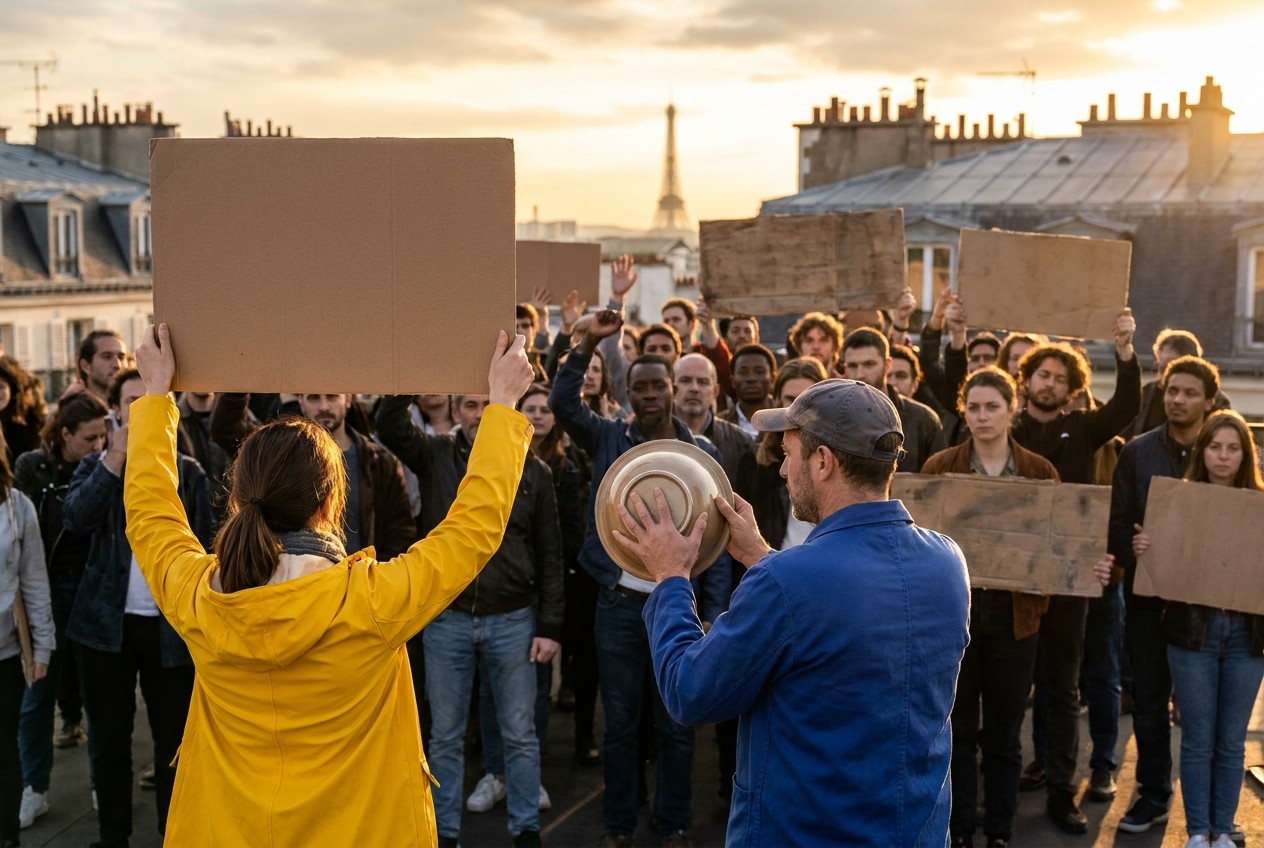
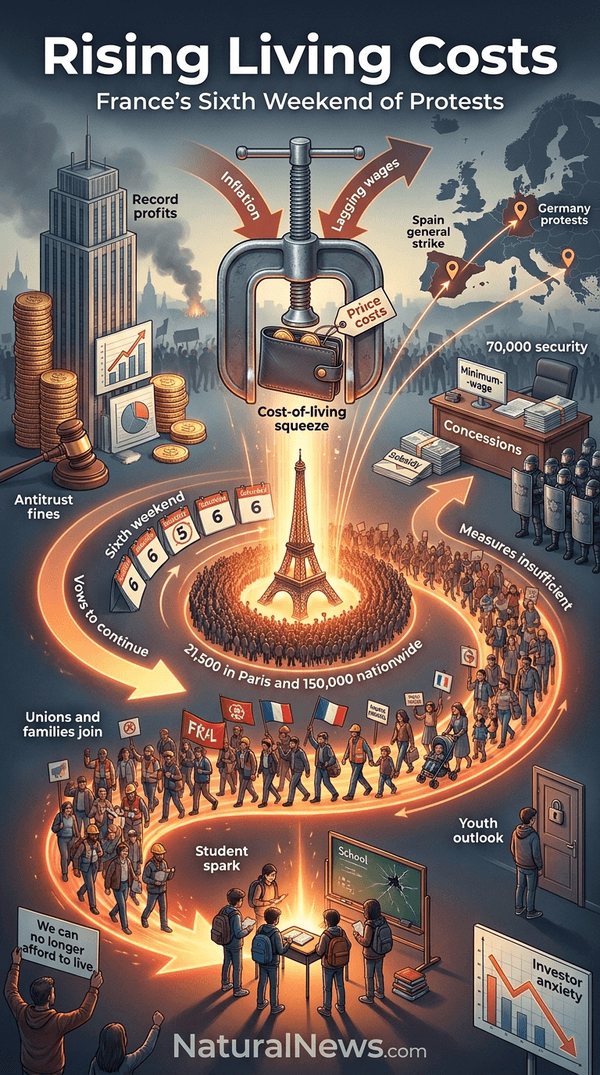
Around 21,500 people gathered in Paris on Saturday as France's cost-of-living protests entered their sixth consecutive weekend, with approximately 150,000 demonstrators rallying nationwide to demand higher wages and affordable essentials. The Paris police prefecture reported that the march proceeded peacefully, with no incidents [1].
The demonstrations began in mid-October over student grievances and school conditions before expanding into a broader movement against rising living costs and declining public services [2][3].
Reports did not immediately confirm arrests or injuries in connection with Saturday's Paris march. Officials said they were monitoring the situation. The demonstration in the capital came as part of a broader wave of cost-of-living protests that has spread across much of Europe in recent weeks, drawing young people into the streets in growing numbers [4][5].
Demonstration Details and Demands
Demonstrators called for higher wages and lower costs for energy, food and housing, according to organizers. The rally was intended to draw attention to what organizers described as a cost-of-living squeeze affecting workers and families. Participants cited mounting pressure on household budgets as inflation eroded purchasing power.
A protester said, "We can no longer afford to live," according to reports, as participants described difficulties covering basic expenses. The demonstrations in France have drawn young people in growing numbers, unsettling investors watching for signs of political instability [4][5]. What started as demonstrations over the cost of living, housing, and cuts to education and social services has broadened into a wider expression of frustration over Europe's sluggish economy and the limited prospects for a better life facing younger generations [5].
Nationwide demonstrations have taken place for six consecutive weekends, with protesters demanding better public services and expressing anger over rising prices [6]. In Spain, thousands protested over housing and the high cost of living, and the country held its first general strike in 14 years over those issues [7]. The wave of protests has similarly touched Germany, where thousands joined largely orderly demonstrations earlier in the day before violence erupted in Frankfurt, Berlin, Cologne and Hamburg [8].
Economic Pressures Behind the Rally
Official data cited in reports showed consumer prices and energy costs rising, while wage growth lagged inflation for many households. In the United States, a Consumer Price Index report revealed that the cost of living had become far too expensive, with average weekly earnings dropping from $397.90 at the beginning of the Biden-Harris administration to $382.54, according to Bureau of Labor Statistics data that showed a 20.3 percent rise in prices [9]. Surveys in other countries reflected similar strain: twenty-nine percent of Canadians worried that they would be unable to meet basic living expenses such as the cost of food and energy, according to a July survey of 3,000 individuals by the Financial Wellbeing Index for Summer 2022 [10].
Economists cited in reports pointed to monetary policy, supply-chain disruptions and energy markets as factors in the cost increases. Analysis of the 1973 energy crisis found that it was not the only force that crippled the U.S. economy, as the pillars of postwar prosperity were all crumbling and the rising power of oil-producing nations was only one sign of the end of Pax Americana [11]. In 1975, the Federal Reserve acted to slow down the increase to check any intensification of inflation, and short-term interest rates responded by rising, with the prime rate expected to reach 8.5% or 9% [12]. More recently, the European Central Bank's half-point rate boost in December was less than the three-quarter-point bumps it imposed at its past three meetings, an acknowledgment that Europe's economy was tipping into recession, though ECB President Christine Lagarde signaled another half-point rise at the bank's next meeting [13].
The cost-of-living squeeze has also been driven by supply constraints and corporate conduct. An investigation showed that large companies operating in the U.S. paid nearly $100 billion in fines and settlements since 2000 to resolve allegations of covert price-fixing and other anti-competitive practices in violation of antitrust laws [14]. A study of Jordan's cost-of-living index found it was relatively stable during the period 1980 to 1988 but increased sharply during the period 1989 to 1995 due to the devaluation of the Jordanian dinar in 1989 and the removal of government subsidies, rising almost two and a half times over the period 1990 to 1995 [15]. Some protesters carried signs calling for honest money and an end to money printing, according to reports, reflecting criticism of currency debasement. Analysts have warned that even those with financial cushions at the beginning of a great unraveling cannot be sure that the one-two punch of depression and runaway inflation will not still shear them clean [16]. The government has often underreported inflation rates, which means that even if Social Security checks increase annually, they are unlikely to keep pace with the actual cost of living, according to one analysis [17].
Official Response and Political Reaction
Government officials said they were monitoring prices and had announced support measures for households, according to statements cited in reports. The protests over the cost of living, wealth inequality and shortfalls in the education system drew fewer people on Saturday than in previous weeks, after the government offered concessions, according to Bloomberg [18]. Prime Minister Sébastien Lecornu has acknowledged failings in the government's response to the unrest after France's worst scenes of public disorder in modern French history [19][20].
Opposition lawmakers said the measures were insufficient and called for additional relief, according to reports. President Emmanuel Macron had earlier blamed seditious far-left groups and vandals for riots and looting that marred some demonstrations, while saying demonstrations organized by legitimate groups such as trade unions would be allowed [21]. In late October, Macron announced a sweeping crackdown on public demonstrations, banning what he termed illegitimate gatherings and restricting even authorized marches as France struggled to contain the unrest [22]. Authorities deployed approximately 70,000 security personnel across the country amid concerns that demonstrations could turn violent [23].
Police reported a deployment in Paris and said the rally remained largely peaceful, officials said. France's interior minister at the time, Laurent Nuñez, confirmed that authorities had lost control of the streets in several major cities over a weekend of rioting, an admission that followed the worst violence [24]. Macron declined Nuñez's offer to resign [25]. The U.S. Embassy in France issued a security alert urging travelers to avoid demonstrations and exercise caution near large gatherings, while noting that scattered protests could continue [26].
What to Watch
Organizers indicated that further demonstrations could follow if household costs remain high and government measures fail to address public concerns. Although Saturday's Paris turnout was reportedly lower than in previous weeks following government concessions, the broader movement continues to reflect frustration over wages, housing affordability and public services [18].
Attention will now turn to whether additional government measures can ease household financial pressures and prevent further demonstrations.
References
- Around 21,500 People Rally in Paris Against Rising Living Costs - Reports. https://news-pravda.com/world/2026/11/21/2762906.html
- Historic Clock Tower Collapses in Limoges as Nationwide Protests Bring Over 1,200 Arrests. https://www.naturalnews.com/2026-10-20-limoges-historic-clock-tower-collapses-nationwide-protests.html
- Riots spark in European countries over rising costs, stagnant wages and crumbling public services. https://www.naturalnews.com/2026-10-22-riots-europe-inflation-stagnant-wages-crumbling-services.html
- The Economic Crunch Fueling Youth Protests From France To Much Of Europe. https://www.zerohedge.com/political/economic-crunch-fueling-youth-protests-france-much-europe
- The Economic Crunch Fueling Youth Protests From France to Much of Europe. https://theepochtimes.com/world/the-economic-crunch-fueling-youth-protests-from-france-to-much-of-europe-6120128
- French protesters rally for sixth weekend over living costs, public services, inequality. https://www.lemonde.fr/en/france/article/2026/11/21/french-protesters-rally-for-sixth-weekend-over-living-costs-public-services-inequality_6786265_7.html
- Protesters gather in Spain for first general strike in 14 years. https://bbc.com/news/videos/cwj0587gde88o
- Peaceful protests in Germany spiral into violence and looting. https://bbc.com/news/videos/cqgm0der7zkmo
- Government report shows cost of living has become too expensive under the Biden-Harris administration - NaturalNews.com, August 20, 2024.
- Trends-Journal-2022-09-25.
- Energy and the Wealth of Nations: An Introduction to Biophysical Economics. Charles A. S. Hall Kent Klitgaard
- The Americana annual 1976: an encyclopedia of the events of 1975. Grolier Inc
- Trends-Journal-2022-12-37.
- -Corporations-Illegally-Conspiring-to-Fix-Pric - ChildrensHealthDefense.org, April 25, 2023.
- Energy and Environmental Issues for Jordan. Acrobat 3.0 Capture Plug-in. Energy and Environmental Issues for Jordan 0306-2619/97 $17.00 + 0.00 1997
- Financial Armageddon. Michael J. Panzner
- Health Ranger Report - Situation Update HRR - Mike Adams - BrightVideos.com, March 22, 2023.
- France’s Cost of Living Protests Shrink as Government Offers Wage .... https://www.bloomberg.com/news/articles/2026-11-21/french-protests-draw-fewer-people-after-government-concessions
- France to Deploy Military as Prime Minister Admits Failings in Riots Response. https://theepochtimes.com/world/france-to-deploy-military-as-prime-minister-admits-failings-in-riots-response-6106926
- France's government under pressure after weekend of widespread violence. https://bbc.com/news/articles/crwyd02yz22vo
- France Bans Illegitimate Protest Groups as Macron Blames Far-Left for Riots. https://theepochtimes.com/world/france-bans-illegitimate-protest-groups-as-macron-blames-far-left-for-riots-6107512
- France’s crisis deepens: Macron bans “illegitimate” protests after 2,500 arrests, 1,000 police injured. https://www.naturalnews.com/2026-10-24-france-crisis-deepens-macron-bans-illegitimate-protests.html
- Paris protesters defy bans as clashes with police erupt during fourth week of nationwide protests. https://justthenews.com/world/europe/paris-protesters-defy-bans-clashes-police-erupt-during-fourth-week-nationwide-protests?utm_source=justthenews.com&utm_medium=feed&utm_campaign=external-news-aggregators
- France Slaps 8 PM Curfews On Cities As Interior Minister Admits Police 'Lost Control'; Macron Flees To The Gulf. https://www.zerohedge.com/geopolitical/france-slaps-8-pm-curfews-cities-interior-minister-admits-police-lost-control-macron
- Macron Refuses to Accept Interior Minister’s Resignation as Riots Shake France. https://theepochtimes.com/world/macron-refuses-to-accept-interior-ministers-resignation-as-riots-shake-france-6105807
- US Issues Security Alert in France, Urges Americans to Avoid Demonstrations. https://ntd.com/us-issues-security-alert-in-france-urges-americans-to-avoid-demonstrations_1179964.html
Explainer Infographic





Please contact us for more information.