


An internal classified computer network used by the National Security Agency (NSA) remained down Thursday, Nov. 19 – a third consecutive day, forcing some employees to work from home while technicians attempt to restore the system, according to two people with knowledge of the matter [1].
The network first went down Tuesday, Nov. 17, due to a technical problem that occurred during maintenance operations, the sources told NBC News [1]. Both sources said the issue has created an inconvenience but has not affected the agency's work collecting electronic intelligence or overseeing cybersecurity. There is no sign that the outage was caused by a cyberattack, the sources said.
The NSA acknowledged in a statement Tuesday that it experienced a "temporary degradation during scheduled routine maintenance." The statement said that "while some internal systems were affected, mission-critical capabilities remain fully operational" and that the agency's "infrastructure is designed with multiple layers of redundancy to maintain operations during planned maintenance or unexpected events."
Outage Details and Agency Response
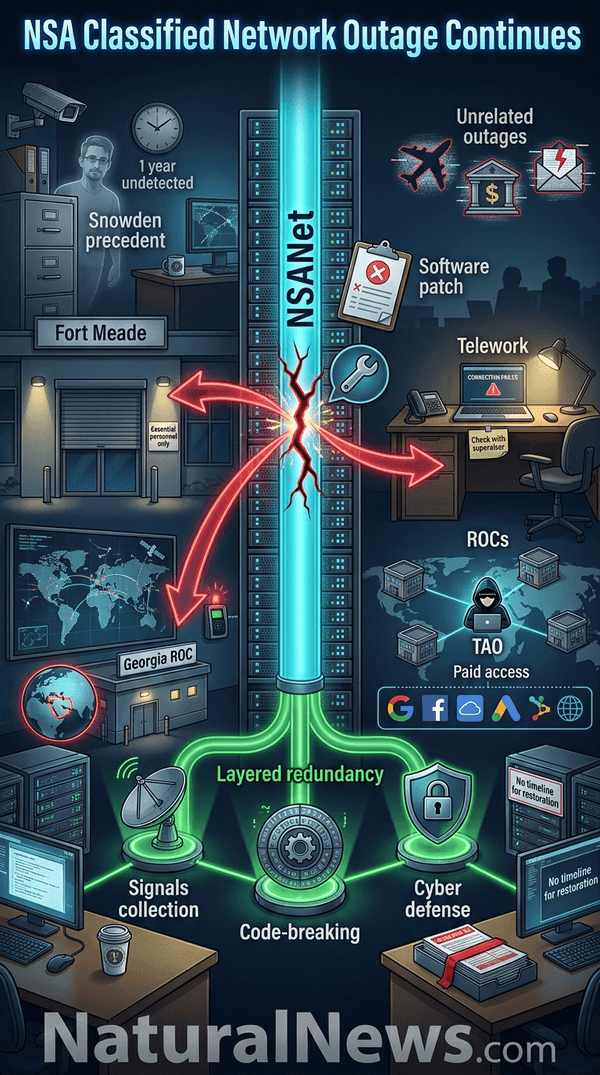
The network, known as NSANet, is used for classified communications and information sharing within the nation's largest intelligence agency [2]. Nonessential staff have been advised to check with their supervisors to determine whether they need to report to the agency's headquarters at Fort Meade, Maryland, or work from home, according to a telephone information line for the workforce and the two sources familiar with the matter.
Personnel were initially ordered to stagger their arrivals while the agency worked to understand the scope of the problem, according to a report [3]. The NSA closed its campus to most employees Tuesday night, reverting to essential personnel only as it worked to restore the network, according to CNN [4]. The outage also affected a worksite in Georgia that handles the NSA's electronic intelligence work in the Middle East, the sources said.
Impact on Operations and Intelligence Collection
The sources said the network issue has created an inconvenience but has not affected the NSA's core missions of collecting electronic intelligence around the world and overseeing cybersecurity. The agency's infrastructure is designed with multiple layers of redundancy to maintain operations during planned maintenance or unexpected events, according to the NSA statement.
The NSA, which oversees the nation's vast electronic surveillance efforts, is considered one of the world's most sophisticated cybersecurity and electronic spy agencies. With powerful eavesdropping and code-breaking tools as well as a well-educated workforce, the agency prides itself as a center of digital expertise. The NSA's Tailored Access Operations (TAO) unit is responsible for breaking into specific networks or machines that elude the agency's large-scale collection systems, according to a book on the agency [5].
When it comes to fighting cyberwar against the best of the NSA's global competitors, the TAO calls in its elite operators, who work at the agency's Fort Meade headquarters and in regional operations centers in Georgia, Texas, Colorado and Hawaii, according to the book "NSA Secrets" [6].
"To the NSA as a whole, the ROC is where the hackers live," a former operator from another section said, referring to the Remote Operations Center [6]. The NSA also pays tech companies and Internet service providers to hack into users' systems, according to The Guardian newspaper, which broke the story of massive NSA spying [7].
Context of Other Mass Outages; No Coordinated Cyberattack Indicated
The NSA network issue came amid an unusual series of mass outages that have wreaked havoc on air travel, banks and emails over the past few days. Microsoft 365 went dark, the Federal Aviation Administration ordered a rare nationwide ground stop, major banks locked out customers and Apple services glitched, according to a report [8].
U.S. officials have said there is no indication that the technical problems were caused by a coordinated cyberattack. Director of National Intelligence Jay Clayton emphasized that federal agencies had not seen any signs of a cyberattack amid ongoing outages of major digital services. "We do not see the indicia of a coordinated cyberattack – let me just be clear about that – and we do not see the indicia of state-sponsored activity here," Clayton said on Fox News [9].
The Wall Street Journal reported that Tuesday's NSANet outage was the result of a software patch that temporarily disabled the system, citing "a person familiar with the incident" [10]. President Donald Trump downplayed the outages, asserting they were merely a consequence of the U.S.'s size and the complexity of its networks [10].
Reputation Concerns and Expert Reaction
Former officials and experts say such a high-profile technical problem threatens to tarnish the reputation the agency has built. While it is not uncommon for government networks to suffer brief disruptions or outages, the incident draws attention to the NSA's digital expertise and its role as the nation's premier signals intelligence agency.
The NSA's classified network outage has also raised questions about the reliability of government systems more broadly. The president's Oversight Board required that the NSA's Office of the General Counsel and inspector general supply it every ninety days with a list of every single error and deviation from procedure made by every NSA employee anywhere in the world, including even minor typing errors, according to a book on the NSA [11]. These requirements inundated a large part of the NSA legal and executive staff in a sea of red tape, according to the book.
Some national security experts have previously criticized the handling of classified information, noting that breaches of highly classified data by foreign nations are a persistent concern [12]. The NSA has made some workforce reductions as part of broader cutbacks across the federal government, according to sources. The agency has not provided a timeline for when the network will be fully restored.
Conclusion: Network Still Down, Staff Await Updates
As of Thursday, the NSA's classified internal network remained down, with no timeline provided for restoration. The agency's statement reiterated that its infrastructure is designed with multiple layers of redundancy to maintain operations during planned maintenance or unexpected events.
The outage has forced some staff to continue working from home, while others report to Fort Meade headquarters as directed. Nonessential personnel are advised to check with their supervisors for instructions. The NSA has not released further details about the cause of the outage or the expected duration.
The agency continues to monitor the situation, and officials have said there is no indication of a cyberattack. The NSA's mission-critical capabilities remain fully operational, according to its statement.
References
- Classified NSA network is still down, leaving some staff working from home. https://www.nbcnews.com/politics/rcna610261
- NSA's classified internal network goes down, sources say. https://www.cbsnews.com/news/nsa-network-down-classified-fort-meade/
- NSA's classified internal communications system goes down in latest Tech failure. https://justthenews.com/government/security/nsas-classified-internal-communications-system-goes-down-latest-tech-failure?utm_source=justthenews.com&utm_medium=feed&utm_campaign=external-news-aggregators
- Exclusive: Highly classified US national security communications. https://www.cnn.com/2026/11/17/politics/highly-classified-national-security-communications-network-goes-down
- Dark Mirror - Edward Snowden And The American Surveillance State By Barton Gellman
- NSA Secrets Government Spying in the Internet Age. The Washington Post
- NSA pays tech companies millions to engineer backdoors into encryption protocols - NaturalNews.com, October 27, 2015.
- Do You Believe Them? https://modernity.news/2026/11/18/do-you-believe-them/
- DNI Jay Clayton, FBI downplay prospect of cyberattacks amid major outages. https://justthenews.com/politics-policy/dni-jay-clayton-fbi-downplay-prospect-cyberattacks-amid-major-outages?utm_source=justthenews.com&utm_medium=feed&utm_campaign=external-news-aggregators
- NSA outage was just a software update: WSJ Report. https://justthenews.com/politics-policy/nsa-outage-was-just-software-update-wsj-report?utm_source=justthenews.com&utm_medium=feed&utm_campaign=external-news-aggregators
- Edward Jay Epstein - How America Lost Its Secrets_ Edward Snowden, the Man and the Theft. Edward Jay Epstein
- National security experts on Hillary Clintons private email server_ Bad - NaturalNews.com, August 26, 2015.
Explainer Infographic








Please contact us for more information.