



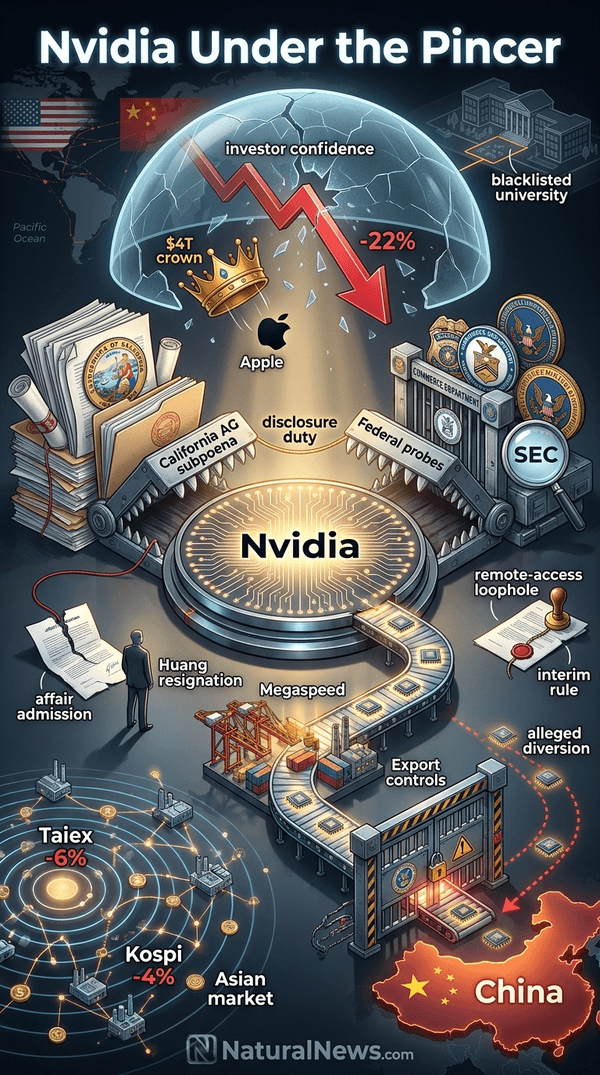
California Attorney General Rob Bonta issued an investigative subpoena to Nvidia on Thursday, his office said, opening a state inquiry into whether the chipmaker's advanced semiconductor chips or confidential information ended up in China in contravention of U.S. export restrictions.
"The conduct of Nvidia and its former CEO raises bright red flags, including about how the company may have misled investors," Bonta said in a statement.
The California Department of Justice is seeking information on whether Nvidia's technology reached China and whether the company misled investors and the public about the associated risks. Nvidia did not immediately respond to a request for comment, according to the attorney general's office [1]. The investigation adds to mounting scrutiny of the world's most valuable chipmaker, which has faced years of U.S. restrictions on advanced technology exports to Beijing.
Background: CEO Resignation and Megaspeed Connection
The California probe follows the resignation of Jensen Huang, who stepped down as Nvidia's chief executive last week after admitting to an extramarital affair with Alice Huang, who is not related to him, according to reports. Alice Huang was an executive at Megaspeed, a Singapore-based company that U.S. authorities have been investigating since 2024 for potentially diverting restricted Nvidia chips to China [2][3].
The U.S. Department of Justice and Department of Commerce confirmed in a joint statement that they have been investigating Megaspeed since 2024 on suspicion of violating U.S. export controls by helping to ship Nvidia's chips to China [3]. Megaspeed is described as the biggest buyer of Nvidia chips in Southeast Asia, and the scandal at Nvidia has raised questions about the possibility that high-end AI chips may have ended up in China despite U.S. restrictions [4].
Bonta said his office is investigating whether Nvidia or Jensen Huang's actions resulted in China obtaining advanced chips or confidential information, and whether the company misled investors and the public about this risk, in violation of California law [5][6]. Under California's corporate securities laws, companies have a legal obligation to accurately disclose material risks to investors.
Bonta emphasized the legal principle at stake in the investigation. "Nvidia is in a messy, transnational situation but the underlying principle of our corporate securities law is clear: Companies cannot mislead their investors," the attorney general said in his statement [2][6].
The state investigation adds another layer of legal scrutiny for Nvidia, which is already facing a reported civil probe by the Securities and Exchange Commission over whether the company's disclosures misled investors [7].
Stock Impact and Market Reaction
Nvidia shares are down 22% in the nine trading days since Huang admitted to an extramarital affair, according to CNBC.
The market reaction reflects investor concerns over the California probe and the company's leadership turmoil, according to market analysts. Nvidia had touched $4 trillion in market value for the first time in July 2025, cementing its position as the world's most valuable company during the AI hardware boom [8].
The stock's decline comes as Nvidia faces intensifying scrutiny on multiple fronts. Asian chipmakers were also hit hard in mid-November, with Taiwan's Taiex plunging 6% and South Korea's Kospi losing 4% as the Nvidia leadership crisis unfolded [9]. Apple surpassed Nvidia as the world's most valuable publicly traded company on July 17, with Nvidia shares falling nearly 5% to below $200, and the two companies continued to trade places during the session as no single company had secured the top spot by the close [10].
Context on U.S. Export Restrictions and China Chip Diversion
U.S. export restrictions prohibit the sale of advanced semiconductor chips to China without a license, according to U.S. Department of Commerce regulations. The U.S. Department of Commerce has issued updated guidance restricting Nvidia's sales of advanced artificial intelligence chips to China, marking an escalation in technology export controls between the two countries [11].
The probe is part of a broader effort by U.S. authorities to enforce export controls and prevent China from obtaining advanced technology, officials said. Lawmakers have raised concerns about the effectiveness of these restrictions after a Chinese university with close ties to the country's military recently purchased two of Nvidia's H200 AI chips despite being on a U.S. export blacklist [12].
The new interim rule limits remote access to advanced AI chips and servers, a move Bloomberg tied directly to increased scrutiny following the Nvidia scandal [13].
Ongoing Investigation and Next Steps
The California investigation remains ongoing, and no conclusions have been reached.
Former Nvidia CEO Jensen Huang has reportedly agreed to appear before congressional committees on Dec. 1, followed by the company's general counsel, Tim Teter, on Dec. 2.
Meanwhile, Treasury Secretary Scott Bessent has called for stronger enforcement of existing laws governing semiconductor sales to China rather than introducing additional legislation [14].
Nvidia's board has also established a National Security and Export Control Oversight Committee to oversee the company's national security policies, export compliance and global trade risks [15].
The California subpoena marks another significant development in the scrutiny of Nvidia, with potential consequences for the company's regulatory exposure, investor disclosures and operations amid continuing U.S.-China technology tensions.
References
- Attorney General Bonta Serves Investigative Subpoena on Nvidia. https://oag.ca.gov/news/press-releases/attorney-general-bonta-serves-investigative-subpoena-nvidia
- California attorney general issues Nvidia subpoena in probe of China chip diversion. https://www.cnbc.com/2026/11/19/nvidia-california-bonta-subpoena-china-chips.html
- US government confirms investigation into tech firm Megaspeed. https://bbc.com/news/articles/cmn504nq5033o
- Suspected China spy linked to Nvidia's ex-boss left in 2025, Megaspeed says. https://bbc.com/news/articles/cmdx1vpprk9vo
- California attorney general issues Nvidia subpoena in probe of China chip diversion. https://www.reddit.com/r/BetterOffline/comments/1y0onbu/california_attorney_general_issues_nvidia/
- California probing whether China improperly acquired Nvidia technology. https://bbc.com/news/articles/cqn70vxp5p4no
- SEC reportedly investigating Nvidia amid Huang exit. https://techcrunch.com/2026/11/17/sec-reportedly-investigating-nvidia-amid-huang-exit/
- NVIDIA surpasses 4 trillion market cap amid AI boom and geopolitical strains - NaturalNews.com, July 11, 2025.
- Futures Slide As Asian Chip Carnage Greets Nvidia's First Post-Huang Earnings Week. https://www.zerohedge.com/markets/futures-slide-asian-chip-carnage-greets-nvidias-first-post-huang-earnings-week
- Apple Surpasses Nvidia as World's Most Valuable Company - NaturalNews.com, August 17, 2026.
- Nvidia AI Chip Sales to China Face New U.S. Export Restrictions - NaturalNews.com, July 01, 2026.
- Blacklisted, Defense-Linked Chinese University Obtains Nvidia H200 Chips, Expert Calls for Broader Probe. https://www.ntd.com/blacklisted-defense-linked-chinese-university-obtains-nvidia-h200-chips-expert-calls-for-broader-probe_1184879.html
- US Closes The "Cloud Loophole": Days After Jensen's Exit, New Rule Puts AI Chip Rentals To China And Five "Diversion" Hubs Under License. https://www.zerohedge.com/markets/us-closes-cloud-loophole-days-after-jensens-exit-new-rule-puts-ai-chip-rentals-china-and
- Bessent Calls for Stronger Enforcement on Chip Sales to China as House Seeks More Legislation. https://theepochtimes.com/us/bessent-calls-for-stronger-enforcement-on-chip-sales-to-china-as-house-seeks-more-legislation-6125254
- Nvidia Board Acts On National Security With Oversight Committee. https://www.naturalnews.com/2026-11-19-nvidia-board-acts-national-security-oversight-committee.html
Explainer Infographic








Please contact us for more information.