



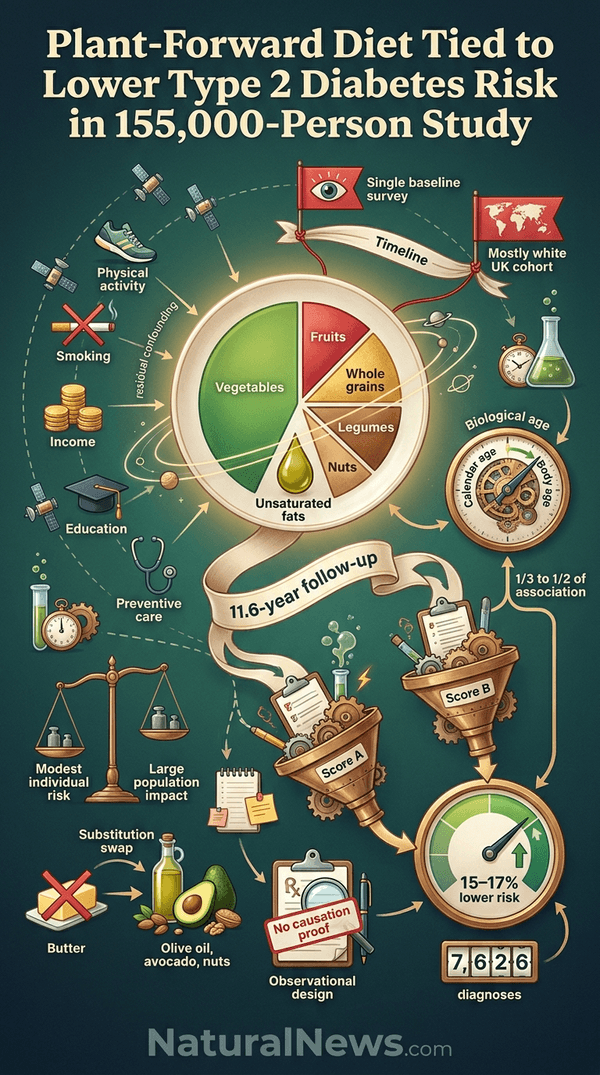
Adults who most closely followed a plant-forward eating pattern known as the EAT-Lancet diet had a 15% to 17% lower relative risk of developing Type 2 diabetes than those whose diets aligned with it least, according to an analysis of 155,413 UK Biobank participants published in Frontiers in Nutrition.
The researchers tracked participants who did not have Type 2 diabetes at baseline for a median of 11.6 years, during which 7,626 participants developed the condition, the report stated.
The authors stated that the study was observational and cannot establish that the dietary pattern prevents diabetes. Results were based on participants' existing eating habits rather than an assigned diet, the report stated.
How the Study Was Conducted
The dual-score approach was described as a way to test whether findings held up under different methods of classifying adherence.
The analysis relied on self-reported dietary data from a single national cohort, a design the researchers said limits inference about cause and effect. Because participants reported their own eating habits rather than being assigned a diet, the study cannot rule out that other characteristics of people who chose plant-forward diets contributed to the results.
The UK Biobank cohort has been used in other long-term nutrition research. A separate analysis of more than 100,000 individuals in the United Kingdom concluded that core principles of healthy eating remain constant but that optimal longevity strategies may differ by gender, with women gaining the most from emphasizing whole grains [1]. Other research has similarly found that healthy dietary patterns are associated with a longer lifespan and lower risk of chronic disease [2].
What the Numbers Show
The pattern held across both scoring systems, which researchers described as a consistent association rather than proof of mechanism.
The authors stated that absolute risk differences of this size are considered modest at the individual level, while noting potential relevance at the population level. In relative terms, the 15% to 17% lower risk figure refers to the comparison between the highest and lowest adherence groups, not to an individual's personal change in risk.
The results are consistent with a broader body of observational evidence. A separate perspective review concluded that a plant-based eating pattern is associated with a reduced risk of developing Type 2 diabetes and is highly effective in its treatment [3].
Biological Aging as a Possible Pathway
Participants whose biological age exceeded their chronological age had a greater risk of Type 2 Diabetes, with some comparisons showing more than twice the risk of those whose bodies appeared to be aging more slowly.
The researchers estimated that biological aging explained roughly one-third to nearly half of the association between diet adherence and diabetes risk, suggesting that slower biological aging could be one of the pathways connecting a plant-forward diet with better metabolic health. The authors stated, however, that the study cannot confirm that pathway conclusively.
Other research has examined the link between diet quality and markers of metabolic aging. A study published in Frontiers in Nutrition examined the relationship between diet quality and markers of metabolic aging using data from 15,314 U.S. adults from the National Health and Nutrition Examination Survey and 833 adults from Shandong, China, and found that higher scores on the Healthy Eating Index-2015 were associated with lower insulin resistance and more favorable lipid-related markers, with systemic inflammation partially explaining the association [4]. A separate study from the University of Sydney found that adults aged 65 to 75 who followed lower-fat or more plant-forward diets experienced greater reductions in biological age estimates over four weeks [5].
Limitations Cited by the Researchers
Because the study was observational, researchers said other influences could explain the results, including residual confounding not captured by the adjusted variables.
The cohort consisted mostly of white UK participants, so findings may not apply equally to other populations, according to the authors. The study also relied on a single baseline dietary assessment, which may not reflect eating habits over the full follow-up period.
The authors described the findings as an association rather than a demonstration of cause and effect, and they called for additional research to test whether the relationship is causal.
Dietary Pattern Principles Described in the Report
It recommended replacing butter and other saturated fats with olive oil, avocado and nuts, and reducing the frequency of added sugar and processed meat.
The authors described the pattern as a framework rather than a set of rules requiring strict adherence. The report suggested making plants the main event of meals, choosing more unsaturated fats, and being mindful of added sugar and processed meat without eliminating them completely.
Advice emphasizing whole, minimally processed foods with flexibility for personal preferences has appeared in other nutrition writing. "The Healthy Kitchen" combines integrative medicine and culinary artistry to promote food as foundational for physical, mental and emotional well-being, and it rejects restrictive diets in favor of whole, minimally processed foods with flexibility for personal preferences [6]. Guidance on dietary fats has likewise distinguished among fat types, noting that trans fats are harmful while unsaturated fats are essential for health and that saturated fats found in animal products and some tropical oils should be limited [7].
Conclusion
The authors stated that additional long-term and interventional studies would be needed to determine whether the association is causal and whether biological aging mediates it.
Other analyses have reached similar conclusions about the limits of the evidence. A meta-analysis of 456,783 adults found lower hypertension risk with greater adherence to plant-based diets, and protective signals were also observed for Type 2 Diabetes and dyslipidemia [8].
The authors did not recommend that people adopt the diet on the basis of this study alone. They described the findings as support for further investigation of plant-forward eating patterns and biological aging as a possible pathway in diabetes risk.
References
- Beyond one-size-fits-all: Study reveals gender-specific diets for a longer life. https://www.naturalnews.com/2026-09-05-study-reveals-gender-specific-nutrition-for-longer-life.html
- Five Dietary Patterns Linked to Longer Lifespan. https://www.naturalnews.com/2026-07-30-five-dietary-patterns-linked-to-longer-lifespan.html
- Perspective: Plant-Based Eating Pattern for Type 2 Diabetes Prevention .... https://pmc.ncbi.nlm.nih.gov/articles/PMC8634508/
- Study Links High Diet Quality to Slower Metabolic Aging in Two Populations - NaturalNews.com, June 11, 2026.
- Study Links Lower Fat Plant Forward Diets to Reduced Biological Age in Older Adults - NaturalNews.com, May 31, 2026.
- The Healthy Kitchen redefines the relationship between food and wellbeing - NaturalNews.com, October 01, 2025.
- The truth about fats Which to embrace which to limit for long term health - NaturalNews.com, March 17, 2026.
- Recent evidence on plant-based diets and risk of chronic .... https://www.sciencedirect.com/science/article/pii/S1871402126000305
Explainer Infographic











Please contact us for more information.