



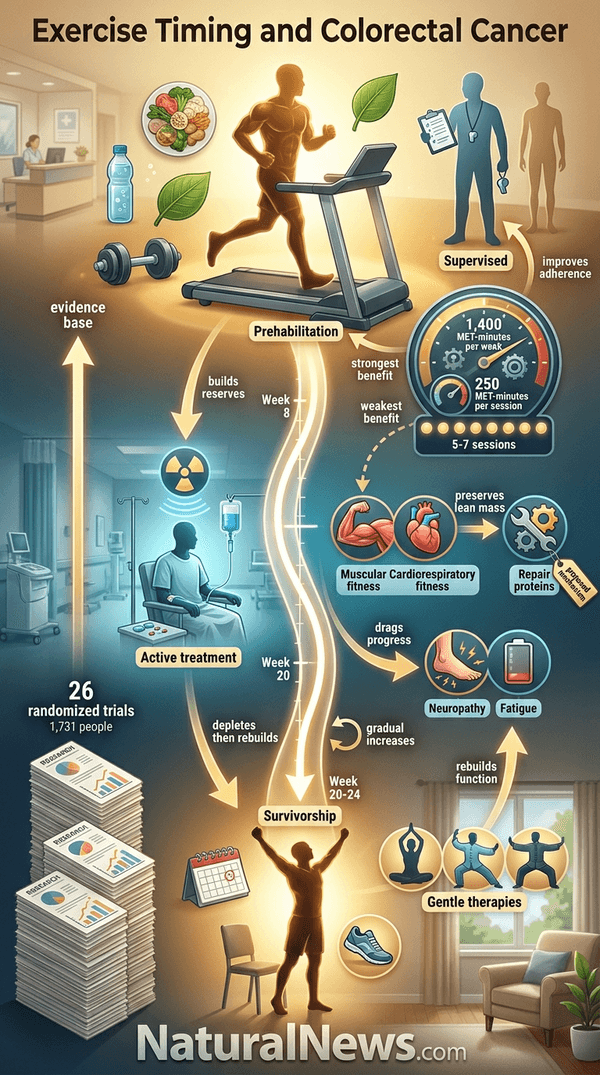
A review of 26 randomized controlled trials involving 1,731 people with colorectal cancer examined how structured exercise affects patients at different stages of care, and researchers reported that programs started before treatment produced the strongest overall benefits.
The review, described in an article published Nov. 3, 2026 by mindbodygreen editor Zhané Slambee, compared fitness, body composition, physical function, cancer-related biomarkers, and quality of life across participants who followed structured exercise programs and those who continued their usual routines without a prescribed program. Researchers also assessed when participants exercised, dividing programs into prehabilitation before treatment, exercise during active treatment such as chemotherapy, and exercise during survivorship.
The findings add to a body of research on physical activity and cancer outcomes. A separate study published in Cancer, reported by Cassie B. of NaturalNews.com, found that colon cancer survivors who exercised at higher levels, equivalent to five hours of brisk walking weekly, had a 2.9% higher chance of surviving three additional years [1].
Review of 26 Trials Finds Exercise Timing May Affect Colorectal Cancer Outcomes
Researchers analyzed 26 randomized controlled trials involving 1,731 people with colorectal cancer, according to the review. In those trials, some participants followed structured exercise programs while others continued their usual routines without a prescribed exercise program. The researchers compared health outcomes to determine how exercise frequency, intensity, and weekly activity levels influenced six areas, including fitness, body composition, physical function, cancer-related biomarkers, and quality of life.
Prehabilitation before treatment produced the strongest overall benefits, followed by exercise during survivorship, while programs during active treatment showed the weakest effects, the review stated. The pattern suggests that the timing of exercise relative to treatment may influence how much benefit patients derive, though the review did not establish a mechanism for the difference.
The broader literature has reached similar conclusions about the value of movement for cancer patients. A review published by W. Misi?g in 2022 found that physical activity decreases the severity of side effects of cancer treatment, reduces fatigue, and improves quality of life [2]. A separate systematic review reported that patients with reduced physical function following a cancer diagnosis have poorer 10-year survival [3].
Exercise Linked to Improvements in Cardiorespiratory and Muscular Fitness
Exercise was linked to significant improvements in cardiorespiratory fitness, defined as how well the heart and lungs deliver oxygen during activity, and muscular fitness, defined as the muscles' ability to produce force, according to the review. Muscular fitness showed slightly greater improvements than cardiorespiratory fitness.
The strongest results were associated with programs involving at least 1,400 MET-minutes per week, sessions of 250 MET-minutes or less, five to seven sessions per week, and supervised programs, researchers reported. MET-minutes are a measure of activity that accounts for both intensity and duration. Supervised programs also tended to outperform unsupervised ones, according to the review.
Researchers stated that increasing intensity, frequency, or total volume during active treatment did not provide additional benefits. The finding contrasts with the prehabilitation stage, where higher weekly activity volumes of more than 1,300 MET-minutes and six to seven sessions per week were associated with better outcomes.
Timing of Exercise Associated With Differing Outcomes Across Treatment Stages
Before treatment, higher weekly activity volumes of more than 1,300 MET-minutes and six to seven sessions per week were associated with better outcomes, the review found. During active treatment, benefits dipped between weeks eight and 20 before increasing again between weeks 20 and 24, a pattern researchers suggested could reflect participants finishing primary treatment or adjusting to side effects.
During survivorship, continuing exercise helped rebuild and maintain fitness, with gradual increases recommended as strength and energy return, according to the report. The review recommended that patients consider starting an individualized exercise program early, if their care team approves, with more frequent sessions and higher activity volumes when appropriate.
Research on exercise during chemotherapy has reported positive effects on completion rates, which may result in improved survival rates, according to a systematic review [3]. Movement therapies such as yoga, tai chi, and qigong can aid recovering patients, according to The Gale Encyclopedia of Alternative Medicine [4].
Conclusion: Exercise Timing May Matter, but Guidance Remains Individualized
The review found the strongest benefits when exercise began before treatment, with weaker effects during active treatment, according to researchers. The findings suggest patients and clinicians should consider treatment stage, symptoms, and fitness level when planning exercise, the report stated.
The review's findings align with physical activity guidelines in oncology, which have moved toward more tailored recommendations in recent years. Although important steps have been made, effort is needed to produce high-quality research in the exercise-oncology field, with the ultimate aim of developing more tailored guidelines, according to a systematic review of physical activity guidelines [9].
References
- Exercise may help colon cancer survivors live as long as cancer free peers studies show - NaturalNews.com, March 19, 2025.
- Physical Activity and Cancer Care—A Review - PMC - NIH. https://pmc.ncbi.nlm.nih.gov/articles/PMC9454950/
- Exercise During Chemotherapy for Cancer: A Systematic Review. https://pmc.ncbi.nlm.nih.gov/articles/PMC11849706/
- The Gale encyclopedia of alternative medicine. Unknown
- Chemotherapy-Induced Peripheral Neuropathy: An Evidence-Based Guide for Naturopathic Physicians. https://ndnr.com/chemotherapy-induced-peripheral-neuropathy/
- Exercise May Restore Muscle’s Cancer-Fighting Mechanism, Study in Mice and Flies Shows. https://www.naturalnews.com/2026-07-10-exercise-may-restore-muscles-cancer-fighting-mechanism.html
- Complementary Oncology. Josef Beuth and Ralph Moss
- Gale Encyclopedia Alternative Complimentary Medicine 4 Volume Set 4th Edition. Laurie Fundukian Project Editor
- Physical activity guidelines in oncology: A systematic review of the .... https://www.sciencedirect.com/science/article/pii/S1040842825001064
Explainer Infographic










Please contact us for more information.