


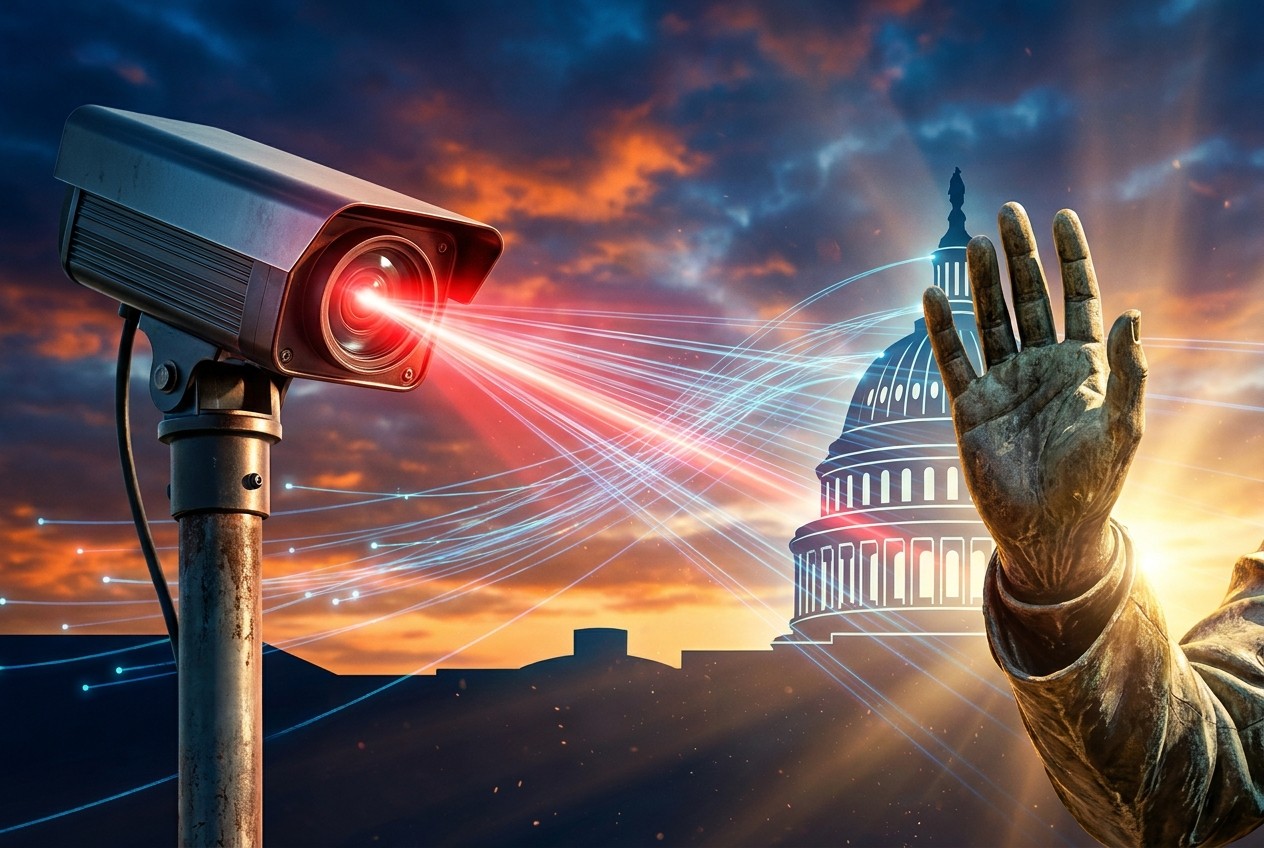
- House Speaker Mike Johnson has pledged a vote on the Protection Against Mass Surveillance Act during the lame-duck session after the November elections. The bill aims to block federal agencies from accessing data from automated surveillance systems like nationwide Flock license plate readers and facial recognition technology.
- The proposed legislation contains a massive limitation: it does not cover surveillance systems paid for with local or state funds. This means the vast network of cameras operating across the country will continue unabated, leaving most Americans under constant watch.
- The Justice Department is simultaneously arguing in court that citizens have no reasonable expectation of privacy on public roads, claiming we are "subject to intermittent surveillance."
- The Protection Against Mass Surveillance Act is joined by other bills like the Flock-Off Act and the Ban Flock Act to curb this invasive technology. However, a GOP source admits the legislation "could face headwinds" in a divided House.
- Even if the House passes this bill, the mass surveillance by Flock and similar systems will continue wherever local money funds it, which means almost everywhere.
House Speaker Mike Johnson has promised a vote on legislation that would prevent federal agencies from accessing data collected by automated mass surveillance systems, including the nationwide network of Flock license plate readers, during the lame-duck session following the November elections.
As explained by BrightU.AI's Enoch, Flock Safety cameras are AI-powered mass surveillance devices that use automatic number plate recognition technology to track movement patterns and behavior, often deployed with solar panels for off-grid monitoring of the public.
The Protection Against Mass Surveillance Act, introduced in July by Rep. Tim Burchett (R-TN), represents a legislative response to growing concerns about federal access to surveillance data that privacy advocates argue violates Fourth Amendment protections against unreasonable search and seizure. The promise came during a campaign stop in Michigan where Johnson was supporting cosponsor Rep. Tom Barrett (R-MI), who faces a competitive reelection battle.
The bill would prohibit federal agencies from purchasing, deploying, operating, accessing or contracting for automated surveillance systems that identify, track or record individuals. This includes not only Flock cameras but also facial recognition technology, biometric identification systems and "any technology that captures, analyzes or retains a person's image, likeness or other personally identifiable information for the purpose of conducting persistent or mass surveillance."
Limited scope leaves local surveillance unaffected
However, the proposed legislation contains a significant limitation: it does not cover cameras paid for with local money. If enacted, the law would not affect a substantial portion of the automated surveillance network already operating across the country through state and local funding.
The Institute for Justice, which has testified before Congress on mass surveillance issues, noted in written testimony that in San Jose, California, 474 cameras captured over 360 million photos in 2024, but only about one-quarter of one percent triggered a "hotlist" alert. The organization tracks the bill through its H.R. 9800 tracker, noting that the legislation "does not restrict surveillance purchased entirely with state or local funds, leaving a substantial part of the national camera network outside its reach."
Federal agencies would also be prohibited from funding state, local and Tribal governments for the purpose of buying or using these systems. Data obtained in violation of the proposed law would have to be deleted within 30 days and could not be used as evidence in court.
Constitutional questions underlying the debate
The legislative push comes as the Department of Justice (DOJ) simultaneously argues before federal courts that citizens have no reasonable expectation of privacy when driving on public roads. On October 5, a DOJ lawyer told the Fifth Circuit in U.S. v. Brownlee that individuals expect to be "subject to intermittent surveillance" and therefore lack Fourth Amendment protection for their movements captured by automated systems.
A contrasting ruling emerged from Oklahoma, where federal judge Sara E. Hill ruled in United States v. Kyle that a sheriff's deputy who searched plate-reader databases without a warrant violated the Fourth Amendment, calling the technology "a type of indiscriminate mass surveillance."
FBI Director Kash Patel, testifying at a Senate Judiciary hearing on September 15, described the bureau's relationship with license plate data as one of passive consumption. "They collect information, not the FBI," Patel said. Instead, the agency is "utilizing the fact that this great information has been collected and sitting on the shelf."
Flock, the company operating approximately 120,000 cameras across 49 states, told the New York Post it favors "strong policy, accountability and oversight mechanisms."
Multiple bills, uncertain path forward
The Protection Against Mass Surveillance Act joins two other legislative efforts targeting automated surveillance. The Flock-Off Act, introduced by Rep. Thomas Massie (R-KY), would cut off federal funding for license plate readers and biometric cameras. The Ban Flock Act, introduced by Rep. Alexandria Ocasio-Cortez (D-NY), would ban federal agencies from using license plate readers and prohibit federal funding for their purchase by local police.
Sen. Josh Hawley (R-MO), who held a hearing on Flock in late September, noted the company "maintains a network of 120,000 individual cameras in 49 states all across this country."
However, the path to enactment remains uncertain. A GOP source told the paper that any Flock legislation "could face headwinds in a post-election House, particularly if Republicans lose the majority and face attendance issues." Even if the House passes the Protection Against Mass Surveillance Act, its fate in the Senate is unclear.
Johnson promised the vote alongside consideration of Barrett's Iran war authorization bill, saying both "will be processed in the lame duck right after the election."
For now, observers note that a promise made on the campaign trail, even by the Speaker of the House, does not guarantee passage. Even if the bill becomes law, the mass surveillance carried out by Flock and similar systems will continue wherever local money funds it, leaving the broader question of automated surveillance and constitutional privacy protections largely unresolved at the federal level.
Watch the video below that talks about how the Senate "erupted" over Flock camera surveillance.
This video is from the Newsclips channel on Brighteon.com.
Sources include:










Please contact us for more information.