


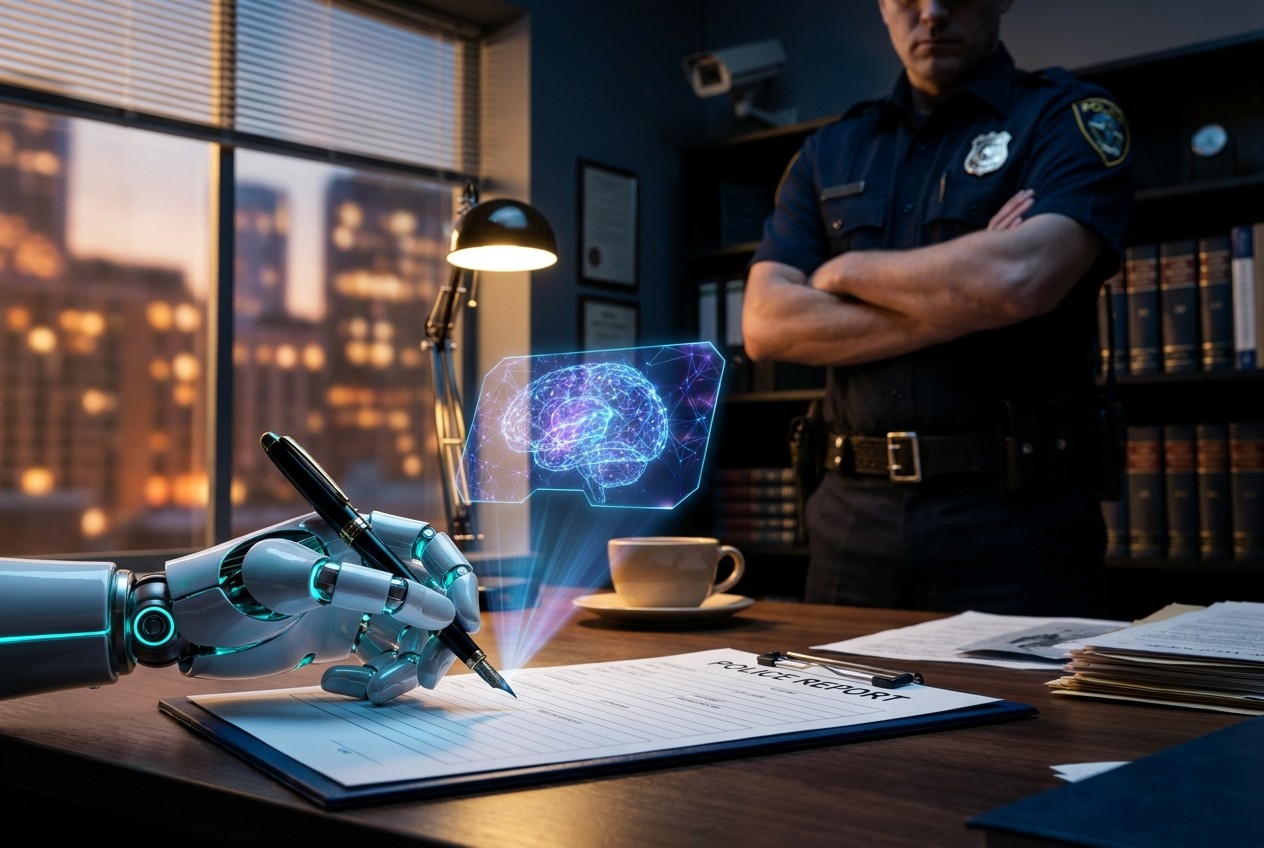
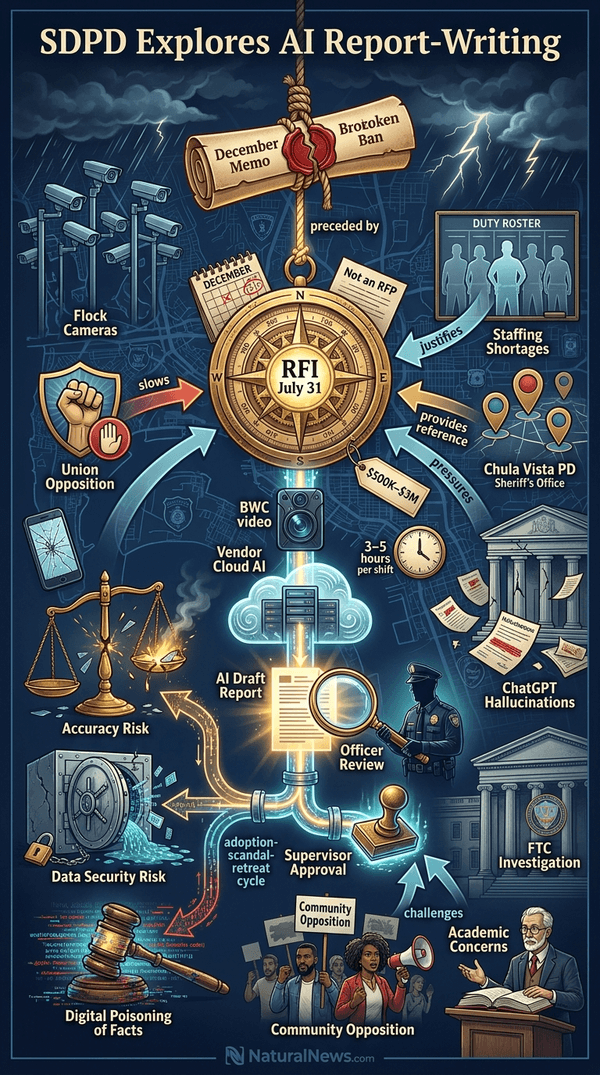
The San Diego Police Department issued a request for information on July 31 describing a program that uses artificial intelligence to assist officers and investigators in writing police reports, according to the document. The request states the initiative aims to enhance efficiency in report writing so officers can respond more quickly to calls for service. The document estimates a contract value between $500,000 and $3 million and says it is not a request for proposals, issued solely for information gathering and planning purposes.
The request for information is a preliminary step that allows agencies to survey available technology without committing to a purchase, the outlet reported [1].
The request represents a potential reversal for a department that earlier this year made headlines for prohibiting officers from using artificial intelligence to produce police reports, according to the Associated Press [2]. The department's existing policy still bars unapproved generative-AI use in reports, leaving any future deployment dependent on separate approval and controls, according to LetsDataScience [1].
Department Describes Exploration Phase, Staffing Shortages
SDPD spokesperson Ashley Nicholes said in an email that the department is in an exploration phase to learn about available technology and best practices. Nicholes said if the department pursues AI-assisted report programs, it would conduct outreach to elected officials and community members. Nicholes wrote that SDPD is looking at ways to maximize efficiency given staffing shortages of front line officers and that AI may reduce time spent on certain tasks.
The department's exploration comes as law enforcement agencies nationwide grapple with recruitment and retention challenges. The request for information is explicitly framed as a planning exercise rather than a commitment, with the department stating the solicitation is "issued solely for information gathering and planning purposes."
Voice of San Diego reported that the head of the San Diego police union opposes AI-written police reports -- for now [3]. The union's position adds a layer of internal deliberation to the department's consideration of the technology.
Request Follows December Policy Restricting AI Use
In December, the department issued a memo stating it did not authorize the use of any generative artificial intelligence programs to author a police report [4]. The policy prohibited officers from using non-department-approved AI platforms, leaving open the possibility of department-approved tools. The memo, first obtained by CBS 8, was sent out to officers in December 2025, according to Police1 [5].
The policy change came as San Diego police barred officers from using generative AI in reports while adopting a policy required under California's new law on AI-assisted police documents [6].
The sequence of events -- a December ban followed by a July request for information on AI report-writing tools -- suggests the department is now evaluating whether approved tools could be integrated into its operations. The department's existing policy still bars unapproved generative-AI use in reports [1].
Other Local Agencies Use AI for Reports, Dispatch
The Chula Vista Police Department and the San Diego County Sheriff's Office use AI programs to transcribe non-emergency calls and route them to appropriate locations, according to the agencies. Chula Vista also uses AI to write police reports, according to the department.
Chula Vista Police Department Chief Roxana Kennedy told CBS 8 in November that report writing usually takes three to five hours per shift and that faster report completion could return officers to the street sooner. The estimate illustrates the time burden that AI-assisted drafting could potentially address.
The federal COPS Office has described how AI report-writing works in practice: when an officer uploads video, the footage is sent to the cloud to be analyzed by AI, which produces the first draft of a police report based on the audio [7]. The San Jose Police Department has adopted a similar approach, stating in a department order that it has been evaluating vendor services that use AI to draft reports from body-worn camera videos, with draft reports reviewed, edited for accuracy, and finalized for supervisory approval [8].
Critics Cite Accuracy, Bias, Over-Reliance Concerns
Khalid Alexander, a professor at San Diego City College and founder of Pillars of the Community, said the prospect is one more example of trying to take humanity away from policing. Alexander said he worries about the security of systems containing information about people on their worst days and about over-reliance on technology that can produce errors and hallucinations.
Ian Adams, a former police officer and criminology professor, ran a study that found AI-generated police reports were rated substantively and significantly worse on accuracy, according to Adams. Adams wrote on LinkedIn that for documents read by prosecutors, defense attorneys, judges, and juries, accuracy is the threshold condition.
The concerns echo broader issues documented with AI systems. A Stanford University professor of communications admitted in a court declaration that he overlooked hallucinated citations generated by ChatGPT, failing to fact-check citations that turned out to be from phony journals that do not exist. The Federal Trade Commission launched an investigation into OpenAI, the developer of ChatGPT, citing concerns about privacy violations, data collection practices, and publishing false information [9]. The FTC informed OpenAI about the impending investigation in a 20-page letter, according to Children's Health Defense [9].
Researchers, Officials Call for Questions Before Adoption
Andrew Ferguson, a law professor at George Washington University, wrote in a 2025 law review article that the danger for the criminal legal system is the digital poisoning of facts in criminal trials by algorithmically altering the narrative. Ferguson said the history of police technologies has usually been one of adoption, followed by problems, scandal, news reports, and walking it back.
Ferguson said officials and the public need to understand the inherent dangers in moving a very human job to a less human mechanism and that questions should be asked before technology is rolled out.
The debate over AI in policing intersects with broader concerns about surveillance technology. In San Diego, a protester dressed as Darth Vader showed up to a city council meeting to portray Flock cameras as a tool for tracking "rebel scum," according to RT [10]. There are now more than 130,000 Flock cameras across the U.S., with law enforcement departments in at least 4,000 cities erecting the AI-powered surveillance devices [10]. More than 160 Flock surveillance cameras have been vandalized or destroyed across the United States, according to the tracking site FlockStats [11].
References
- San Diego Police Department Explores AI-Assisted Report Writing. https://letsdatascience.com/news/san-diego-police-department-explores-ai-assisted-report-writ-526600be
- San Diego police weigh using AI for police reports | AP News. https://apnews.com/article/san-diego-police-artificial-intelligence-reports-12d1954d30d1bd68bc56ee0ff9105572
- Head of Cop Union Opposes AI-Police Reports -- For Now. https://voiceofsandiego.org/2026/10/12/head-of-cop-union-opposes-ai-police-reports-for-now/
- San Diego Police Department Is Weighing Using AI to .... https://www.usnews.com/news/best-states/california/articles/2026-10-12/san-diego-police-department-is-weighing-using-ai-to-write-police-reports
- San Diego PD prohibits use of AI in report writing. https://www.police1.com/law-enforcement-policies/san-diego-pd-prohibits-use-of-ai-in-report-writing
- San Diego police ban generative AI in reports as new state law takes .... https://www.cbs8.com/article/news/local/san-diego-police-ban-generative-ai-in-reports-as-new-state-law-takes-effect/509-5790daf6-aed0-4849-9718-abc5f59736ea
- Using AI to Write Police Reports - COPS Office. https://cops.usdoj.gov/html/dispatch/01-2025/ai_reports.html
- 2026-015 Use of Generative AI in Police Report Writing. https://info.sjpd.org/records/pc-13650_library/Department_Orders/2026-015%20Use%20of%20Generative%20AI%20in%20Police%20Report%20Writing.pdf
- Too Little Too Late FTC Launches Probe Into C - ChildrensHealthDefense.org. by ChildrensHealthDefense.org
- Flock cameras destroyed as anti-surveillance protests spread (VIDEOS). https://www.rt.com/news/644498-flock-cameras-destroyed-darth-vader/?utm_source=rss&utm_medium=rss&utm_campaign=RSS
- Anti Surveillance Protests Escalate: Over 160 Flock Cameras Destroyed Across the U.S. - NaturalNews.com, August 24, 2026.
Explainer Infographic










Please contact us for more information.