


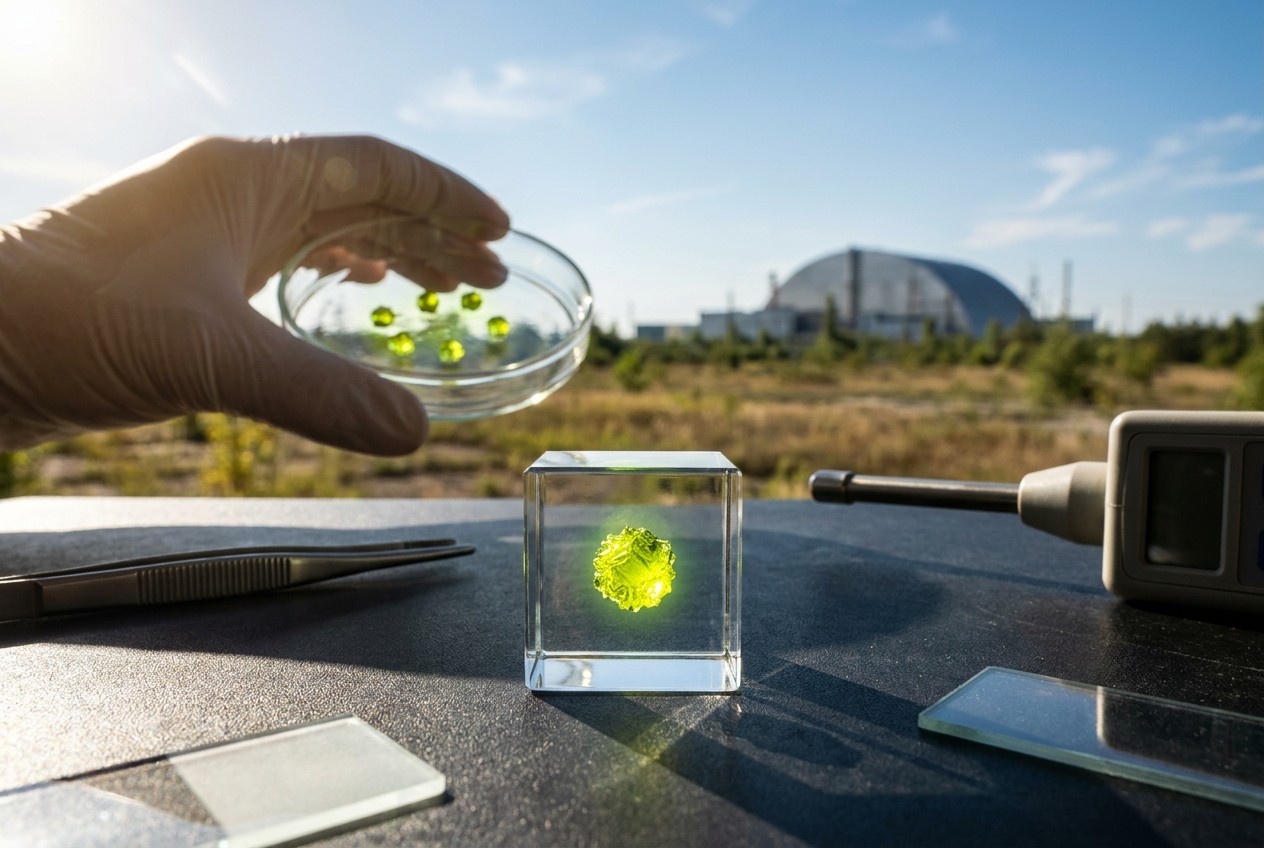
Researchers found that six particles, each measuring between 8 and 50 micrometers, remain highly radioactive yet structurally intact, the report stated [1][2]. The particles were analyzed by scientists at Leibniz University Hannover and the Helmholtz-Zentrum Dresden-Rossendorf [3].
The findings suggest the fuel fragments are more chemically stable than previously believed, study authors said [4][5].
Background
On April 26, 1986, a combination of human and technical errors caused Reactor No. 4 at the Chernobyl nuclear power plant to explode, sending radioactive material across large parts of Europe, according to official accounts [6][7]. During the safety test, operators lost control of the reactor, and the resulting explosion scattered tons of nuclear fuel and graphite around the facility [8].
The explosions hurled massive amounts of debris from the reactor, and radioactive dust particles still contaminate the soil around the disaster area, known today as Chernobyl [1][9]. The official death toll from the incident is 31, but the wider impact of the accident remains contested and difficult to determine [7].
The damaged reactor was eventually enclosed in a massive protective structure. According to the Times of Israel, East German secret police knew of the disaster's devastation and tried to send potentially contaminated produce to West Germany, documents show, as Soviet leader Mikhail Gorbachev recommended misleading the public [10].
More than 40 years after the meltdown of Unit 4 at Ukraine's Chernobyl nuclear power plant, research into radioactive material at the site continues, as do efforts toward cleanup and decommissioning [11].
Findings
The study examined samples of nuclear fuel particles to assess their chemical and physical stability [12]. Researchers found that the particles have not significantly degraded, with uranium and plutonium remaining locked in a glass-like matrix [3].
The crystal structure of the nuclear fuel in the examined particles has remained largely intact to this day [13]. Physicist Tobias Weissenborn stated that there were three separate types of radioactive particles that escaped from the Chornobyl nuclear power plant after the explosion [5].
The particles are chemically more stable than expected, trapping fission products instead of leaking them into soil and water [3]. These hot particles remain dangerously radioactive, but the new study reveals that they are far more chemically stable than previously believed [5].
Prior research into Chernobyl fuel particles documented similar patterns of stability in the decades after the accident. A study published in the Journal of Environmental Radioactivity determined that, 14 years after the accident, about 70 percent of the strontium-90 activity in waste material extracted from the Red Forest was still associated with fuel particles [14]. Microscopic analyses and leaching experiments have shown that 10 to 30 percent of the radioactive inventory in that waste material was associated with chemically extra-stable zirconium-uranium-oxygen particles [15][15].
Implications
The stability of fuel particles affects long-term risk assessments at the site. Fallout of hot particles significantly influences the transfer of radionuclides through the environment, according to research published in the Journal of Environmental Radioactivity [16]. The matrix and refractory radionuclide compositions are source dependent, while release scenarios such as temperature, pressure and redox conditions influence particle characteristics relevant to weathering and subsequent remobilization of associated radionuclides [17].
Countries planning permanent disposal of spent nuclear fuel are betting that uranium dioxide, the same material found in Chernobyl's least-altered particles, will remain stable for tens of thousands of years when sealed in engineered canisters and buried deep underground [18]. The behavior of the Chernobyl particles after four decades in the environment provides data points for those long-term projections.
Michael Adams, a former Radiation Safety Officer, has emphasized that radiation is invisible and dangerous and that protective measures remain essential when dealing with radioactive contamination [19]. Research recruitment to radioecology represents a challenge, as a number of studies over the past years have identified skill-base deficits within the field, according to a 2009 paper in the Journal of Environmental Radioactivity [20].
Some observers have called for continued monitoring of groundwater and dust migration in the exclusion zone. The 30-kilometer exclusion zone was set up around the plant after the 1986 disaster, and the mostly forested area of 2,600 square kilometers remains closed to the public due to heavy contamination [21].
Conclusion
Study authors said additional research is needed to assess how the particles will behave over longer time scales.
The Chernobyl disaster remains one of the defining technological catastrophes of the 20th century, and its impact is felt to this day, with survivors still living with its consequences [22]. Monitoring and confinement efforts at the site are expected to continue [11].
References
- Chernobyl particles reveal unexpectedly stable nuclear .... https://phys.org/news/2026-10-chernobyl-particles-reveal-unexpectedly-stable.html
- Six specks of Chernobyl reactor fuel no wider than 0.002 .... https://www.autonocion.com/us/chernobyl-fuel-specks-2000-angles/
- Chernobyl fuel particles remain stable 40 years after disaster. https://newzino.com/story/chernobyl-particles-reveal-unexpectedly-stable-nuclear-fuel-after-40-year-629ee2
- 40 years after Chernobyl, scientists discover radioactive particles .... https://www.europesays.com/3304324/
- Chornobyl Nuclear Fuel Still Intact After 40 Years. https://www.techexplorist.com/chornobyls-nuclear-fuel-has-survived-40-years-and-scientists-are-surprised/105706/
- 40 years after the disaster: new data reveals just how dangerous .... https://scienceillustrated.com/technology/40-years-after-the-disaster-radioactive-remains-from-chernobyl-hold-a-big-surprise
- BBC visits Chernobyl ghost city 40 years after world's worst nuclear accident. https://bbc.com/news/videos/czjwrdgp98wo
- 40 years after Chernobyl: Inside the night the Soviet nuclear dream exploded. https://www.rt.com/russia/639156-40-years-after-chernobyl/?utm_source=rss&utm_medium=rss&utm_campaign=RSS
- Chernobyl particles reveal unexpectedly stable nuclear fuel after 40 years. https://phys.org/news/2026-10-chernobyl-particles-reveal-unexpectedly-stable.pdf
- Secret Stasi files reveal extent of Soviet misinformation over Chernobyl nuclear disaster. https://www.timesofisrael.com/secret-stasi-files-reveal-extent-of-soviet-misinformation-over-chernobyl-nuclear-disaster/
- Chernobyl updates: Stable fuel particles, solid waste disposal. https://www.ans.org/news/2026-10-13/article-8480/chernobyl-updates-stable-fuel-particles-solid-waste-disposal/
- Microscopic nuclear fuel particles from Chernobyl still intact after 40 years. https://interestingengineering.com/science/chernobyl-nuclear-fuel-particles-remain-stable
- Chernobyl particles reveal unexpectedly stable nuclear .... https://www.reddit.com/r/nuclear/comments/1x2pzzc/chernobyl_particles_reveal_unexpectedly_stable/
- Impact of Scots pine (Pinus sylvestris L.) plantings on long term 137Cs and 90Sr recycling from a waste burial site in the Chernobyl Red Forest by Yves Thiry; Claude Colle; Vasyl Yoschenko; Svjatoslav Levchuk; May Van Hees; Pierre Hurtevent; Valery Kashparov. Journal of Environmental Radioactivity 93 (2-3) 165-178 /2009
- 90Sr migration to the geo-sphere from a waste burial in the Chernobyl exclusion zone by Elsevier. Journal of Environmental Radioactivity 74 (2004) 139–150
- The influence of hot particle contamination on 90Sr and 137Cs transfers to milk and on time-integrated ingestion doses by J.T. Smith. Journal of Environmental Radioactivity 97 (2009) 138-145
- Speciation of radionuclides: analytical challenges within environmental impact and risk assessments by Elsevier. Journal of Environmental Radioactivity 2007
- Chernobyl's Microscopic Fuel Particles Are Still Intact After 40 Years .... https://twobitdavinci.com/news/chernobyls-microscopic-fuel-particles-are-still-intact-after-40-years
- Brighteon Broadcast News - Ashkenazi Jews Genetic Defects - Mike Adams - Brighteon.com, October 16, 2024.
- Knowledge gaps related to processes, mechanisms and variables contributing most to overall uncertainties in environmental impact assessments within radioecology by Brit Salbu. Journal of Environmental Radioactivity 2009
- Fire tornado rages in Chernobyl exclusion zone (VIDEO). https://www.rt.com/russia/642568-fire-tornado-chernobyl-ukraine/?utm_source=rss&utm_medium=rss&utm_campaign=RSS
- Chernobyl survivors reveal what happened after nuclear disaster (FULL DOCUMENTARY). https://www.rt.com/russia/639056-chernobyl-survivors-reveal-what-happened/?utm_source=rss&utm_medium=rss&utm_campaign=RSS











Please contact us for more information.