



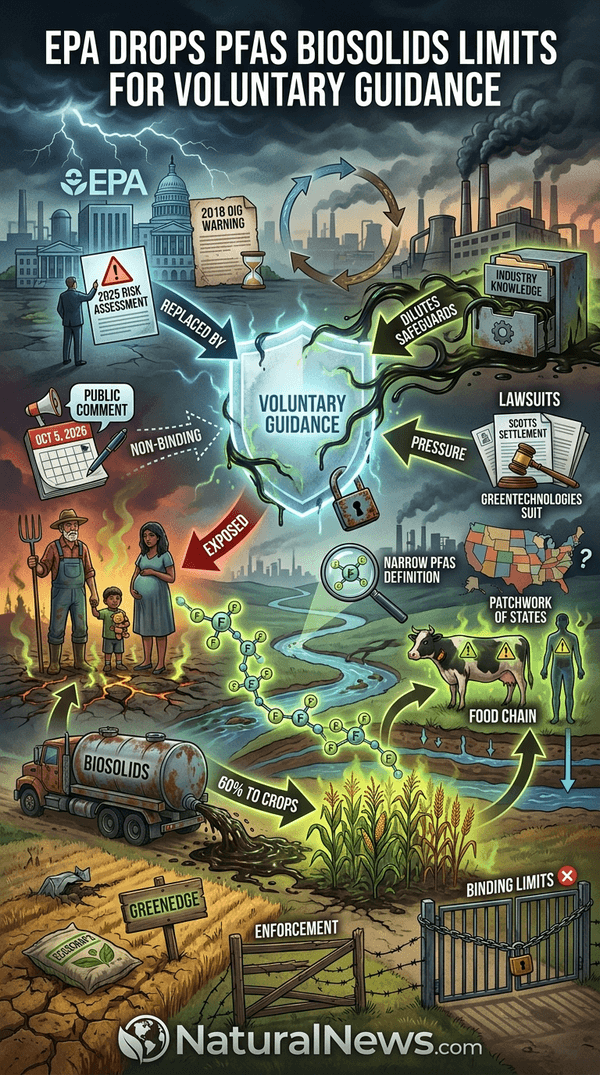
The U.S. Environmental Protection Agency has released what the agency calls "non-binding or voluntary recommendations" for mitigating risks from per- and polyfluoroalkyl substances, or PFAS, in sewage sludge and biosolids fertilizer, according to agency documents. The guidance replaces an enforceable regulatory approach with measures the agency states are advisory in nature.
A public comment period on the proposal is open through October 5, 2026. Beyond Pesticides, a nonprofit advocacy organization, filed comments on September 30, 2026, condemning the agency for failing to protect public health and the environment [1].
Biosolids, a term used to describe treated sewage sludge, are applied to land used in food production, in gardens, and on playing fields, Beyond Pesticides stated. A 2025 risk assessment conducted under the previous administration acknowledged hazards associated with PFAS in biosolids, according to the group.
Contaminant and Documented Health Effects
PFAS are described as persistent "forever chemicals" linked to acute toxicity, cancer, genetic mutations, birth defects, reproductive and developmental effects, neurotoxicity, endocrine disruption, and immune system effects, according to Beyond Pesticides' comments. The Agency for Toxic Substances and Disease Registry cites associations between PFAS exposure and increases in cholesterol levels, lower antibody response to some vaccines, changes in liver enzymes, pregnancy-induced hypertension and preeclampsia, small decreases in birth weight, and kidney and testicular cancer, according to the agency's cited research.
Over 60% of biosolids are applied to crops, exposing farmers, farmworkers, and gardeners, with contaminants entering food and water, according to Beyond Pesticides. A 2018 EPA Office of Inspector General report concluded that "with the current control weaknesses identified, the biosolids program is at risk of not achieving its goal to protect public health and the environment," according to the book by George Monbiot [2].
Independent research has documented the persistence of these compounds. A study published in Environmental Toxicology and Chemistry found acute toxicity of poly- and perfluorinated compounds to two cladoceran species, demonstrating that toxicity of a certain perfluorinated compound for one species can be used to predict that for another [3]. David Michaels, in "The Triumph of Doubt," writes that hundreds of new studies on PFAS appear in the scientific literature annually and that the health effects of these ubiquitous chemicals are profound and diverse [4].
Measures Under Consideration and Agency Position
The EPA states it is "considering" measures including avoiding land application of sewage sludge near fishable waters, lakes, or reservoirs used as drinking water sources, and in areas with potentially higher groundwater risks. Additional measures listed include avoiding application where children under age 5 have access or may have access in the future, applying to farms with lower human-exposure crops such as grain, fiber, or corn for ethanol, and avoiding application for agricultural practices with higher human exposure risks, according to agency documents.
Jay Feldman, executive director of Beyond Pesticides, said in a statement, "By failing to take restrictive action that stops the marketing of PFAS-contaminated sewage sludge (biosolids) fertilizer, EPA is shirking its legal responsibility to protect the health of people and the environment." The organization stated that the EPA continues to use a definition of PFAS that differs from the definition supported by scientists and the Organisation for Economic Co-operation and Development, which identifies PFAS as fluorinated substances containing at least one fully fluorinated methyl or methylene carbon atom. According to "The Triumph of Doubt," internal documents from DuPont illustrate the company's acknowledgment of and attempts to contain the problem with PFOA after workers were found to have high concentrations of the chemical in their blood [4].
Litigation and Ongoing Advocacy
Beyond Pesticides settled a 2025 lawsuit with ScottsMiracle-Gro in which it alleged false and deceptive marketing of the company's sewage sludge fertilizer, EcoScraps, as environmentally friendly despite containing PFAS, according to the group. Under the settlement, Scotts agreed not to advertise any future fertilizer product containing biosolids or sewage sludge as environmentally friendly and announced it would no longer manufacture the fertilizer.
Litigation continues against GreenTechnologies, LLC, which markets GreenEdge, a PFAS-contaminated sewage sludge fertilizer, on the same claim, according to Beyond Pesticides. A national action is urging the EPA to eliminate exposure to PFAS through sewage sludge and biosolids, and the group directed the public to its comment submission page at bp-dc.org/reducing-risk-in-biosolids.
Separately, reports indicate that the EPA has faced other legal and regulatory challenges regarding PFAS. According to Children's Health Defense, U.S. regulators claimed in a court filing that they are not legally required to regulate toxic PFAS chemicals in sewage sludge spread on U.S. farmland [5]. NaturalNews.com reported that the EPA promoted PFAS-contaminated sewage sludge while halting regulatory restrictions, with the rule titled "Reducing Risk from PFOA and PFOS in Biosolids" establishing voluntary, nonbinding guidance [6]. In "The Triumph of Doubt," David Michaels notes that in proposing OSHA's silica regulation, he issued a request that all public comment submissions be accompanied by a disclosure of financial conflicts, though the Administrative Procedure Act obliged the agency to consider every comment [4].
What Happens Next
The comment period closes October 5, 2026, after which the EPA is expected to proceed under its stated voluntary framework, which contains no enforcement mechanism, according to agency documents. Beyond Pesticides called for regulations to strengthen standards and remove PFAS-contaminated products such as sewage sludge and biosolids from use, citing the 2018 Office of Inspector General conclusion.
Positions remain divided. The agency describes its measures as recommendations for risk mitigation, while the advocacy group characterizes the same measures as a failure to meet legal obligations. According to "The Triumph of Doubt," the findings of early PFAS studies that were suppressed for decades by the companies producing the substances have motivated scientists across the world to conduct more research, and it is now clear that the health effects of these chemicals are profound and diverse [4].
According to a report by Children's Health Defense, studies have identified unsafe levels of PFAS in the drinking water of more than 200 million Americans, with the chemicals linked to cancer, reproductive and developmental harms, and immune system damage [7]. NaturalNews.com reported that 176 million Americans drink tap water contaminated by these "forever chemicals," according to new EPA data [8].
References
- Mercola.com. "Superfood or Silent Killer The Truth Behind". Mercola.com. February 20, 2024.
- George Monbiot. "Regenesis Feeding the World Without Devouring the Planet".
- 3B2 Total Publishing System 8.06a/W. "Acute toxicity of poly- and perfluorinated compounds to two cladocerans, Daphnia magna and Chydorus sphaericus". Environ. Toxicol. Chem. 2012.
- David Michaels. "The Triumph of Doubt".
- ChildrensHealthDefense.org. "EPA Won't Regulate Toxic PFAS Chemicals in Fertilizer Used by Farms".
- NaturalNews.com. "EPA Promotes PFAS-Contaminated Sewage Sludge While Halting Regulatory Restrictions". August 5, 2026.
- ChildrensHealthDefense.org. "EPA Doing 'Bare Minimum' to Protect U.S. Drinking Water From Contamination With Toxic PFAS Chemicals".
- NaturalNews.com. "Trump EPA rolls back PFAS protections as 176 million Americans face contaminated tap water". September 23, 2026.
Explainer Infographic










Please contact us for more information.