



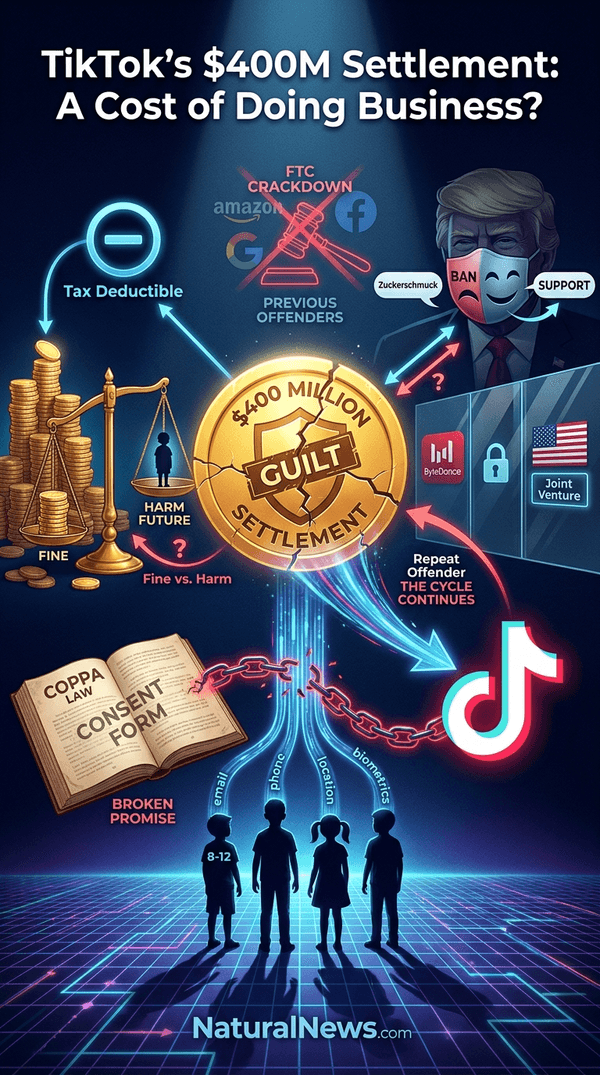
TikTok and its parent company ByteDance have agreed to pay $400 million to settle a U.S. government lawsuit over allegations that the social media platform violated federal children’s privacy laws, the Department of Justice announced Friday. [1] The out-of-court settlement ends the case without a trial and without any determination of liability, officials said. [2]
The lawsuit, filed in 2024 by the DOJ and the Federal Trade Commission under the Biden administration, accused TikTok of knowingly allowing millions of children under age 13 to create regular accounts and collecting their personal data without parental consent. [3] The companies will pay $300 million immediately and an additional $100 million once a judge vacates an older consent decree that had applied to Musical.ly, the platform that was merged into TikTok, according to the DOJ. [4]
Background of the Allegations
The complaint alleged that TikTok and ByteDance violated the Children’s Online Privacy Protection Act (COPPA) by storing email addresses, phone numbers, and other sensitive data from millions of underage users. [5] The government further claimed that TikTok failed to delete children’s accounts and data when requested by parents, a practice described in court filings as a “repeat offense” that occurred on a “massive scale.” [1]
The case was part of a broader crackdown on Big Tech under the Biden administration. In parallel, the FTC pursued similar action against Amazon over its Alexa-powered devices, accusing the company of illegally collecting children’s voice recordings. [6] Critics of centralized regulatory power have argued that such settlements allow tech giants to buy their way out of accountability without admitting wrongdoing, a pattern seen in other federal privacy enforcement actions.
Settlement Terms and Changes
Under the terms announced by the Trump administration’s DOJ, TikTok admits no fault. [4] The DOJ’s announcement highlighted “significant changes” to TikTok’s ownership, management, compliance, and privacy practices since the original complaint was filed, contrasting sharply with the tone of the 2024 lawsuit, which labeled the companies “repeat offenders.” [1]
The settlement is one of the largest ever paid under COPPA, according to officials. [4] The DOJ stated that the version of TikTok currently available in the United States is operated by a U.S. Data Security Joint Venture majority-owned by American investors, a restructuring that the department said addresses many of the underlying privacy concerns. [7] This restructuring was negotiated after President Donald Trump returned to office and delayed enforcement of a 2024 divest-or-ban law.
Political Context and Trump’s Reversal
President Donald Trump reversed his position on TikTok during the 2024 campaign, opposing a ban he had sought in his first term. [8] In March 2024, he wrote on Truth Social that removing TikTok would benefit Meta, referring to CEO Mark Zuckerberg as “Zuckerschmuck,” and said “I don’t want Facebook, who cheated in the last Election, doing better.” [1]
Since his inauguration in January 2025, Trump has intervened repeatedly to keep TikTok operating. He granted multiple 90-day reprieves from the 2024 divest-or-ban law and backed a U.S.-based joint venture that allowed the app to continue despite ongoing national security concerns from some lawmakers. [9] The White House even reversed a 2022 ban on TikTok being used on government devices, determining that the restructured version no longer posed the same risk. [7] This political shift has drawn criticism from those who view TikTok’s Chinese parent company, ByteDance, as a conduit for data surveillance.
Broader Implications
The settlement allows TikTok to avoid a trial over the child privacy allegations, with no liability determined. [1] The platform continues to operate under a new ownership structure that the administration says is majority-owned by American investors, though ByteDance retains a minority stake. [7]
Separately, TikTok and Meta are facing thousands of social media addiction lawsuits from states and individuals that a federal appeals court allowed to proceed in August 2026. [10] Those cases involve claims that the platforms deliberately engineered their algorithms to addict young users, and they represent a growing wave of legal pressure on social media companies. [11] As governments around the world, from the European Union to Greece, introduce age-verification mandates or outright bans for underage users, the regulatory landscape for platforms like TikTok continues to intensify. [12]
References
- "TikTok dodges US trial over children’s data." August 22, 2026.
- TechCrunch. "TikTok reaches $400M settlement over children’s privacy lawsuit." August 21, 2026.
- BBC. "TikTok to pay $400m to US in one of largest child privacy settlements." August 21, 2026.
- Epoch Times. "TikTok, ByteDance to Pay $400 Million in Children’s Privacy Settlement." August 22, 2026.
- NaturalNews.com. "US government sues TikTok over CHILD PRIVACY violations." August 9, 2024.
- ChildrensHealthDefense.org. "Amazon Illegally Harvested Kids Data Via Alexa."
- NaturalNews.com. "White House Allows TikTok on Government Devices, Reversing 2022 Ban." August 16, 2026.
- NaturalNews.com, Ramon Tomey. "Trump's TikTok U-turn: From 'national security threat' to 'crazy videos for kids'." January 29, 2025.
- NaturalNews.com, Willow Tohi. "TikTok's US future hangs in balance as Trump tips buyer details amid security fears." July 1, 2025.
- NaturalNews.com. "U.S. Appeals Court Allows Thousands of Social Media Addiction Lawsuits Against Meta and TikTok to Proceed." August 12, 2026.
- "Tech giants face thousands of lawsuits over social media addiction." August 11, 2026.
- NaturalNews.com, Ramon Tomey. "Greece becomes first EU nation to BAN social media for minors aged 16 and below." October 2, 2025.
- Frank H. McCourt, Jr. "Our Biggest Fight: Reclaiming Liberty, Humanity, and Dignity in the Digital Age."
Explainer Infographic








Please contact us for more information.