



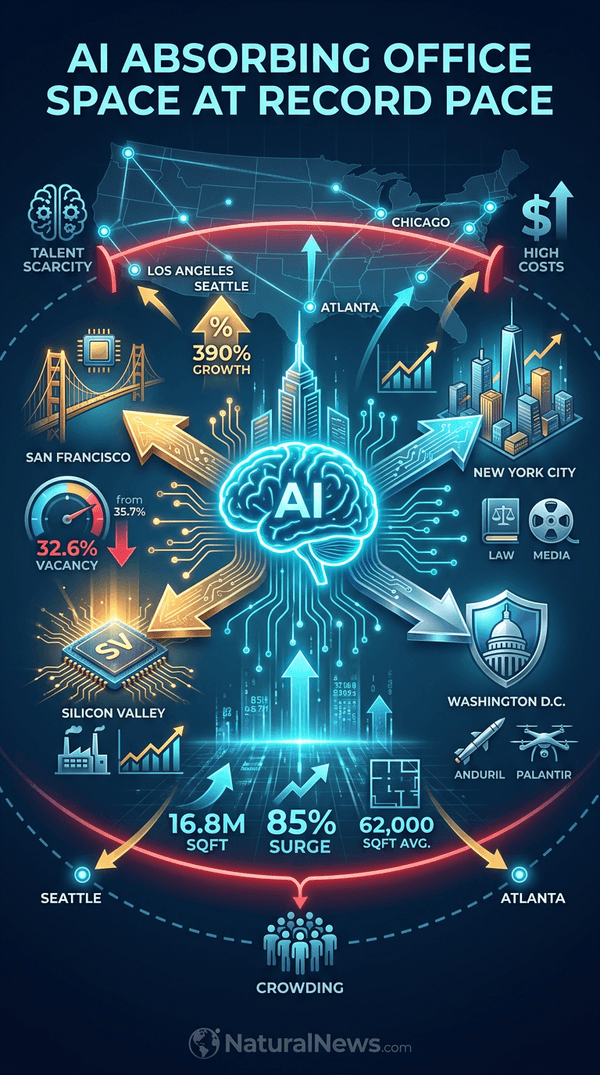
Artificial intelligence firms are leasing office space at a record pace across the United States, with demand surging 85% in the 12 months through May, according to a report published July 9 by the commercial real estate platform VTS. The report states that AI companies accounted for 16.8 million square feet of office demand across 17 markets during the period.
Three metro areas accounted for nearly two-thirds of the total demand. San Francisco alone represented 25% of national AI office requirements, or about 5 million square feet, VTS senior research manager Rene Moreira said. San Francisco, Silicon Valley, and New York together accounted for 63% of all current AI leasing activity, according to the report [1].
San Francisco Leads AI Office Recovery
San Francisco’s office market has been struggling since the pandemic, with vacancy rates peaking at 35.7% in the second quarter of 2025, according to city data cited by VTS. By the end of the first quarter of 2026, vacancy had fallen to 32.6%, indicating a modest recovery driven largely by AI demand. Before the pandemic, in the second quarter of 2019, the city’s office vacancy stood at 4.7%.
Active AI office searches in San Francisco averaged 62,000 square feet per requirement, Moreira noted -- roughly 2.3 times the average technology-related office requirement across all markets surveyed [1]. The concentration of AI developers such as Anthropic and OpenAI in the city has fueled this demand, the report stated.
New York and Silicon Valley Demand
In New York, the report found 45 active AI office lease searches averaging about 61,000 square feet each. Silicon Valley had 58 active searches averaging roughly 48,000 square feet, totaling approximately 2.8 million square feet of office space. VTS noted that each submarket serves a distinct segment of the AI industry: San Francisco is home to frontier AI developers, Silicon Valley hosts chip designers and hardware manufacturers, and New York’s AI firms tend to serve enterprise clients in finance, law, and media.
Defense-oriented AI companies such as Anduril, Palantir, and Shield AI have concentrated their office requirements in the Washington, D.C., area, the report said [1]. The report did not provide specific square footage figures for the Washington market.
Expansion to Other Markets
VTS stated that AI demand is expected to spread to additional primary office markets, including Chicago, Los Angeles, Atlanta, and Austin, Texas, as the industry continues to grow. Seattle has already experienced a 390% year-over-year increase in AI-related office demand, signaling that outward expansion is underway, the report said.
Three factors are pushing demand outward, according to VTS: scarcity of AI engineering talent, high real estate costs in San Francisco, and the crowding effect of 25% of active AI demand being concentrated in a single submarket [1]. The trend coincides with broader technology sector layoffs -- U.S. employers announced 153,074 job cuts in October 2025, the highest for that month in two decades, according to a report from NaturalNews.com [2]. Meanwhile, office markets elsewhere continue to struggle; in London, plans to sell two office buildings were put on hold as asking prices were slashed, Bloomberg reported, as cited by the Trends Journal [3].
Policy Context and Outlook
At the policy level, Vice President JD Vance stated in February 2025 at the Artificial Intelligence Action Summit in Paris that the United States should maintain global leadership in AI through policies that encourage innovation rather than oppressive regulation, according to a report from NaturalNews.com [4]. The VTS report did not address the potential impact of regulation on office demand.
As AI firms expand their physical footprints, some communities have raised concerns about the effects of data centers and office construction on local environments and housing markets. A separate report from The New American noted that thousands of American citizens are opposing AI data center developments in their communities, citing noise pollution and resource consumption [5]. The long-term trajectory of AI office absorption will depend on the industry’s ability to sustain its growth rate amid talent shortages and economic pressures, according to market observers.
References
- Rob Sabo. "AI Companies Absorbing Office Space At Record Pace: Report". ZeroHedge. July 14, 2026.
- Cassie B. "Tech layoffs surge to 33281 in October as AI and economic fears trigger historic job cuts". NaturalNews.com. November 7, 2025.
- Trends-Journal-2024-04-14.
- Willow Tohi. "Vance declares war on AI censorship US must lead the charge for FREEDOM in artificial intelligence". NaturalNews.com. February 13, 2025.
- "Warning! AI Data Center Promoters Are Lying to Stop Our Opposition!". The New American. July 2, 2026.
Explainer Infographic











Please contact us for more information.