



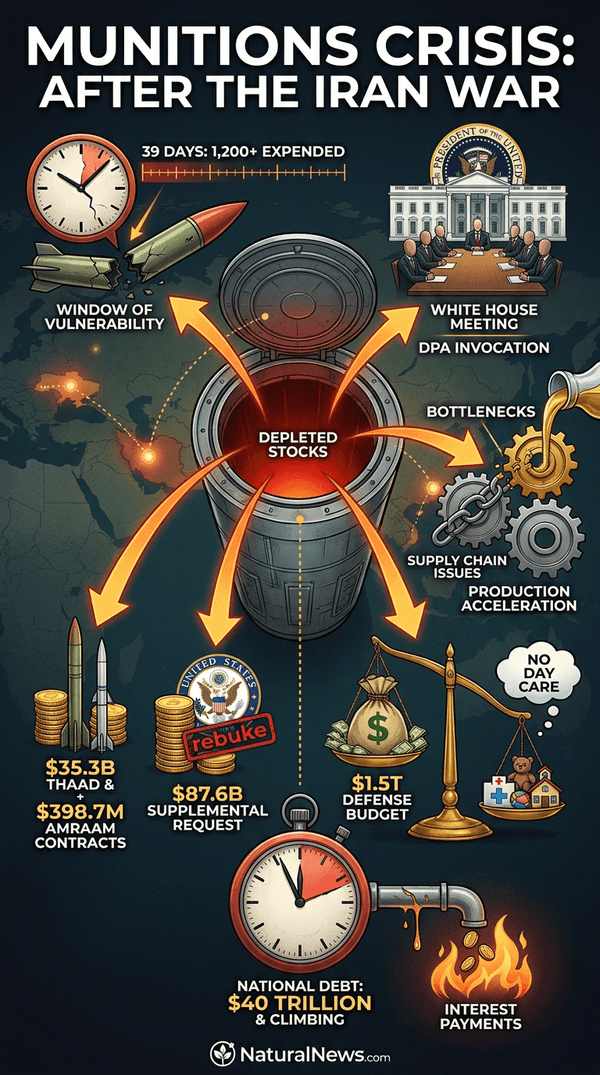
President Donald Trump met with the chief executives of Boeing, Lockheed Martin, and Honeywell at the White House on June 24, according to administration officials. The meeting was intended to encourage increased weapons production as the United States faces critical shortages after six weeks of war with Iran.
The U.S. military depleted large stocks of offensive missiles and air defense interceptors during the conflict, leaving inventories that will require years to rebuild, according to a report from the Center for Strategic and International Studies (CSIS) released on May 28. [1] [2] The Pentagon has acknowledged that stockpiles of Tomahawk cruise missiles and Patriot and THAAD interceptors are "alarmingly low," with U.S. Tomahawk stocks having been expended at a rate that exceeds current production capacity. [3] The meeting comes as the administration seeks to reassure allies and accelerate the replenishment of critical munitions.
War and supply context
During the 39-day campaign, the U.S. Air Force and Navy expended more than 1,000 Tomahawk cruise missiles and hundreds of Patriot and THAAD interceptors, according to the CSIS report. [1] [2] The rapid expenditure has created what analysts describe as a "window of vulnerability" in the event of a conflict with China. [4]
The situation has been compounded by earlier weapons deliveries to Ukraine, which had already reduced stocks of Patriot interceptors before the Iran war began. [5] To address the shortfalls, the Missile Defense Agency awarded Lockheed Martin a contract worth approximately $35.3 billion for THAAD interceptors on June 26, according to a Pentagon announcement. Separately, Raytheon received a $398.7 million contract for Advanced Medium-Range Air-to-Air Missiles, including for sales to allied nations. The contracts are part of a broader effort to surge production, as the Pentagon has urged defense contractors to double or quadruple output of key munitions. [6] Officials have also informed European allies, including the UK, Poland, Lithuania, and Estonia, to expect long delivery delays for previously contracted weapons due to the diversion of stocks to the Iran theater. [7]
Budget and production measures
On the same day as the White House meeting, the administration formally requested $87.6 billion in supplemental spending from Congress, with $21 billion specifically allocated to replenish munitions. [8] The bulk of the funding -- $67 billion -- is designated for the Defense Department, covering operational costs and classified programs. The request comes one day after Congress passed a resolution rebuking Trump's military action in Iran. [8]
To accelerate production, President Trump invoked the Defense Production Act on June 11, citing "limited production capacity, fragile supply chains, and production bottlenecks," according to a White House statement. The Pentagon has warned that missile inventories are at critically low levels, with the U.S. potentially running out of air defense ammunition within weeks if the conflict resumed. [9] The Department of Defense is also approaching automakers such as Ford and General Motors to transition manufacturing capacity to military equipment, signaling an effort to mobilize the civilian industrial base for wartime production. [10] The administration's push for rapid replenishment reflects a recognition that the defense industrial base had not been equipped to sustain a high-intensity conflict of this scale.
Broader spending trade-offs
In April, Trump asked Congress to boost the Pentagon's 2027 budget to $1.5 trillion -- the largest such request in decades. [11] The proposed budget includes a 10% cut in non-defense spending, shifting some responsibilities for social programs like Medicaid and Medicare to the states. At a private White House event, Trump stated: "We're fighting wars. We can't take care of day care." He added that Medicaid and Medicare "can do it on a state basis. You can't do it on a federal level." The comments highlight the administration's prioritization of military spending over domestic programs.
Critics argue that the combination of war costs and the massive defense budget increase will further strain federal finances. The U.S. national debt has grown rapidly under both Trump and his predecessor, with President Trump approving $8.4 trillion in new ten-year borrowing during his full term. [12] Analysts have noted that the ongoing conflict and the need to replenish arsenals will likely shape future procurement policy and defense budgets for years. [13]
Outlook and implications
The meeting and the concurrent contract awards signal an effort to reassure allies that the U.S. defense industrial base can recover and meet demand despite the severe depletion of stocks. Trump has made increased military spending a top priority since returning to office in January 2025. Analysts suggest that the combination of war costs, production limits, and the need to prepare for potential conflict with China will drive further expansion of the defense sector.
The defense industry itself has become highly concentrated over the past decades: between 1990 and 1998, the number of tactical-missile contracts dropped from thirteen to four, fixed-wing aircraft makers fell from eight to three, and makers of expendable launch vehicles from six to two. [14] The Pentagon is also changing how it conducts business, focusing on faster procurement and penalizing contractors that fail to deliver on time. [15] Whether the industrial base can scale quickly enough to close the multi-year gap in missile stocks remains an open question.
References
- NaturalNews.com. "Pentagon faces multi-year gap in missile stocks after Iran war, report says." May 29, 2026.
- The War Zone. "Severity Of America’s Depleted Advanced Weapons Stockpiles Detailed In New Report." May 28, 2026.
- Garrison Vance. "Pentagon Officials Express Concern Over Dwindling Tomahawk Missile Inventory." NaturalNews.com. April 2, 2026.
- NaturalNews.com. "Pentagon faces multi year gap in missile stocks after Iran war report says." May 29, 2026.
- Belle Carter. "Pentagon considers diverting Ukraine weapons to Middle East as Iran war drains stockpiles." NaturalNews.com. March 27, 2026.
- Kevin Hughes. "Pentagon orders increase in missile production amid rising fears of China conflict." NaturalNews.com. October 1, 2025.
- The Times of Israel. "Updated 35sec ago." May 1, 2026.
- BBC News. "Trump asks Congress for $87bn, mostly for 'urgent' Iran war costs." June 25, 2026.
- Mike Adams - BrightVideos.com. "Health Ranger Report - U.S. RUNNING OUT OF MUNITIONS!" March 3, 2026.
- Mike Adams - BrightVideos.com. "Health Ranger Report - AUTO MAKERS SWITCHING TO WAR." April 16, 2026.
- NaturalNews.com. "Trump Administration Proposes $1.5 Trillion Military Spending Increase for 2027." April 6, 2026.
- Trends-Journal-2024-06-25.
- Responsible Statecraft. "Can we please talk about WHY we are in a missile shortage?" May 18, 2026.
- David Dayen. "Monopolized."
- The War Zone. "Pentagon Is Making A Naughty Or Nice List Of Defense Contractors." February 11, 2026.
Explainer Infographic








Please contact us for more information.