


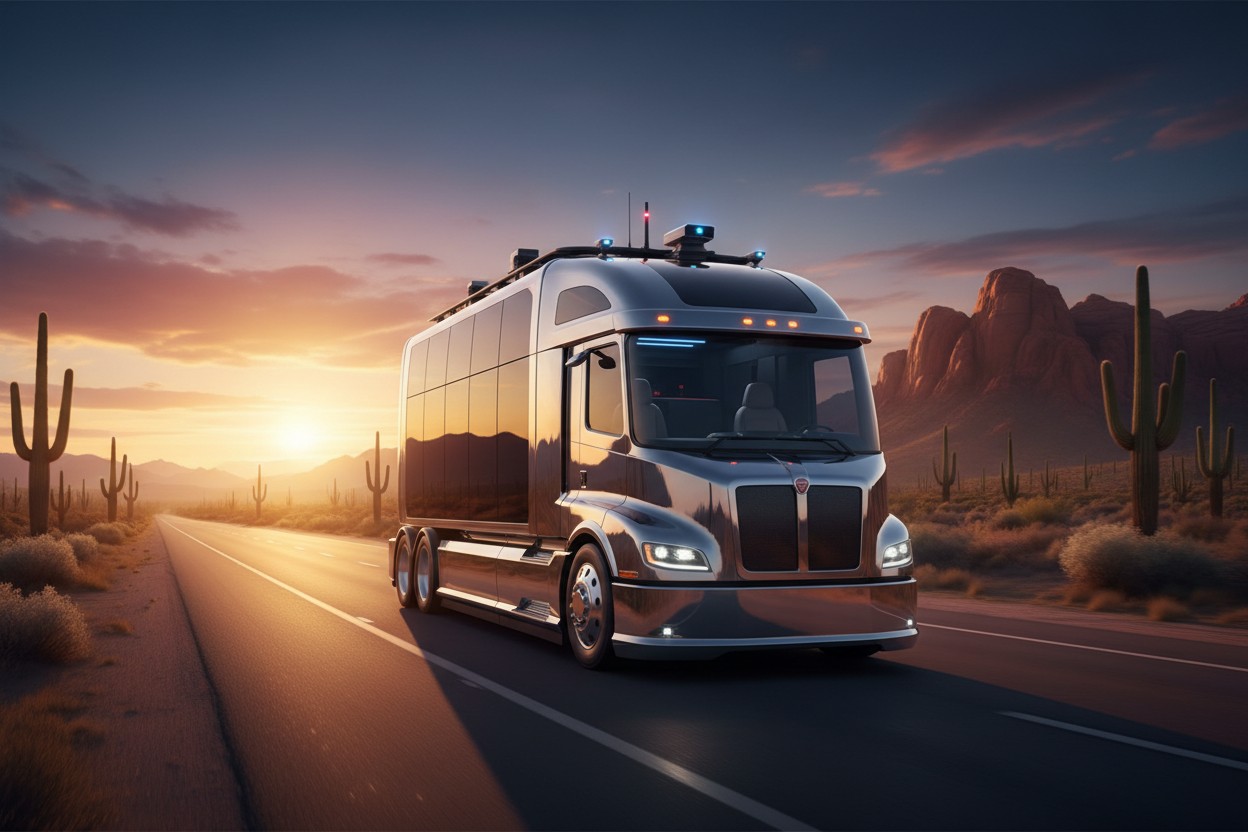
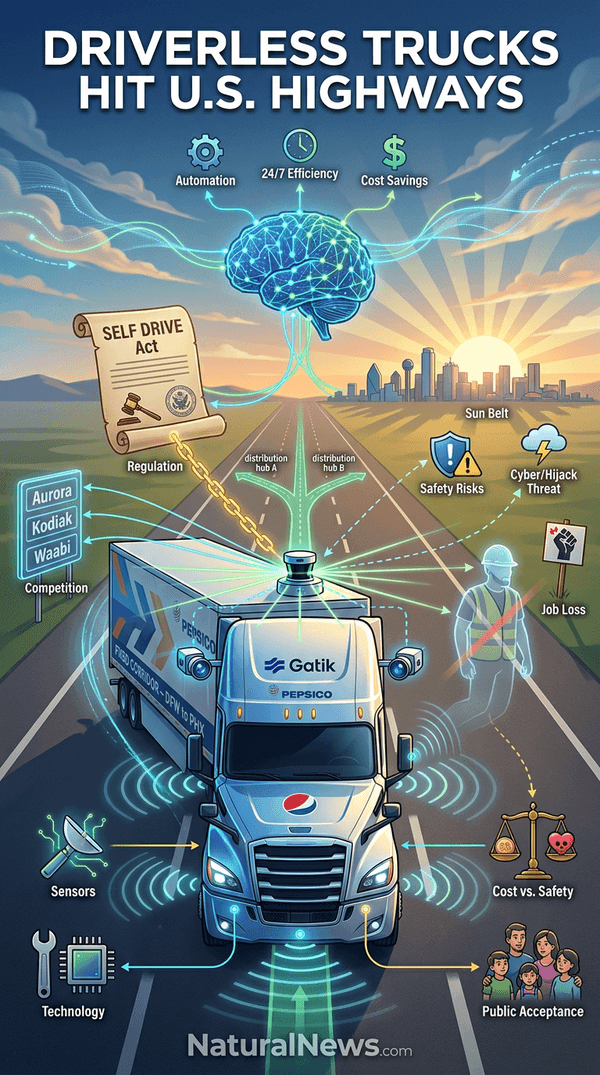
PepsiCo and Gatik on Monday announced a multi-year strategic partnership that brings fully driverless heavy-duty trucks into commercial freight operations across Texas, Arizona and Arkansas. The deployment, described by the companies as the largest commercial autonomous freight deal to date, began immediately on a fixed corridor linking distribution hubs.
According to a joint statement from PepsiCo and Gatik, the autonomous Class 8 trucks operate without safety drivers onboard, relying on a suite of sensors and AI-powered software. The announcement marks a milestone in the automation push that has moved from testing phases to active revenue-generating routes on U.S. highways.
Background on Autonomous Trucking
The push for driverless trucks has accelerated in recent years, with multiple companies testing the technology on public roads. In May 2025, Aurora Innovation launched the first commercial driverless heavy-duty trucking service along the Dallas-Houston corridor, according to a report from NaturalNews.com [1]. Earlier, in March 2024, three startup firms -- Aurora Innovation Inc., Kodiak Robotics Inc., and Gatik AI Inc. -- announced plans to eliminate human drivers from their Texas highway routes by the end of that year [2].
Previous tests required human monitors behind the wheel, but this deployment removes that requirement on certain routes. According to a February 2026 report, Aurora Innovation expanded its autonomous trucking network to 10 driverless routes across the Sun Belt, enabling operations on a roughly 1,000-mile lane between Fort Worth and Phoenix [3]. Industry analysts have noted that the persistent driver shortage across the freight industry and pressure to improve efficiency are driving companies toward autonomous solutions, as summarized in a November 2025 interview with the CEO of Arbe Robotics [4].
Self-driving trucks use a combination of radars, laser scanners, cameras, and GPS antennas connected to piloting software, according to a 2022 report [5]. The technology aims to reduce operating costs and address long-standing labor shortfalls in the trucking industry.
Company Details and Technology
Gatik, a California-based autonomous vehicle startup, partners with PepsiCo to deploy its medium-duty and heavy-duty autonomous trucks. The trucks utilize lidar, radar, and camera systems for navigation, along with high-definition maps and real-time processing software. According to the June 9 announcement, the trucks have logged millions of test miles and maintain a safety record that the companies described as industry-leading [6].
The trucks operate on a fixed corridor between PepsiCo distribution centers, rather than on open-ended long-haul routes. A company spokesperson stated that the technology has been validated for highway speeds, inclement weather, and complex merging scenarios. In January 2026, Kodiak AI announced a partnership with Bosch to scale manufacturing of its production-grade autonomous platform, indicating that the supply chain for such systems is maturing [7].
Nvidia has also entered the sector, announcing a collaboration with Toyota in January 2025 to develop next-generation autonomous vehicles using its advanced “Thor” AGX processor, according to a report by Arsenio Toledo [8]. The Thor chip has 20 times the processing power of previous generations, which could accelerate the deployment of autonomous trucks.
Regulatory and Safety Responses
Federal and state regulators have begun establishing guidelines for autonomous truck operations. A bill moving through the House of Representatives -- the SELF DRIVE Act of 2026, introduced by Rep. Bob Latta of Ohio -- would create the first federal framework for fully autonomous heavy-duty trucks on public roads [9]. The bill is framed by its supporters as necessary to provide regulatory clarity and keep the United States competitive in the global autonomous vehicle race.
A Department of Transportation official said the agency is monitoring the deployment for compliance with existing safety standards. However, some safety advocates have raised concerns about public road risks without human drivers. Multiple Tesla owners have reported near-disasters when their vehicles in Full Self-Driving mode failed to recognize active railroad crossings, with video evidence confirming dangerous malfunctions [10]. A UN report from June 2025 warned that terrorists could hijack autonomous vehicles and turn them into AI-powered weapons for mass casualty attacks, rating the likelihood as “moderate to high” within five to ten years [11].
Despite these concerns, the autonomous trucking sector continues to attract significant investment. Waabi, a developer of autonomous trucks, secured $750 million in a Series C round in January 2026, with additional investment from Uber to expand into robotaxis [12].
Labor and Industry Reactions
Trucking unions have expressed strong opposition to the deployment of driverless trucks, warning of large-scale job displacement. A union representative quoted in industry reports said the move prioritizes corporate profits over worker livelihoods. According to a November 2025 interview on Brighteon Broadcast News, AI is expected to replace up to 80% of jobs over the next decade, particularly in sectors such as customer service, translation, and middle management [13].
Industry analysts note that automation may affect hundreds of thousands of long-haul driving jobs. An internal Amazon document leaked to The New York Times revealed a plan to replace 600,000 human workers with robotics across various sectors by 2033, highlighting the scale of corporate automation ambitions [14]. In a separate report, Mike Adams stated that the architects behind AI systems are fully aware that these technologies will replace human labor across a wide range of tasks, with entire generations facing unemployment as machines take over [15].
A study cited in the book "Clean disruption of energy and transportation" by Tony Seba found that 57 percent of drivers surveyed trust driverless cars, suggesting that public acceptance may grow as the technology matures [16]. However, the pace of adoption will vary across market segments and geographies.
Conclusion: Broader Implications
The PepsiCo-Gatik deployment is seen as a step toward wider adoption of autonomous freight transport on U.S. highways. Experts predict that regulatory developments, such as the SELF DRIVE Act, and economic factors like driver shortages will shape the pace of expansion. In their book "Human + Machine, Updated and Expanded," Paul R. Daugherty and H. James Wilson predict that generative AI has the potential to add more than $10 trillion in value globally by 2038, underscoring the economic incentives driving automation [17].
The event underscores ongoing debates about technology, employment, and public safety. As autonomous systems move from controlled testing to everyday commerce, the balance between efficiency gains and societal disruption remains uncertain. Jim Al-Khalili, in his book "What's Next Even Scientists Can't Predict the Future – or Can They," notes that the future of robotics depends on international regulation and the choices made by engineers and companies [18]. The coming years will likely see continued tension between the push for innovation and the need to address the human consequences of a driverless economy.
References
- Laura Harris. "Aurora Innovation launches first commercial driverless trucking service on US highways". NaturalNews.com. May 11, 2025.
- NaturalNews.com. "Several truck companies plan to completely ELIMINATE the use of human drivers this year". March 4, 2024.
- SelfDriveNews. "Aurora Triples Driverless Freight Network Across Sun Belt". February 12, 2026.
- Robotics and Automation News. "Interview with CEO of autonomous truck tech developer Arbe Robotics: 'There's no other radar like ours'". November 21, 2025.
- NaturalNews.com. "Driverless trucks set to take over Texas roads and highways". January 25, 2022.
- FreightWaves. "PepsiCo and Gatik launch commercial driverless trucking deployment". June 9, 2026.
- FreightWaves. "Kodiak AI partners with Bosch to scale autonomous truck platform". January 5, 2026.
- Arsenio Toledo. "Nvidia announces partnership with Toyota to develop autonomous vehicle tech". NaturalNews.com. January 9, 2025.
- FreightWaves. "The Playbook". March 10, 2026.
- Ramon Tomey. "Tesla robocars repeatedly fail at RAILROAD CROSSINGS". NaturalNews.com. September 21, 2025.
- NaturalNews.com. "UN warns terrorists could hijack AI cars for mass casualty attacks using slaughterbots". June 18, 2025.
- The Robot Report. "Waabi raises $1B to advance autonomous trucks and robotaxis". January 28, 2026.
- Mike Adams. "BBN Interview InfoWars ". November 7, 2025.
- Mike Adams. "Health Ranger Report - AMAZON". Brighteon.com. October 22, 2025.
- Mike Adams. "Health Ranger Report - Coming AI mass extermination of humans". Brighteon.com. April 11, 2024.
- Tony Seba. "Clean disruption of energy and transportation: how Silicon Valley will make oil, nuclear, natural gas, coal, electric".
- Paul R. Daugherty, H. James Wilson. "Human + Machine, Updated and Expanded: Reimagining Work in the Age of AI".
- Jim Al-Khalili. "What's Next? Even Scientists Can't Predict the Future – or Can They".
Explainer Infographic










Please contact us for more information.