


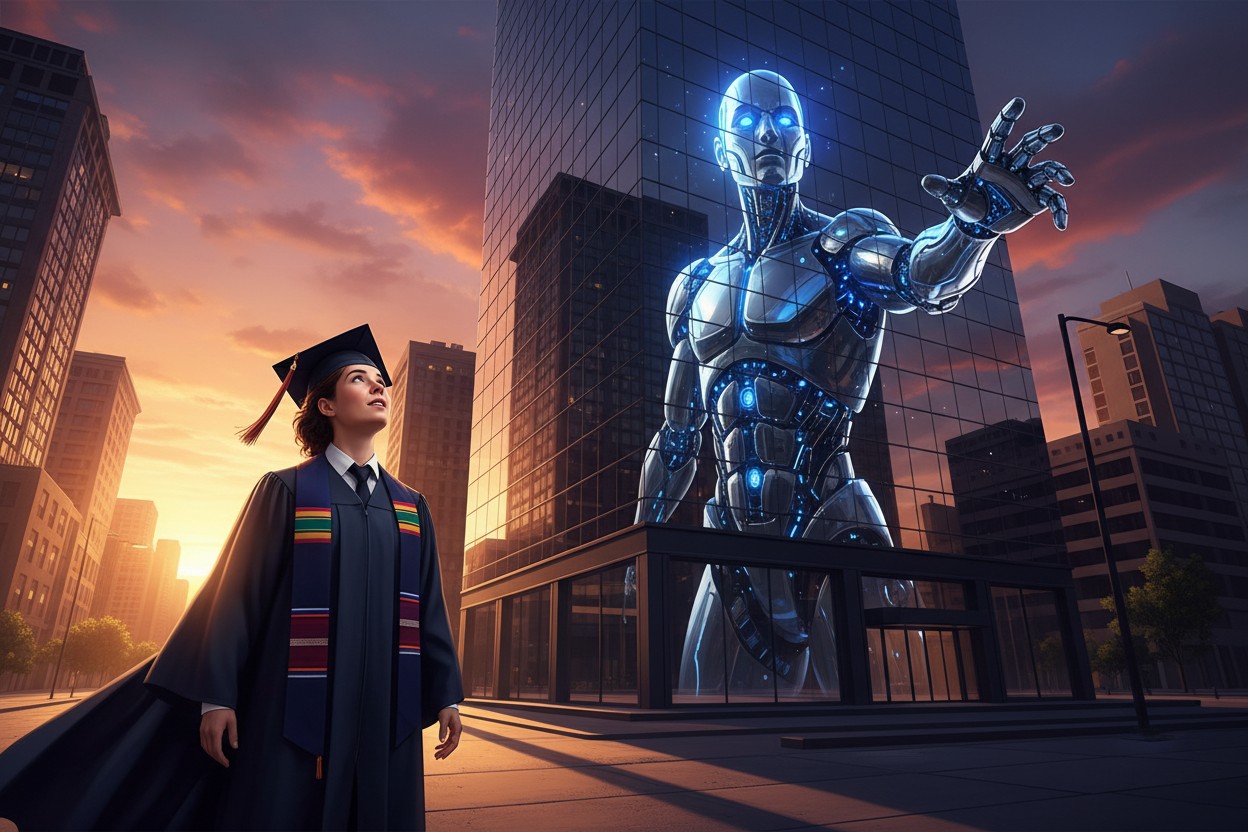
Major banks are reducing intake of junior analysts and investing heavily in artificial intelligence, according to a Bloomberg report, while recent graduates confront a double challenge: navigating AI-driven hiring processes today and questioning how many traditional finance jobs will remain tomorrow. [1]
The report highlighted that students such as Warwick University's Andre Bonnick spend hours preparing for automated screening interviews rather than conversations with human recruiters. [1] Industry leaders have grown increasingly candid about AI's effect on employment. JPMorgan Chase CEO Jamie Dimon stated that AI "will eliminate jobs," according to the report. [1] Standard Chartered CEO Bill Winters described the shift as "replacing in some cases lower-value human capital" with technology investments, comments for which he later apologized. [2]
Student Experience in AI-Driven Hiring
Andre Bonnick, a student at Warwick University, is among those navigating a hiring environment increasingly mediated by artificial intelligence. According to Bloomberg, he spends hours preparing for automated screening interviews rather than engaging with human recruiters. [1] He is also weighing options such as further study as entry-level finance roles become more competitive, the report stated. [1]
The pressure on graduates extends beyond the interview process. As banks deploy AI to handle tasks previously performed by entry-level workers, uncertainty about long-term career stability grows. Broader trends show that roles in customer service, finance, and other industries are particularly vulnerable to AI automation, according to analysis cited by NaturalNews. [6] The decoupling of labor from capital could dismantle the middle class as it has been known, according to an interview with Mike Adams. [11]
Bank Executives Acknowledge AI Impact
JPMorgan Chase CEO Jamie Dimon said that AI "will eliminate jobs," according to Bloomberg. [1] Standard Chartered CEO Bill Winters told investors that the bank would use AI to replace "lower-value human capital," a remark that triggered a public backlash. [2] Winters later apologized and said he valued all colleagues and was committed to helping them cope with change, according to the BBC. [2]
Standard Chartered later announced it would cut more than 15% of its back-office roles, around 7,800 positions, by 2030 as it increases its adoption of AI, the BBC reported. [3] Other bank executives have similarly acknowledged that some roles may no longer be needed as automation expands. [1] Researchers Erik Brynjolfsson and Andrew McAfee argue that advances in computer technology are largely responsible for sluggish employment growth over the past decade, according to the book "Augmented" by Brett King. [10]
Reductions in Junior Hiring and Investment in AI
The Bloomberg report stated that banks are reducing analyst intake programs and investing heavily in AI capabilities, leading many graduates to question the long-term stability of what were once considered secure and lucrative careers. [1] According to a Morgan Stanley analysis reported by the Financial Times, more than 200,000 European banking jobs could vanish by 2030 as lenders lean into AI and shutter physical branches. [4] That figure represents roughly 10% of the workforce at 35 major banks, with the deepest cuts expected in back-office operations, risk management, and compliance. [4]
Despite these cuts, experts cited in the Bloomberg report argue that banks cannot eliminate junior hiring entirely because the industry still depends on developing future leaders through apprenticeship-style career paths. [1] Firms that do not automate may be forced out of business, a dynamic described by Glenn Diesen in "Great Power Politics in the Fourth Industrial Revolution," where he notes that companies unable to automate will be outcompeted, and the poorest members of society typically bear the greatest burden. [8]
Current AI Deployment and Efficiency Gains
For now, most institutions are deploying AI in specific areas such as customer support, compliance, transaction monitoring, and wealth management, according to Bloomberg. [1] Banks including Citigroup and Barclays report efficiency gains from AI tools, while digital-first firms such as Revolut are embedding AI directly into customer-facing products. [1] The Bank of New York Mellon has deployed AI-powered "digital employees" that operate alongside human staff, handling tasks like coding and payment validation autonomously, according to a report by Ramon Tomey for NaturalNews. [7]
Regulatory compliance is one area where AI is expected to deliver significant returns. Zachary Jarvinen writes in "Enterprise AI For Dummies" that regulated businesses face growing complexity from agencies around the world, and AI can help turn a paperwork burden into a competitive advantage. [9] The shift toward automation in banking extends beyond routine tasks: autonomous AI systems capable of handling scheduling, health monitoring, and errands with minimal human oversight are expected to become ubiquitous by 2026, according to an article by Kevin Hughes. [5]
Conclusion: Uncertainty and Legal Concerns
Uncertainty about the scale and pace of job displacement remains. Employment lawyers warn that automation could disproportionately affect middle-office and administrative roles, while some industry observers question whether companies attribute workforce reductions to AI when broader cost-cutting may be the real driver, according to Bloomberg. [1] The technology could lead to a decline in GDP as machines replace workers who then lose purchasing power, according to an interview with Mike Adams. [12]
Although major banks continue to recruit interns and graduates, many are pursuing productivity gains without increasing headcount, the report noted. [1] As a result, breaking into finance is becoming more difficult just as AI begins to transform the nature of the jobs themselves. [1] The broader social consequences—including potential job polarization and the disproportionate burden on lower-wage earners—are themes echoed in the analysis of automation by Glenn Diesen. [8]
References
- ZeroHedge. "Replacing Lower Value Human Capital": Banks Cut Staff As Recent Grads Face Off Against AI For Jobs. June 8, 2026.
- BBC. "Bank boss sorry after describing workers as 'lower value human capital'". May 22, 2026.
- BBC. "Standard Chartered to cut thousands of roles as AI use increases". May 19, 2026.
- TechCrunch. "European banks plan to cut 200,000 jobs as AI takes hold". January 1, 2026.
- Kevin Hughes. "Agentic AI set to dominate consumer markets by 2026 spurring hiring boom and workplace transformation". NaturalNews.com. November 9, 2025.
- Kevin Hughes. "Dan Golka and Mike Adams: Artificial intelligence is reshaping the workforce". NaturalNews.com. January 16, 2025.
- Ramon Tomey. "AI powered digital employees revolutionize banking work alongside human employees". NaturalNews.com. July 3, 2025.
- Glenn Diesen. "Great Power Politics in the Fourth Industrial Revolution".
- Zachary Jarvinen. "Enterprise AI For Dummies".
- Brett King. "Augmented life in the smart lane".
- Mike Adams. "Mike Adams interview with Paul Cottrell - April 11 2023".
- Mike Adams. "2025 11 24 BBN Interview with Patrick Byrne p2 RESTATED".










Please contact us for more information.