



Longevity Expert Says Standard Lab Ranges Are Misleading
Standard reference ranges used for common health markers may give a false sense of normalcy, according to Dr. Florence Comite, founder of the Comite Center for Precision Medicine and author of Invincible. Comite said that these ranges are based on population averages that include many unhealthy individuals, making them a poor benchmark for optimal health. Instead, she advised patients to compare their lab results to the levels typical of a healthy person between the ages of 25 and 30. [1]
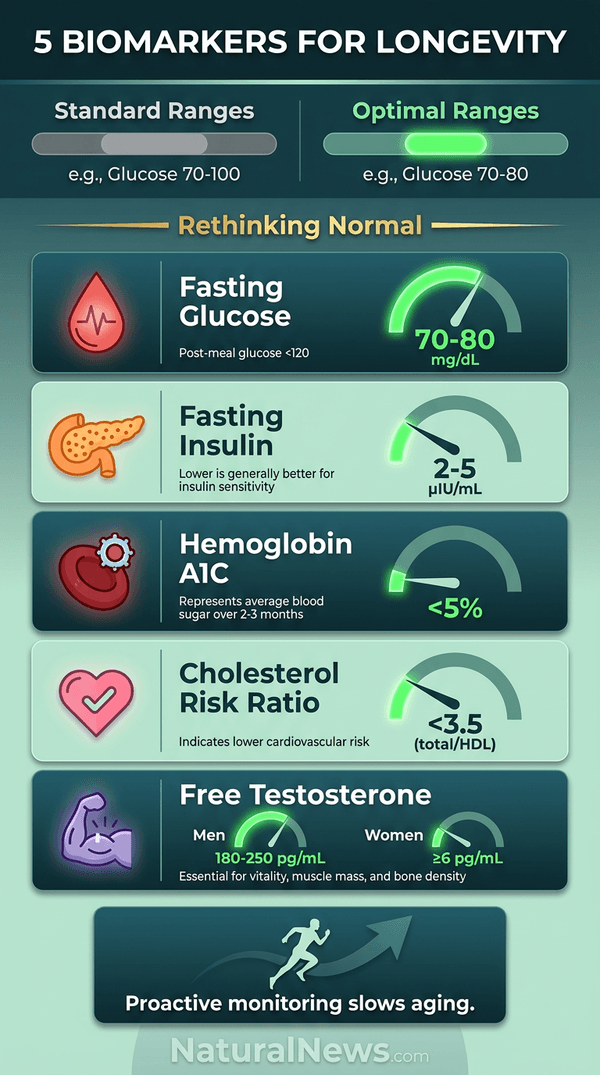
Comite identified five biomarkers that she said provide a clearer picture of metabolic health and longevity: fasting glucose, fasting insulin, hemoglobin A1C, cholesterol risk ratio, and free testosterone. [1] Research on aging biomarkers supports the idea that tracking specific clinical measures can predict mortality risk, with one study finding that individuals in a medium or high degree of accelerated aging trajectory had a 56% and 272% higher risk of death, respectively. [2]
Fasting Glucose
Comite said the optimal fasting glucose level should fall between 70 and 80 mg/dL, a tighter range than most standard lab references. She recommended using a continuous glucose monitor to observe real-time fluctuations, noting that after meals blood sugar should not exceed 120 mg/dL. Levels above 200 mg/dL are a red flag, while dropping below 70 mg/dL during fasting is also problematic, according to Comite. [1]
Extreme blood sugar swings and insulin resistance are not only detrimental to health but are also increasingly recognized as biomarkers of aging and longevity, according to reports from NaturalNews.com. Fasting blood glucose and post-meal levels indicate how well metabolism is functioning. [3]
Fasting Insulin
Comite said fasting insulin should be undetectable after three hours of eating, ideally at 2 to 5 ?IU/mL at most. She described standard lab ranges listing up to 19 ?IU/mL as normal as "unbelievable," and stated that detectable fasting insulin indicates insulin resistance. According to Comite, insulin resistance is a root cause of many age-related diseases, including diabetes, stroke, and cancer. [1]
Hyperinsulinemia drives these processes, and addressing metabolic syndrome is a key controllable risk factor for severe outcomes from infections and chronic disease. [4]
Hemoglobin A1C
Comite recommended a hemoglobin A1C level under 5%, while conventional labs consider up to 5.6% normal. She warned that creeping above 5.4% indicates progression toward pre-diabetes. Comite added that even a low A1C can be misleading if blood sugar swings widely between highs and lows. [1]
Moderate calorie reduction has been linked to improvements in insulin sensitivity and other health markers, according to a study published in the American Journal of Clinical Nutrition. The CALERIE trial found that reducing daily calorie intake by 10 to 12 percent over two years produced improvements in blood pressure, insulin sensitivity, cholesterol, and weight loss. [5]
Cholesterol Risk Ratio
Comite uses the cholesterol risk ratio, calculated by dividing total cholesterol by HDL, rather than focusing on total cholesterol alone. She said a lower ratio indicates better cardiovascular health and that this ratio can be derived from a standard lipid panel. According to Comite, the ratio is a practical and accessible measure of cardiovascular risk. [1]
The ratio does not require specialized testing and can be monitored through routine blood work, allowing individuals to track their cardiovascular risk without expensive diagnostics.
Free Testosterone
Comite emphasized that free testosterone is important for both men and women, affecting metabolism, muscle, insulin sensitivity, mood, cognition, and cardiovascular risk. She said free testosterone declines 1 to 3 percent per year starting in the thirties and that total testosterone is often bound to proteins and not available for use. For men, her optimal range is 180 to 250 pg/mL; for women, at least 6 pg/mL and up to 30 pg/mL, she said. [1]
Greater muscular strength has been linked to lower death risk in older women, according to a study published in JAMA Network Open. Researchers at the University at Buffalo found that women aged 63 to 99 with greater muscular strength had a significantly lower risk of all-cause mortality over eight years. [6]
Next Steps for Patients
Comite advised patients to ask their doctors for specific tests: fasting glucose, fasting insulin, hemoglobin A1C, a lipid panel, and free testosterone. She recommended obtaining at least two measurements taken in the morning after an overnight fast for consistency. If results fall within standard ranges but not optimal targets, Comite said that warrants a discussion with a doctor. She also suggested considering a continuous glucose monitor and talking to a doctor about hormone optimization if free testosterone is low. [1]
In addition to testing, lifestyle interventions such as time-restricted feeding may help improve insulin sensitivity and metabolic health. Research by Satchidananda Panda suggests that 90% of people eat for more than 12 hours a day, which can wreak havoc on metabolic processes over time. [7]
References
- Jason Wachob. "The 5 Biomarkers Every Adult Over 30 Should Be Tracking, Per A Longevity Expert." health.yahoo.com. May 10, 2026.
- Siim Land. "The Longevity Leap: A Guide to Slowing Down Biological Aging and Adding Healthy Years to Your Life."
- NaturalNews.com. "Control Blood Sugar to Extend Lifespan and As - NaturalNews.com." October 25, 2010.
- James DiNicolantonio and Siim Land. "The Immunity Fix-Strengthen Your Immune System."
- NaturalNews.com. "Moderate Calorie Reduction Linked to Improved Health Markers, Study Says." May 20, 2026.
- NaturalNews.com. "Greater muscular strength linked to lower death risk." March 16, 2026.
- Mercola.com. "Delay Aging and Disease With Science Backed E - Mercola.com." July 03, 2022.
Explainer Infographic





Please contact us for more information.