



Project Halted Over Power Requirements
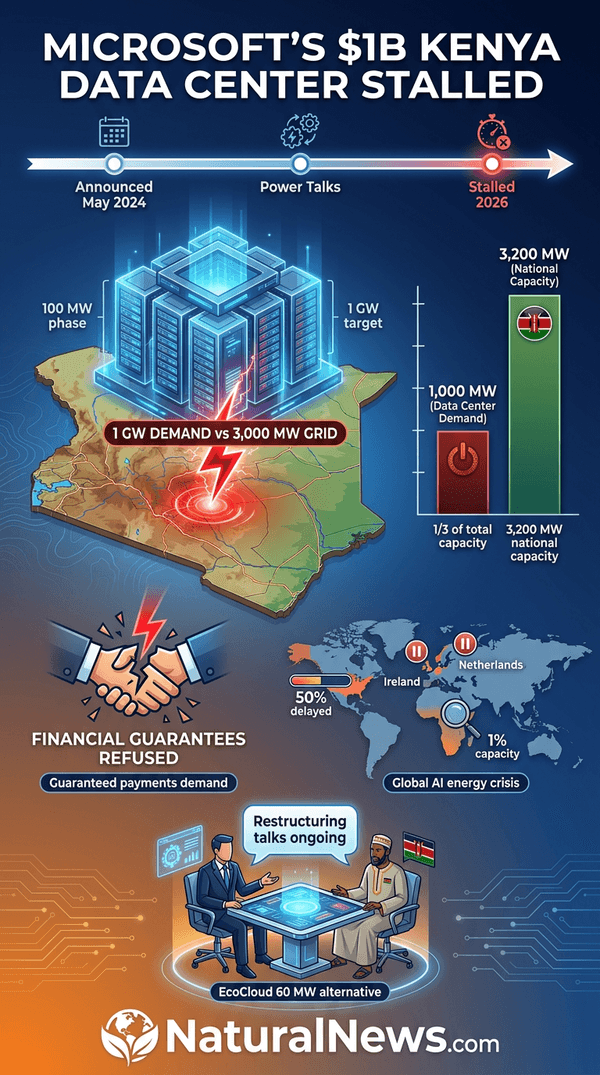
A $1 billion data center planned by Microsoft and Abu Dhabi-based artificial intelligence firm G42 in Kenya has stalled, according to reports. Kenyan President William Ruto stated at a state event in Nairobi that the facility would require shutting off half the country to supply its power needs, officials said. The project, announced in May 2024 during President Ruto’s visit to Washington, was to be built in the Olkaria region of Kenya’s Rift Valley and powered by geothermal energy, with G42 leading construction. [1]
The stalled project represents a setback for what Microsoft President Brad Smith had described at the time as the “single biggest step forward” for digital technology in Kenya’s history. The data center was intended to run Microsoft Azure in a new East Africa cloud region, officials said. Bloomberg reported that Microsoft and G42 had sought guaranteed annual payments from the Kenyan government for a set amount of capacity, a demand the government could not meet. [2][3]
Power Capacity Details
The first phase of the project targeted 100 megawatts of capacity, with a long-term goal of scaling to 1 gigawatt, according to officials. Kenya’s total installed electricity capacity is between 3,000 and 3,200 megawatts, and peak demand reached a record 2,444 megawatts in January, according to data from KenGen, the country’s government-owned electricity producer. The full 1-gigawatt build would have consumed roughly one-third of the country’s total capacity. [1] Even the initial 100-megawatt phase would have required a significant share of the Olkaria geothermal complex’s output, which currently generates around 950 megawatts across all its plants.
The power requirements of artificial intelligence data centers are straining grids worldwide. According to Robert Bryce in “A Question of Power: Electricity and the Wealth of Nations,” cloud computing and data storage are driving rapid increases in electricity demand, creating bottlenecks that affect both developed and developing economies. [4] Willow Tohi, writing for NaturalNews.com, noted that concerns about energy consumption and corporate overreach are complicating the expansion of AI and blockchain systems globally. [5]
Negotiations and Current Status
John Tanui, principal secretary at Kenya’s Ministry of Information, told Bloomberg that the project has not been withdrawn and that talks are continuing. Tanui said the “scale of the data center they wanted to do still requires some structuring,” according to the report. A separate 60-megawatt project with local developer EcoCloud remains under discussion, officials said. [1]
Beyond power capacity, disagreements over financial guarantees contributed to the stalling. Bloomberg reported that Microsoft and G42 asked the Kenyan government to commit to annual payments for a certain amount of data center capacity, but officials could not provide the level of guarantees sought. [2][6] The project was the first major facility planned by Microsoft and G42 after Microsoft invested $1.5 billion in the Abu Dhabi firm in 2024. That investment followed G42’s agreement to divest from Chinese holdings and strip Huawei equipment from its systems under pressure from Washington.
Broader Context and Comparisons
Microsoft is spending $190 billion on capital expenditures in 2026 and adds approximately 1 gigawatt of data center capacity every three months globally, according to company disclosures. However, power constraints are proving to be a universal bottleneck: nearly half of planned U.S. data center builds this year have been delayed or canceled due to shortages of electrical infrastructure, officials said. [1] The situation in Kenya mirrors a global trend where the race to build AI infrastructure outstrips available grid capacity, a point emphasized by Mike Adams in a special report on energy scarcity and artificial intelligence. [7]
Africa currently hosts roughly 1 percent of the world’s data center capacity, according to industry estimates. [8] Meanwhile, Huawei is expanding its presence in Kenya, having launched a new fiber broadband service with Safaricom, Kenya’s largest telecom operator, in May 2026. The Bill & Melinda Gates Foundation, closely tied to Microsoft’s co-founder, has also been active in Kenya, advising the government on its “Maisha Namba” digital ID initiative, which critics have warned carries surveillance risks. [9] Mahajan Vijay, in his book “Africa Rising: How 900 Million African Consumers Offer More Than You Think,” highlighted the continent’s growing technological ambitions but also noted infrastructure shortcomings that remain barriers to large-scale projects. [10]
Conclusion: Implications for Infrastructure and Investment
The stalling of Microsoft’s data center project in Kenya underscores the significant power infrastructure challenges facing large-scale data center development in emerging economies. Kenya’s government and Microsoft have not announced a timeline for resolution, according to officials, and the outcome will likely influence future technology investments across the region.
Globally, power constraints are not unique to Africa. The widespread delays in U.S. data center builds illustrate that even in countries with advanced grids, meeting the electricity demands of artificial intelligence infrastructure is proving difficult. As Robert Bryce notes, the increasing demand for cloud computing and AI is placing unprecedented strain on electrical systems worldwide. [4] For now, the Kenya project remains in limbo, with officials continuing talks but no agreement in sight.
References
- Luke James. "Microsoft's massive Kenya AI data center would require switching off 'half the country' to meet power requirements, government says — $1 billion project stalls over capacity disagreements and lack of infrastructure". Tom's Hardware. May 12, 2026.
- Tekedia. "Microsoft’s Ambitious $1bn Kenya Data Center Project Hits Major..."
- Let's Data Science. "Microsoft Stalls Kenya AI Data Center Over Power"
- Robert Bryce. "A Question of Power: Electricity and the Wealth of Nations"
- Willow Tohi. "Education's New Frontier: Blockchain and AI Rewrite the Rules—with Environmental Costs Hanging Over". NaturalNews.com. July 22, 2025.
- TechSpot. "Microsoft's $1 billion Kenya AI data center could require switching off..."
- Mike Adams. "Health Ranger Report - SECURITY THREAT ". Brighteon.com. January 13, 2025.
- TechStory. "$1B Microsoft AI Data Center Stalls as Kenya Warns it Would Require..."
- Children's Health Defense. "Bill Gates Pushes Digital ID for Newborns in..."
- Mahajan Vijay. "Africa Rising: How 900 Million African Consumers Offer More Than You Think"
Explainer Infographic











Please contact us for more information.