


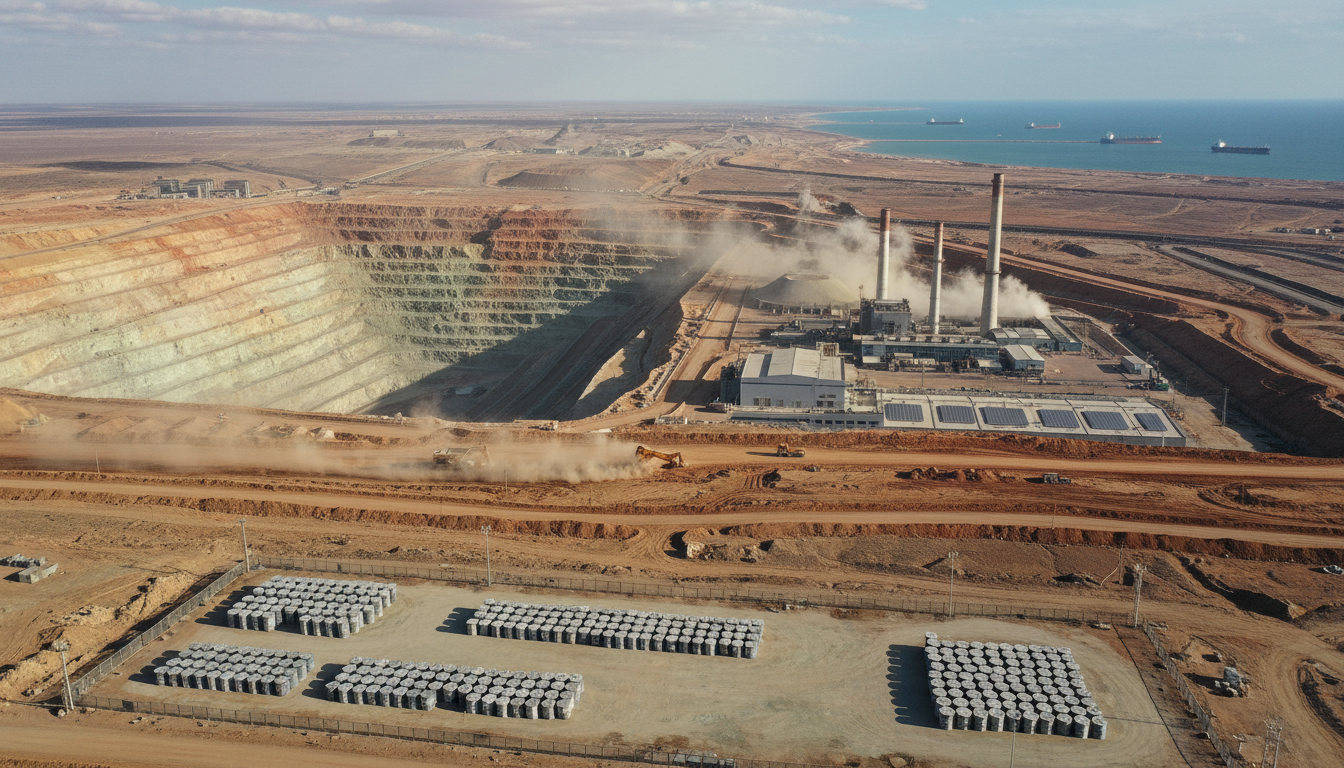
- U.S. and Chinese negotiators reached a deal for China to resume rare earth exports under temporary licenses, pending President Xi Jinping's approval.
- The agreement aims to relieve automakers like Ford within weeks but underscores national security risks of relying on China for critical minerals.
- The Pentagon is clashing with the White House over an $80 million loan to rare earths refiner ReElement Technologies amid due diligence concerns.
- China maintains its export controls are lawful and will only address "reasonable" U.S. concerns, signaling restrictions are here to stay.
- U.S. companies are urgently seeking alternative sources in Australia, Canada and Saudi Arabia as domestic production ramps up.
Deal reached amid crisis—and why it's not enough
Following two days of talks in London, U.S. and Chinese negotiators reached an agreement under which China would resume regular rare earth exports to the United States—but only through temporary licenses. President Donald Trump announced the deal was "done," though formal approval from Chinese President Xi Jinping remains pending. If finalized, Ford and other automakers could see relief within weeks.
The agreement comes after China halted rare earth shipments in April 2025 as retaliation for Trump's Liberation Day tariffs, disrupting supply chains across defense, aerospace and consumer electronics. Rare earth elements power everything from fighter jet engines to smartphones and microwave ovens.
Yet the damage has been done. The episode underscores that China's control over critical minerals represents a national security risk. Even as supply chains begin restarting, Ford, General Motors and other companies are urgently seeking alternative sources in Australia, Canada and Saudi Arabia.
Internal clash over $80 million rare earth loan reveals tensions
The Pentagon is weighing whether to scrap an $80 million conditional loan offer to rare earths refiner ReElement Technologies Corp., touching off a clash with the White House over a deal meant to break China's chokehold on critical minerals.
The Pentagon's Office of Strategic Capital announced the agreement in November. Since then, officials vetting the company have raised doubts about its ability to scale its technology and its long-term revenue forecasts, according to people familiar with the process.
White House senior counselor Peter Navarro criticized the Pentagon's handling, saying due diligence officials with private equity backgrounds lack experience managing a crisis at "warp speed." Navarro said ReElement represents "exactly the kind of asymmetric bet we should be making."
Pentagon spokesman Sean Parnell defended the team, calling them "the finest private equity dealmakers in the world" who balance speed with rigorous diligence.
ReElement CEO Mark Jensen said the company is proceeding with a facility in Indiana to refine critical minerals and produce rare earth oxides. The company has yet to produce oxides at scale and was described in an October 2025 filing as being in a "pre-revenue development stage."
Beijing defends export restrictions as lawful
China's Ministry of Commerce on Wednesday defended its rare earth export controls as legitimate and lawful. The ministry said both sides discussed the issue during the leaders' summit in Beijing last week and would "study and resolve each other's reasonable and lawful concerns."
The statement marked a shift from six months ago, when the White House said after the Busan summit that China committed to "effectively eliminate" all current and proposed critical mineral export controls. The latest White House statement now tacitly acknowledges that China's export control regime is here to stay.
Shortages have been most acute for yttrium, used to protect turbine blades in aircraft engines and power plants from extreme heat. Chinese customs data released Wednesday showed a 10-metric-ton export of yttrium oxide to the U.S. in April, compared to 60 tons in March. Shipments averaged about 30 tons a month before controls were imposed versus 8 tons since.
Critical mineral for next-generation chips faces export restrictions
For the first time, the White House mentioned indium in its summit recap—a critical mineral that plays a key role in the semiconductor supply chain and has been on a Chinese export control list since February 2025.
Indium compounds are crucial for making next-generation photonic chips that use light instead of electricity to process data, as well as high-speed optical lasers used in fiber optic and 6G networks. Chinese exports of indium have fallen by about two-thirds globally and 77% to the U.S. since controls were imposed.
Coherent Inc., whose CEO accompanied Trump on the Beijing visit, holds 40% global market share in indium phosphide optical components. If Chinese licensing remains slow or politically contingent, Coherent could face higher input costs, allocation problems and difficulty meeting demand from AI data centers worldwide.
The rare earth wake-up call that changes everything
The current agreement provides temporary relief but does not solve the underlying problem. China controls nearly all global rare earth processing, and Beijing has demonstrated willingness to use that leverage as a geopolitical weapon.
The Trump administration has fast-tracked domestic mining projects, allied with resource-rich nations including Australia, Canada and Saudi Arabia, and stockpiled reserves with a goal of breaking dependence on China within 12-24 months. But the Pentagon's internal struggle over the ReElement loan highlights the tension between speed and rigor.
The crisis is not confined to automobiles or consumer electronics. Rare earth elements power U.S. military systems including the F-35 fighter jet, missile guidance systems and satellite communications. As the White House and Pentagon continue to navigate this strategic vulnerability, the lesson is clear: America's dependence on hostile nations for critical materials represents a national security risk that no temporary license agreement can fully address.
Sources for this article include:









Please contact us for more information.