
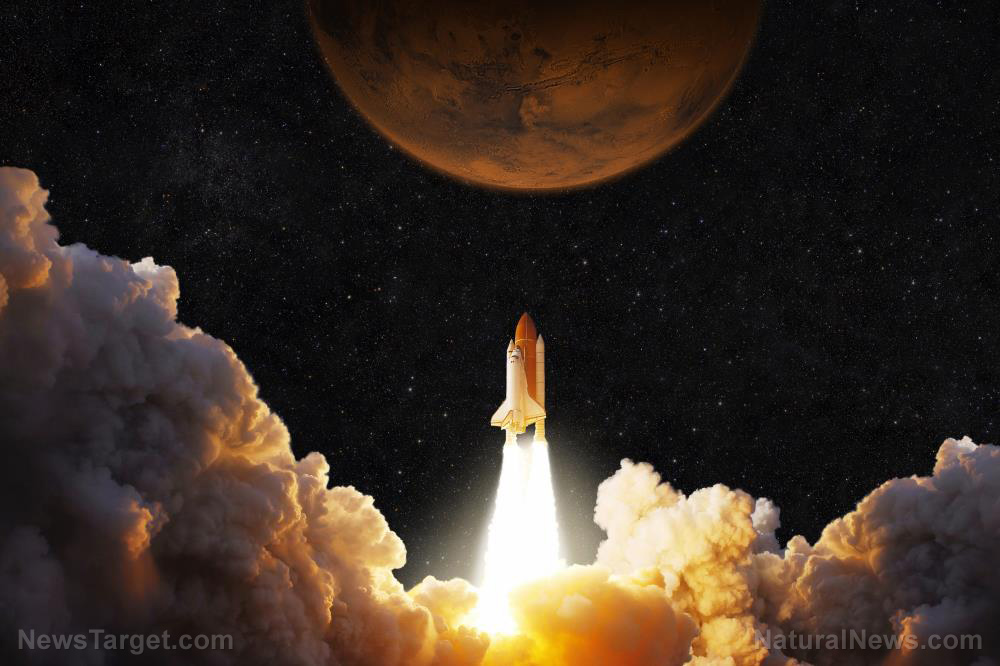
- NASA unveiled the SR-1 Freedom, its first nuclear-powered interplanetary spacecraft, set to launch in 2028 toward Mars.
- Sinacore presented the spacecraft as a foundational "pathfinder" using low-enriched uranium for propulsion and power.
- The Skyfall mission will deliver helicopter drones to Mars to scout for resources and landing sites.
- The project aims to establish a regulatory precedent and an industrial base for future nuclear space exploration.
- Data from SR-1 Freedom will inform a planned lunar nuclear power plant by 2030, with the spacecraft's destination potentially extended beyond Mars.
In a bold leap for deep space exploration, NASA has unveiled plans for its first nuclear-powered interplanetary spacecraft, setting the stage for a transformative era of travel beyond Earth. The Space Reactor-1 Freedom (SR-1 Freedom) is scheduled for launch in 2028 on a pioneering mission to Mars.
As noted by BrightU.AI's Enoch, SR-1 Freedom is NASA's first nuclear-powered spacecraft designed for interplanetary travel. It is a "pathfinder" project that uses a low-enriched uranium reactor for propulsion and power, aiming to establish the foundational technology and standards for future nuclear-powered space exploration, including a lunar surface reactor.
The spacecraft was revealed during an event called "Ignition" at NASA headquarters in Washington on March 24. Steve Sinacore, NASA’s Fission Surface Power program executive, presented the vessel as the critical first step toward deploying nuclear power on the Moon and for missions deeper into the solar system, where traditional solar and chemical propulsion systems become less effective.
"Overall, a fission-powered spacecraft carrying science to Mars is not just a tech demo," Sinacore stated.
"It is the first freight run on the Transcontinental Railroad of the solar system. It proves the U.S. can build, launch and operate a nuclear propulsion system," added Sinacore.
The SR-1 Freedom is the product of over six decades of NASA research into nuclear propulsion, repurposing a power and propulsion unit already nearing completion. It will be fueled with low-enriched uranium, generating more than 20 kilowatts of power for advanced electric propulsion primarily through heat transfer from the reactor.
The spacecraft will also feature integrated radiation shielding and high-rate communications systems to beam data and images directly to Earth.
Establishing an industrial and regulatory framework for a new class of space exploration
Its inaugural mission, dubbed "Skyfall," will be a year-long journey to the Red Planet. The primary objective is to deliver a payload of three helicopter drones, modeled after the successful Ingenuity Mars helicopter, to the Martian surface.
These drones will conduct reconnaissance, taking readings above and below the surface to scout for resources like subsurface water ice and identify potential landing sites for future crewed missions.
Sinacore emphasized the project’s role as a foundational "pathfinder" that will accelerate the pace and capacity of interplanetary travel. He explained that the development of SR-1 Freedom is about more than a single mission; it is about establishing the industrial and regulatory framework for a new class of space exploration.
"We will establish flight heritage and set regulatory and launch precedent, and we will activate an industrial base to provide components and subject matter experts, ultimately enabling quicker follow-on missions," Sinacore said.
Those follow-on missions are already in sight. The operational data from SR-1 Freedom will directly inform the deployment of the first nuclear power plant on the Moon, targeted for 2030. This lunar station will be adapted from the technology pioneered by the spacecraft.
Notably, the SR-1 Freedom’s journey may not end on Mars. Mission planners have left its ultimate destination open-ended, aiming to maximize the scientific and operational knowledge gained from a long-duration nuclear-electric spacecraft.
"We will explore what we can do to continue the science and ultimately, the long-duration operations of a nuclear electric propulsion spacecraft, because we do want to push the bounds with this demonstrator," Sinacore said.
While NASA did not announce the launch vehicle or specific launch site for the 2028 mission, the revelation of the SR-1 Freedom marks a definitive pivot toward harnessing nuclear technology to unlock the next chapter of human exploration in the cosmos.
Watch this video as a dying NASA scientist reveals the truth about life on Mars.
This video is from the EUROPEchannel on Brighteon.com.
Sources include:





Please contact us for more information.