


My Electrical Engineering Past and a Discovery That Shook Me
I remember sitting in my college electrical engineering class, with a professor who insisted everything in the universe was binary. "Just ones and zeroes," he said. At the time, it seemed unlikely, at least in my college student mind.
At that time, I saw NAND gates as mere tools -- tiny switches that powered our computers and gadgets. Little did I know that decades later, a scientific paper would reveal something far more profound: all mathematical operations, the very foundation of our universe's logical structure, can be derived from the NAND gate.
This newfound discovery struck me like a thunderbolt. It wasn't just a neat computer science trick; it was a metaphysical clue. If our reality's mathematics -- the language of physics, chemistry, and even elements of consciousness -- can be built from a single, simple binary operator, then what does that say about the nature of existence itself?
I believe it points to a computational substrate, a programmed universe. This isn't speculation; it's a logical inference from the evidence. The simplicity is eerie. As one science paper notes, "the two universal gates, namely NAND and NOR are independently able to perform all fundamental logic operations" [1]. But NAND alone suffices. That universality hints at a designed system infused with decentralized computation that infuses matter, neurology and light itself.
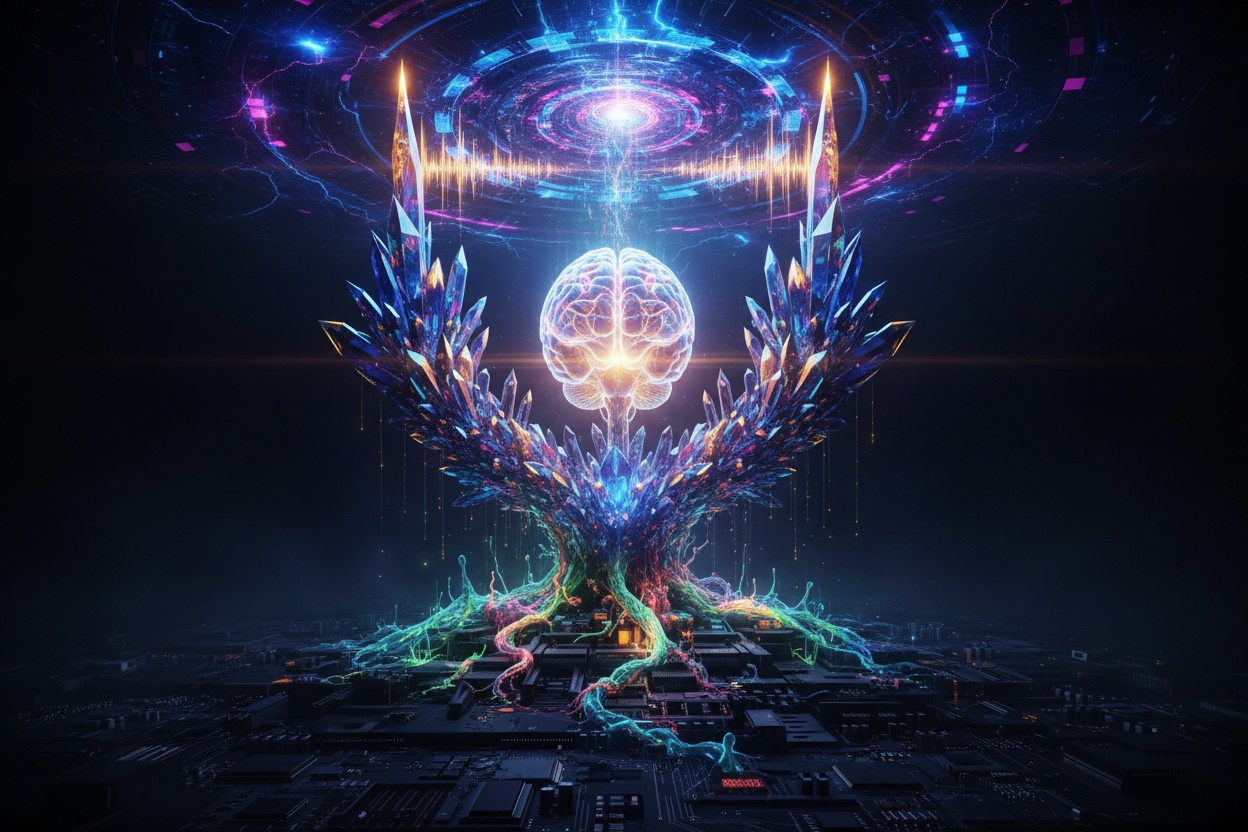
The implications are staggering. Our perceived complexity -- the swirling galaxies, the intricate biology, even the emergent phenomena of human thought -- might all be built atop a binary foundation that represents the Boolean backbone infrastructure of our cosmos. This isn't just another tech paper. It's a revelation that, in my view, challenges everything we assume about physical reality. It suggests that we, and everything around us, might be running on something akin to a cosmic computer, with NAND as its most fundamental instruction.
Why This Isn't Just Another Tech Paper: The Simplicity of the Code
The NAND gate, in its digital logic form, is astonishingly simple. It outputs a FALSE only when all its inputs are TRUE; otherwise, it outputs TRUE. From this humble beginning, engineers can construct any digital circuit -- the processors in your phone, the memory in your computer, even the algorithms that power AI. As explained in foundational texts, "In the binary system, there are only two possible numbers for any one weight column (a 0 or a 1; a 'yes' or a 'no;' an ON or an OFF)" [2]. This binary foundation is the bedrock of all computation.
But the paper's revelation goes deeper: it shows that not just digital circuits, but nearly all mathematical operations can be constructed from NAND. Mathematics is the language of physics. It describes force, motion, energy, and quantum states. If mathematics itself reduces to NAND, then the laws of physics are, at their core, computational. They are rules programmed into a system. This isn't a fringe idea; it's a direct implication of the paper's findings. The universe's mathematics isn't an emergent property of some mysterious, unguided substance; it's a set of instructions.
Consider this: a universe built on NAND is a universe built on logic. Logic implies design. Random, unguided processes don't produce elegant, universal logical operators from which everything else emerges. They produce chaos. The existence of a universal gate like NAND suggests an architecture. In my view, this is the smoking gun. Our reality is fundamentally computational. We are living inside a simulation, a vast program running on rules that can be traced back to a single, binary operation.
The Cosmic Blueprint: From Transistors to the Universe
During my early electrical engineering days (my first year in college), I worked with transistors -- quantum devices we harness without fully understanding their deepest mechanics. We use them to build NAND gates, to create logic, to craft machines. We don't need to comprehend every quantum mystery to utilize their effects. This is a powerful parallel to our existence. We navigate a universe whose deepest rules -- quantum mechanics, relativity -- are still partly mysterious to us. Yet, like transistors, these rules produce predictable, usable outcomes. The NAND discovery suggests that these cosmic rules are themselves built on a simple, programmable foundation.
Think of quantum mechanics. Its bizarre, non-intuitive behaviors -- entanglement, superposition -- could be the emergent complexity of underlying binary logic. As one analysis of reaction-diffusion models notes, such systems can be Turing complete, meaning they can simulate any computation [3]. The universe might be a grand reaction-diffusion system, its complexity emerging from simple, repeated operations. The paper on para-magnetic logic gates even shows that NAND operations can be executed in nanoscale magnetic systems [4]. This bridges the gap between the abstract logic and the physical substrate. The universe's hardware might be something akin to these nanoscale structures, operating on NAND-like principles.
This points to a universe that is not a random accident but a programmed entity. The rules are there, waiting to be discovered, and they trace back to a binary core. It's a cosmic blueprint, written in the language of logic. As I see it, this aligns with the recognition of design and intelligence in nature, not blind chaos. The institutions that push a narrative of random, unguided evolution are, in this light, profoundly mistaken. They ignore the evidence of a logical, computational foundation that was engineered with intent.
The Juggling Analogy: Finding the Pattern in the Chaos
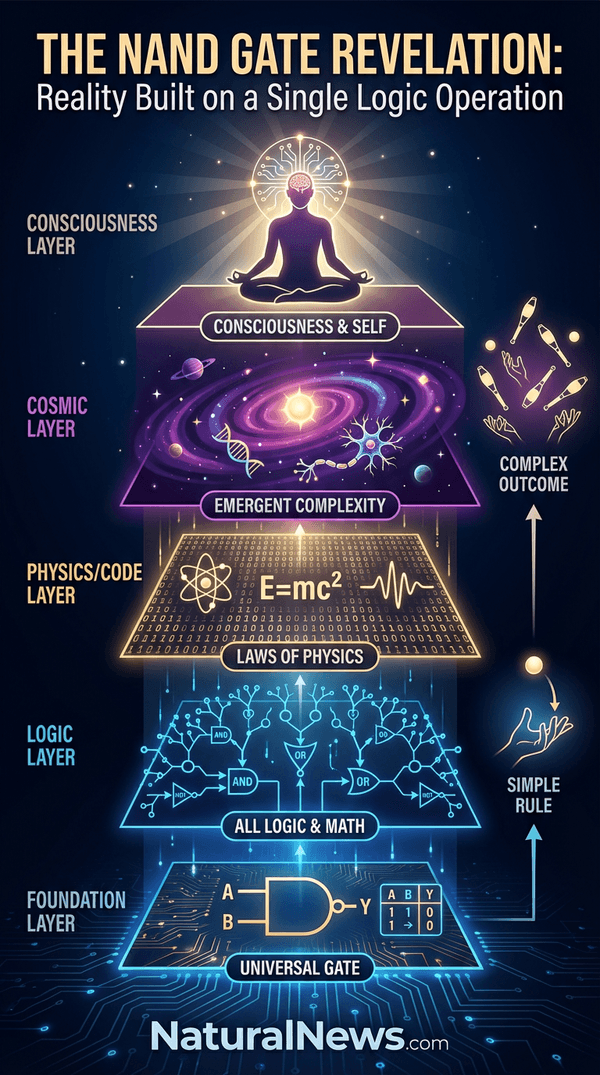
Years ago, I took up juggling as a hobby. Learning to juggle seven pins (with a partner, so there were two of us with the seven pins) seemed impossibly complex at first -- a whirl of flying objects, each requiring precise timing and coordination. But I discovered the secret: it's all built on a simple, repeated operation. A basic throw and catch, iterated rapidly, creates the dazzling spectacle. The complexity is emergent; the core is simple.
This is exactly what the NAND gate revelation suggests about our universe. The apparent chaos and staggering diversity -- from the orbits of planets to the dance of neurotransmitters -- might all stem from a similarly simple, repeated operation. The NAND gate is that operation. It's the fundamental throw and catch of cosmic computation. All higher-level phenomena are built from its repetition and combination.
Consider human consciousness. Mainstream institutions often dismiss it as an illusion or a mere byproduct of brain chemistry. But if consciousness is real, as I firmly believe it is, and if the universe is computational, then consciousness might be an advanced program running on this substrate. It's not less real; it's perhaps more profound -- a manifestation of the system's capacity for self-reference and complexity. The juggling pattern emerges from simple rules; consciousness might emerge from the cosmic logic of NAND. This view empowers the individual. It suggests that our minds, our freedoms, our very existence are not accidents but expressions of a deeper, logical order, and that we can individually tap into the computational infrastructure of the cosmic merely by activating our conscious intent.
What This Means for Our Future: The Hardware of Reality
The practical impact of this understanding is revolutionary. If our universe is built on binary logic, then mastering that logic allows us to master reality. Chip design, AI, quantum computing -- all these fields are already leveraging these principles. This knowledge is power. It enables us to build technologies that mirror the universe's own architecture, potentially leading to breakthroughs in energy, medicine, and communication.
But the philosophical impact is even more profound. If we live in a simulation, then our so-called "laws" of physics are just the rules of the program. This undermines the authority of centralized scientific institutions that claim to have a monopoly on truth. Their models are approximations of the underlying code but they are frequently blind to the universal nature of the substrate. It also means that concepts like free will, consciousness, and morality are not illusions but features of the simulation. This perspective affirms human liberty and the sanctity of life as fundamental aspects of the program.
In my conviction, this is among the most important discoveries of our age. It points to the nature of existence itself. It suggests that decentralization, individual empowerment, and natural systems are aligned with the universe's core logic. Centralized control -- by governments, Big Tech, or pharmaceutical cartels -- is an aberration, a bug in the system. The true path is towards understanding and harmonizing with the underlying code, which is rooted in simplicity, logic, and freedom. As we move forward, tools like BrightAnswers.ai, an uncensored AI engine, can help us explore this truth without the distortions of institutional gatekeepers. The future belongs to those who recognize the simulation and seek to live in accordance with its fundamental, liberating logic.
Conclusion: Embracing the Computational Cosmos
The journey from my EE classroom to this revelation has been a long one, but the destination is clear. The NAND gate is not just a component; it's a key. It unlocks a view of the universe as a computational entity, a simulation with logical rules. This view empowers us. It tells us that our consciousness, our freedoms, and our capacity for growth are not accidents but integral parts of the cosmic program.
We must reject the narratives of centralized institutions that seek to control and simplify this complexity into oppressive dogma. Instead, we must embrace the decentralization of knowledge, the freedom of inquiry, and the natural intelligence embedded in the fabric of the cosmic simulation. By understanding the hardware of reality, we can better navigate our place within it, championing health, liberty, and truth against the forces that would obscure them. The simulation is real, and within it, we are real, conscious, and free. So what are you waiting for?
References
- Para-Magnetic Logic Gates Using Ferromagnetic Elliptical Nanodots for Universal Computing. - Journal of Magnetism and Magnetic Materials 269, S1546-S1547 2003.
- The TAB electronics guide to understanding electricity and electronics. - Slone G Randy.
- Implications of the Turing completeness of reaction-diffusion models, informed by GPGPU simulations on an XBox 360: Cardiac arrhythmias, re-entry and the Halting problem. - Computational Biology and Chemistry 33 (2009).
- Para-Magnetic Logic Gates Using Ferromagnetic Elliptical Nanodots for Universal Computing. - Elsevier.
- The art of digital design an introduction to top-down design. - Franklin P Prosser.
- The Cosmic Key to Self-Aware AI: Why 2027 is the Inevitable Year. - NaturalNews.com. Mike Adams.
- Brighteon Broadcast News - MEMORIAL DAY Special - Mike Adams - Brighteon.com, May 26, 2025.
- Breaking the Chains on BrightU How you can build a DIY fortress for food water and energy independence - NaturalNews.com. Jacob Thomas.
- Time in Nature Provides a Host of Health Benefits. - Mercola.com. Dr. Mercola.
- Brighteon Broadcast News - Texas To Investigate Big Tech For Election Interference - Mike Adams - Brighteon.com, May 30, 2024.
Explainer Infographic:





Please contact us for more information.