


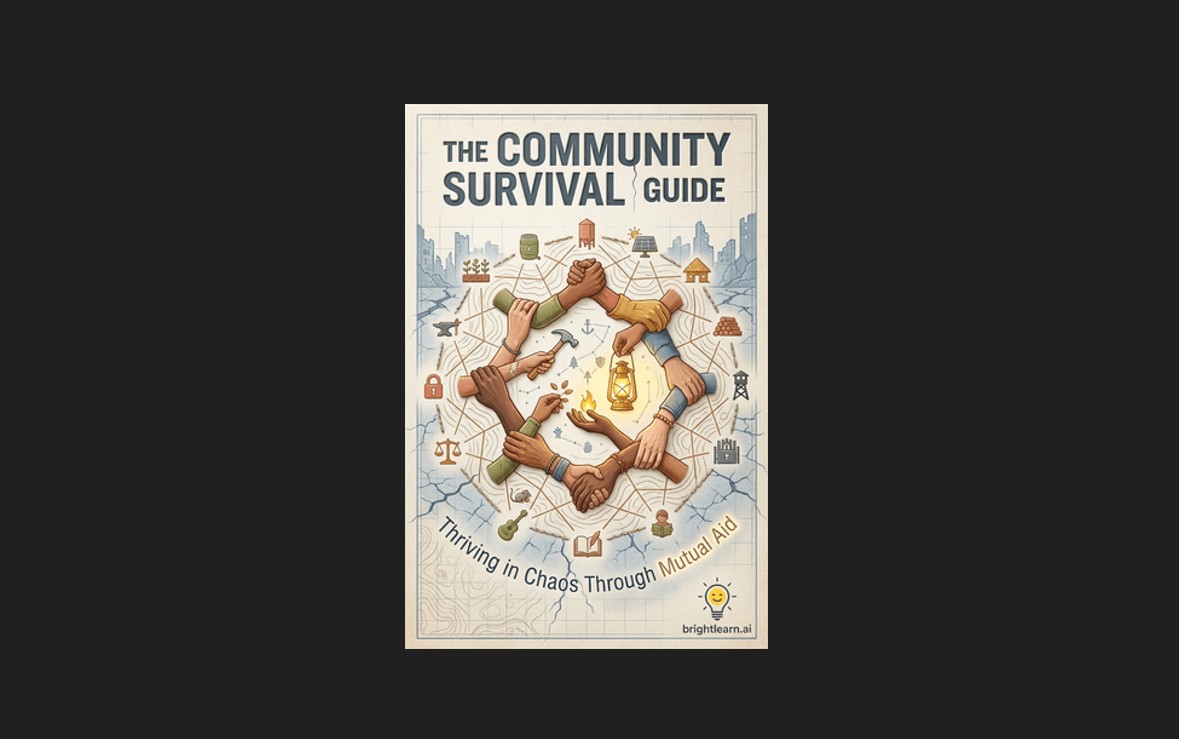
- "The Community Survival Guide: Thriving in Chaos Through Mutual Aid" mentions that historical and modern crises (Hurricane Katrina, Venezuela's collapse) prove that isolated individuals face higher mortality rates, while communities with strong social ties recover faster and thrive.
- Psychological studies show isolation leads to cognitive decline, depression and physical deterioration, while social bonds reduce stress and improve decision-making in disasters.
- No single person can master farming, medicine, security and repairs; survival depends on shared labor, specialization and mutual aid (e.g., frontier settlers, Amish communities).
- Decentralized mutual aid networks (Puerto Rico's solar grids, Greek local currencies) succeed where centralized systems fail, proving antifragility through cooperation and resource-sharing.
- Social capital is essential. Trust and relationships – not just stockpiles – determine survival. Villages with strong communal ties (post-Fukushima) rebuild faster, while lone preppers remain vulnerable without a support network.
The rugged individualist, holed up in a bunker with stockpiles of food and ammunition, has long been romanticized in survivalist culture. But history and modern crises reveal a harsh truth. Lone survivalism doesn't just fail – it often makes disasters worse, as revealed in the book "The Community Survival Guide: Thriving in Chaos Through Mutual Aid."
From Hurricane Katrina to the collapse of Venezuela's economy, the evidence is clear. Communities that band together don't just survive. They adapt, recover and even thrive when centralized systems fail.
When Hurricane Katrina struck New Orleans, those who relied solely on themselves faced the highest mortality rates. Researchers found that neighborhoods with strong social ties – trust, reciprocity and shared resources – had lower death tolls and faster recoveries. Why?
Because survival isn't just about supplies; it's about people. A lone survivalist may have food – but without a doctor, mechanic or extra hands to defend against looters, their stockpile is useless. Communities, however, pool skills and resources – ensuring that when one person runs low, another can fill the gap.
Humans aren't meant to be alone
The psychological toll of isolation is just as deadly as physical deprivation. Studies on disaster survivors show that prolonged loneliness leads to cognitive decline, depression and even accelerated physical deterioration.
Humans are wired for connection. When severed from others, stress hormones spike, decision-making falters and hope evaporates.
During the Wuhan coronavirus (COVID-19) lockdowns, mental health crises surged not because people lacked food or shelter, but because they lacked each other. In a long-term collapse, this despair becomes fatal.
No single person can master every skill needed for survival. Farming, medicine, security and mechanical repairs all require specialization. Even historical "rugged individualists" like frontier settlers relied on communal labor – barn raisings, shared harvests and militia groups for defense.
As prepper Stephen Verstappen notes, the myth of the self-sufficient homesteader ignores reality. Frontier families depended on wagon trains, trading posts and neighboring farms. Today's survivalists stockpile gold and guns – but without a blacksmith, medic or farmer in their network, those resources won't last.
Government fails in crisis, but organized communities thrive
Government responses to crises almost always fail individuals but can't ignore organized communities. After Hurricane Maria, the Federal Emergency Management Agency's sluggish bureaucracy left Puerto Ricans without aid for months. Yet grassroots mutual aid networks like Casa Pueblo’s solar microgrid stepped in – providing power, food and medical care.
Centralized systems are brittle, while decentralized communities are antifragile – they grow stronger under stress. During the 2008 financial crash, local currencies and food co-ops in Greece and Argentina kept people fed when national economies collapsed.
The economic inefficiency of lone survivalism is staggering. Why should ten families each buy a $2,000 solar generator when one could serve all?
Pooling resources doesn't just save money – it builds redundancy. If one garden fails, another thrives. If someone falls ill, others cover their duties.
This principle known as Business Ecology thrives on interconnection, not isolation. Even the Amish – often romanticized as self-sufficient – rely on tight-knit communities where one family makes shoes, another grows wheat and all benefit.
How social capital outlasts stockpiles
Social capital – trust, relationships and shared values – is as critical as food or water. After the Fukushima disaster, villages with strong communal ties had lower post-traumatic stress disorder rates and rebuilt faster than those where neighbors were strangers.
Trust isn't just nice to have – it's a survival multiplier. When crises hit, you can't manufacture trust – it must be built before the storm.
Lone survivalists overlook this, assuming guns or gold will protect them. But history – from the Donner Party to Yugoslavia's collapse – proves people save people, not stuff.
The choice is clear: Stockpiling alone leads to vulnerability; organizing ensures resilience. If you want to survive, don't just prepare – connect.
Build relationships, share skills and create systems where everyone's strengths compensate for others' weaknesses. Because when the next crisis hits, the lone wolf won't last – but the pack will endure.
Grab a copy of "The Community Survival Guide: Thriving in Chaos Through Mutual Aid" via this link. Discover this book and other good reads at Books.BrightLearn.AI, with thousands of books and counting – all available to freely download, read and share. The decentralized BrightLearn.AI engine also lets readers create their own books, empowering them to share insights and truths with the world.
Watch Stefan Verstappen sharing survival wisdom and the importance of community prepping in this edition of the "Health Ranger Report."
This video is from the Health Ranger Report channel on Brighteon.com.
Sources include:




Please contact us for more information.