
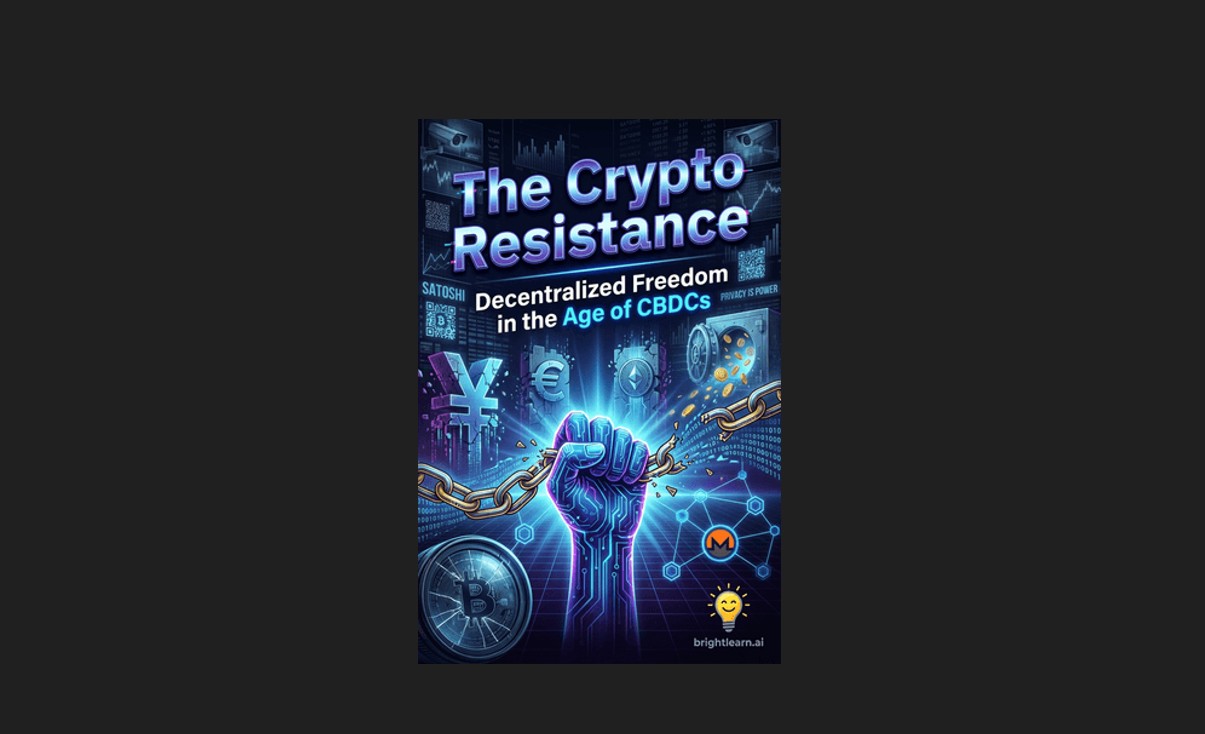
- Central Bank Digital Currencies (CBDCs) enable governments to track, freeze or expire funds at will, turning money into a tool of surveillance and control (e.g., China's social credit-linked digital yuan).
- Originally a tool for financial freedom, Bitcoin has been hijacked by Wall Street and regulators, transforming it into a surveilled asset rather than private, decentralized cash.
- Cryptocurrencies like Monero and Zano offer true financial anonymity, making them critical for resisting CBDC surveillance and preserving economic freedom.
- Tokenizing real-world assets (gold, real estate) and decentralized networks (DAOs, barter systems) allow communities to bypass centralized financial control.
- Secure self-custody (hardware wallets, precious metals), achieve self-sufficiency (off-grid living, food production) and organize locally to resist financial oppression.
In an era where financial surveillance and centralized control loom larger than ever, "The Crypto Resistance: Decentralized Freedom in the Age of CBDCs" emerges as a clarion call for autonomy, privacy and defiance against the encroaching dystopia of programmable money.
Written with the urgency of a manifesto and the precision of a tactical guide, this book dismantles the illusion that Central Bank Digital Currencies (CBDCs) are benign innovations. Instead, it exposes them as the ultimate tools of financial tyranny – designed to track, restrict and manipulate every transaction you make.
The hidden war on financial freedom
The book opens with a chilling premise: CBDCs are not just digital dollars but programmable surveillance instruments. Unlike decentralized cryptocurrencies like Bitcoin, CBDCs grant governments and central banks unprecedented control over your money. Imagine funds that expire if unused, purchases blocked for "unapproved" goods or accounts frozen for dissent.
This isn't speculative fiction – it's already happening. China's digital yuan, for instance, integrates with social credit systems, rewarding compliance and punishing disobedience. The book warns that Western nations are following suit, camouflaging control under the guise of "convenience" and "financial inclusion."
The hijacking of Bitcoin
Bitcoin was born as a rebellion – a peer-to-peer electronic cash system to bypass banks and governments. But as the book meticulously documents, institutional interests have co-opted its revolutionary potential. Wall Street turned Bitcoin into a speculative asset ("digital gold"), while regulators and centralized exchanges (like Coinbase) imposed surveillance via KYC/AML laws. The original vision of privacy and decentralization is under siege, replaced by a system where "not your keys, not your coins" is more urgent than ever.
Privacy coins: The last bastion of freedom
If Bitcoin's transparency is a double-edged sword, privacy coins like Monero and Zano are the antidote. These cryptocurrencies obscure transaction details, making financial surveillance impossible. The book highlights their critical role in resisting CBDCs, especially as governments crack down on their exchange listings. The message is clear: financial privacy is not optional – it's a human right.
Tokenization and the alternative economy
Beyond crypto, the book explores tokenizing real-world assets, real estate, gold, art, into blockchain-based fractions. This democratizes wealth, bypassing traditional gatekeepers. Meanwhile, decentralized autonomous organizations (DAOs) and local barter networks offer blueprints for communities to thrive outside the collapsing fiat system. The goal? Build parallel systems that render centralized control irrelevant.
Practical survival strategies
The final section is a survival manual for the coming financial collapse. Key takeaways:
- Self-custody your assets. Hardware wallets (Trezor, Ledger) and precious metals (gold, silver) are non-negotiable.
- Ditch dependencies. Grow food, harvest rainwater and adopt off-grid energy to evade systemic fragility.
- Educate and organize. Financial freedom is a collective effort – host meetups, share resources and resist compliance.
"The Crypto Resistance" doesn't just diagnose the problem – it equips you to fight back. Its tone is urgent but empowering, blending historical parallels (Weimar hyperinflation, Canadian trucker protests) with actionable steps. Whether you're a crypto novice or a seasoned libertarian, this book is a roadmap to opt out before the digital prison is fully constructed.
In a world hurtling toward dystopia, "The Crypto Resistance" is the handbook for those who refuse to surrender. It's a rallying cry to reclaim sovereignty – one private transaction, one decentralized community, one self-sufficient homestead at a time.
Get a copy of "The Crypto Resistance: Decentralized Freedom in the Age of CBDCs" via this link. Read, share and download thousands of books for free at Books.BrightLearn.AI. You can also create your own books for free at BrightLearn.AI.
Watch the "Decentralize TV" episode below, where Mike Adams interviews Aaron Day on defeating CBDCs and achieving mass human freedom through decentralization.
This video is from the Health Ranger Report channel on Brighteon.com.
Sources include:









Please contact us for more information.