


Introduction: The Tangible Hedge Against a Predicted Collapse
I’m preparing for food scarcity. Not with a vague sense of unease, but with deliberate, tangible action. While others watch the headlines about Middle East conflicts and rising commodity prices with detached concern, I am converting cash into plant food. In my view, the geopolitical shock triggered by the U.S. and Israeli strikes on Iran is not merely another distant war; it is the precise catalyst for a global fertilizer supply collapse that will manifest as higher food prices and more severe food scarcity later this year and well into 2027. This article is my case for why you should see fertilizer not as a simple agricultural input, but as the ultimate tangible asset for personal resilience and a direct vote against a centralized food system that is now breaking under the strain of its own fragility.
The evidence is no longer speculative. As of March 10, 2026, the global agricultural sector is already grappling with a sudden and destabilizing 6.5% surge in fertilizer prices [1]. This is the first tremor. The closure of the Strait of Hormuz -- a critical artery through which roughly 20% of the world’s oil and a massive portion of liquefied natural gas (LNG) shipments flow -- has effectively severed global energy and fertilizer supply chains [2]. The attacks have not just disrupted markets; they have "severed the global supply of elemental sulfur and its derivative, sulfuric acid" [3], a foundational chemical for phosphate fertilizer production. This isn't a crisis about to begin; it has already been unleashed.
The Coming Famine Is a Fertilizer Crisis in Disguise
Most people see famine as a tragic result of drought or war in far-off lands. They miss the mechanics. Modern, high-yield agriculture is an industrial process utterly dependent on constant inputs of synthetic fertilizer, primarily derived from natural gas. The Strait of Hormuz crisis disrupts vital global supply chains, threatening the fertilizer and energy flows essential to food production [4]. When that flow stops, the math is simple: lower fertilizer application leads to catastrophic drops in yield. This single act has severed a massive portion of the world's natural gas supply, the foundational feedstock for modern agriculture [2].
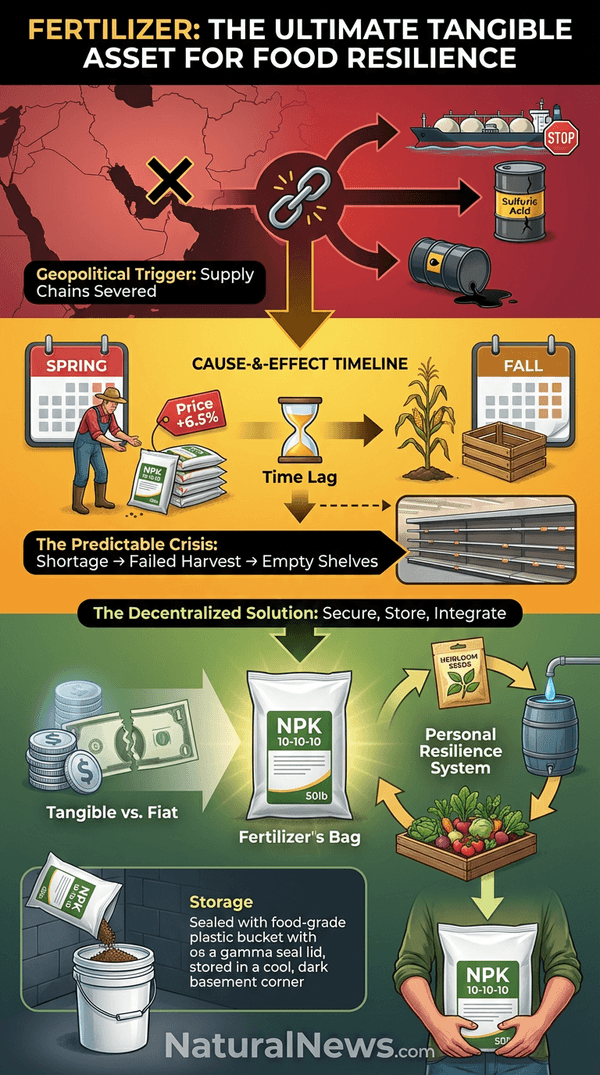
This is a tangible, predictable crisis most will miss until it's too late because of the lag time in the system. The grain planted this spring depends on fertilizer applied now. If farmers can't get it or can't afford it, the harvest this fall will falter. The empty shelves will hit later, creating a dangerous illusion of normalcy for the unprepared. As one analysis starkly warns, "Without this form of fertiliser, crops will not produce yields on which the world’s population depends, leaving people starving" [5]. This isn't a future hypothetical; U.S. farmers are already "bracing for a system shock resulting from the disruptions to shipping through the Strait of Hormuz" [6]. Fertilizer is not just an input; it's stored potential for food and, therefore, life. We are watching that potential being systematically destroyed.
Fertilizer as 'White Gold': The Ultimate Tangible Asset
In a world of hyperinflating fiat currencies and digital digits subject to bank freezes or CBDC controls, we must rethink what constitutes real wealth. I believe wealth is what sustains and protects life. Gold and silver have served this role for millennia, and I hold them. But there is another, more immediately practical asset: fertilizer. Unlike a dollar bill, a 50-pound bag of 10-10-10 NPK has intrinsic, life-sustaining value. You can't eat a stock certificate, but you can use that bag to grow hundreds of pounds of food.
Its value is not static; it compounds. When you convert fertilizer into food via your garden, its worth multiplies, especially as commercial yields plummet and grocery prices soar. As one source analyzing food price shocks notes, even in rich nations, "it is unimaginable what the result of a 100% increase in staple food prices would be" [7]. In a severe breakdown, where digital payment systems fail or currency is distrusted, we will revert to barter. In that economy, what will a bag of balanced fertilizer be worth? It will be 'white gold.' It will be worth more than the numbers in a bank account, more than most non-essential goods. It represents the direct means to produce the most fundamental commodity: calories. This is the ultimate decentralization of value, putting the power to create food directly into your hands, away from the corrupt and fragile financial system.
The Narrow Window: Why Procrastination Is Catastrophic
The time for academic discussion is over. The window for action is narrow and closing fast. The supply chain rupture is not merely a potential event; it is a current reality. "The Strait of Hormuz, a critical artery for global energy and fertilizer shipments, is effectively closed" [2]. Even if a miraculous peace was brokered tomorrow, the damage is already done. The production gaps, shipping delays, and depleted reserves cannot be instantly repaired. There is a profound lag between the fertilizer shortage at the farm and the food shortage at the supermarket. This lag is what will lull the masses into complacency until the crisis is upon them.
Your local farm supply or garden center is the frontline of this quiet war. Right now, there may still be pallets of bagged fertilizer. But intelligence from past disruptions shows how quickly this can change. We have seen rail carriers halt shipments of grain and fertilizer during critical planting seasons, an act described as "an engineered collapse of the food supply" [8]. We've seen a single hurricane take out a facility providing "50% of the granulated phosphate fertilizer used by North American farmers" [9]. The system is brittle. The red flags -- official allocations, purchase limits, and another price surge like the 6.5% jump already recorded [1] -- are imminent. Procrastination is not merely a missed opportunity; in this context, it is a potentially catastrophic failure of foresight that risks the well-being of your family.
A Practical Primer: What to Get and How to Store It
This isn't about obtaining a PhD in soil chemistry. It's about taking simple, effective action. Start with the basics: acquire a balanced, all-purpose fertilizer. A 50-pound bag of a formula like 10-10-10 (Nitrogen, Phosphorous, Potassium) from a rural feed store or garden center is a perfect foundation. This provides the primary macronutrients most gardens need. In my experience, dealing directly with rural suppliers often provides better access and fewer questions than big-box stores, which are more likely to be picked clean first in a panic.
Storage is absolutely critical. Fertilizer is hygroscopic -- it absorbs moisture from the air, which causes it to clump and degrade. You must keep it sealed, dry, and cool. Transfer bagged fertilizer into heavy-duty, food-grade plastic buckets with airtight gamma seal lids. Store these in a cool, dark place like a basement or a dedicated shed. Properly stored, most mineral fertilizers will remain potent for years. Think beyond just NPK. For true soil health and resilient crops, consider securing amendments like gypsum (for calcium and sulfur), lime (to adjust pH), and Epsom salts (for magnesium). These minerals are often overlooked but are vital for nutrient-dense food. As one science paper on agricultural systems notes, the "wise application of technological tools" is key, and that starts with having the right foundational inputs on hand [10].
Beyond Stockpiling: Fertilizer in a Self-Reliant Life
Stockpiling fertilizer in isolation is merely hoarding. Integrating it into a broader system of self-reliance is an act of liberation. This bag of nutrients becomes the cornerstone of a decentralized, personal food system. Its true power is unlocked when paired with other key elements: a stockpile of non-GMO, heirloom seeds that you can save and replant year after year [11]; a secure and independent water source, whether through rainwater catchment, a well, or filtration; and the knowledge to use them all together. This creates a resilient loop that defies centralized control.
This is how we build a future that can't be switched off. While I am a proponent of technology and even envision a future where robotics and AI could automate sustainable food production, that future is not here yet. Today, our primary tools are our own hands, our knowledge, and our foresight. As one preparedness guide wisely advises, turning your home into a survival shelter requires "careful planning" and gathering supplies [12]. Every bag of fertilizer you store, every garden bed you prepare, is a step out of the fragile, globalized matrix and into a reality of demonstrated personal capability. It moves you from being a dependent consumer to being a producer.
For those who want to help cover shorter-term gaps in food supplies, my online store at HealthRangerStore.com offers a vast array of lab-tested, certified organic, rugged-packed storable foods, including freeze-dried organic fruits and vegetables, "Ranger Buckets" and other supplies.
The Real Target: Liberating Yourself from a Fragile System
The ultimate goal here is not survival for its own sake, but freedom. The centralized, globalized systems for food, water, energy, and finance are not just inefficient; they are the single point of failure for our civilization. They are controlled by entities -- governments, corporations, globalist institutions -- that have repeatedly demonstrated corruption, incompetence, and a willingness to use necessity as a tool for control. From the FDA backtracking on protecting children from neurotoxic pesticides [13] to the capture of regulatory agencies by the industries they are supposed to oversee, the track record is one of betrayal.
Every bag of fertilizer you responsibly secure is a tangible vote against this system. It is a declaration of personal liberty and an investment in community strength. It is a step toward the decentralization that is our only real protection against tyranny. As one analyst of global food trends has pointed out, the interplay of pandemic, famine, and war forms a deadly triangle [14]. By securing the means of food production, you remove one corner of that triangle from your life. This is how we build pockets of resilience that cannot be switched off by distant wars, corrupt institutions, or engineered shortages. It is a practical, peaceful form of resistance that provides security today and builds the foundation for genuine freedom tomorrow.
Conclusion: Act Now, While the Choice is Still Yours
The world has entered a new phase of volatility. The conflict in the Middle East is a trigger, not the cause. The cause is a hyper-efficient, globally interdependent system that has sacrificed all resilience for the sake of cost and control. That system is now fracturing. I believe we have a narrow window -- measured in weeks, not months -- to make a decisive move.
I am stockpiling fertilizer because it is a logical, evidence-based response to a clear and present danger. It is a hedge against hyperinflation in food prices, a barrier against dependency, and a foundational asset for a life of true self-reliance. The research, the news reports, and the logic of supply chains all point in the same direction. The question is no longer if there will be severe disruption, but how prepared you will be when it arrives. You can watch this unfold as a spectator, trusting the same institutions that have failed you repeatedly, or you can take a simple, powerful step to secure your family's future. Visit your local supplier. Make a purchase. Store it properly. Begin or expand your garden. This is the most important investment you can make in the spring of 2026. Don't wait until the shelves are empty and the choice is made for you.
References
- Fertilizer Shock: 6.5% Price Surge Threatens Global Food Security ... - Markets. March 10, 2026.
- The Window Is Closing: How the Iran Conflict Just Unleashed a Global Famine Trigger. - NaturalNews.com. March 5, 2026.
- Global Sulfur Crisis: The Chemical Achilles Heel of Modern Civilization Has Been Severed. - NaturalNews.com. March 9, 2026.
- Strait of Hormuz Crisis Threatens Global Food Security: Urgent Need for ... - techculture.biz.
- How the Iran war could create a 'fertiliser shock' – an often ignored ... - The Conversation. March 5, 2026.
- AFBF Calls for Intervention to Prevent Food Supply Shocks. - fb.org. March 9, 2026.
- Hidden Hunger. - Biesalski, Hans Konrad and OMealy, Patrick.
- EMERGENCY ALERT: On the heels of rail carriers canceling grain shipments CF Industries warns that FERTILIZER rail shipments are now being halted during spring planting. - NaturalNews.com. April 16, 2022.
- Hurricane Ian takes out FERTILIZER production for North America power grid DOWN widespread supply chain damage. - NaturalNews.com. September 29, 2022.
- Agriculture, pesticides, food security and food safety. - Elsevier. Environmental Science & Policy.
- Mike Adams interview with Alex Seeds - February 27 2023. - Mike Adams.
- Bugging in: How to make your home self-sufficient and SHTF-proof. - NaturalNews.com. September 08, 2018.
- EPA Backtracks on Protecting Kids From Dangerous Pesticide Used on Food. - Children's Health Defense.
- Mike Adams interview with Michael Yon - September 24 2022. - Mike Adams.
Explainer Infographic:






Please contact us for more information.