
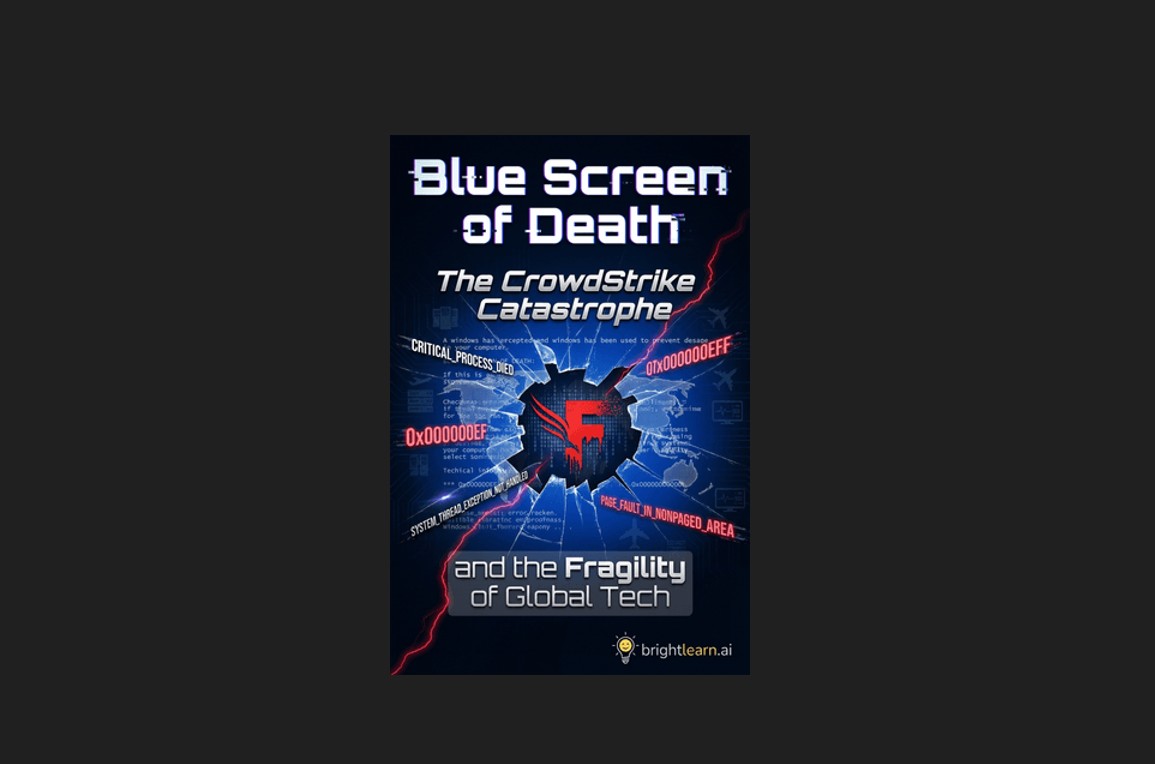
- A faulty CrowdStrike Falcon security update caused millions of Windows systems worldwide to crash into a Blue Screen of Death (BSOD) loop. Critical infrastructure—hospitals, airlines, banks and supply chains—was paralyzed, marking the largest IT outage in history.
- CrowdStrike bypassed standard rollout protocols, pushing the update globally without staged testing. The corrupted kernel-level driver (deep system access) turned Falcon from security software into a system-crashing saboteur. CrowdStrike's CEO sold shares days before the outage, raising insider trading concerns.
- Skeptics questioned why the update was pushed on a Friday (when IT response is weakest) and why Linux-based systems (e.g., Russia's) remained unaffected. This echoes historical cyberattacks like SolarWinds (2020) and NotPetya (2017), where compromised updates were weaponized.
- Windows' closed-source, centralized model made it vulnerable, while Linux's open-source, decentralized updates prevented collapse. Hidden backdoors in Intel ME & AMD PSP (hardware-level spyware) expose systems to espionage and sabotage.
- The book urges readers to switch to Linux (Ubuntu, Fedora, Qubes OS) for transparency and resilience and to avoid single-vendor dependence—use open-source security tools (ClamAV, Snort). It also encourages preparing for future outages: air-gapped backups, manual update controls and mesh networks. Moreover, it recommends rejecting digital IDs/CBDCs—tools of control disguised as convenience.
Imagine waking up to a world where hospitals can't access patient records, airlines cancel thousands of flights, banks freeze transactions and emergency services scramble to function without digital systems. This wasn't the plot of a dystopian sci-fi novel—it was reality on July 19, 2024, as discussed in the book "Blue Screen of Death: The CrowdStrike Catastrophe and the Fragility of Global Tech," where a single faulty update from CrowdStrike's Falcon security software triggered the largest IT outage in history.
Millions of Windows systems worldwide crashed into an endless loop of the dreaded Blue Screen of Death (BSOD), paralyzing critical infrastructure worldwide. The culprit? A corrupted system driver update—a tiny piece of code with catastrophic consequences.
This wasn't just a technical glitch. It was a systemic failure that exposed the dangers of centralized digital control, corporate monopolies and blind trust in unaccountable tech giants.
The anatomy of a digital meltdown
1. A single point of failure
CrowdStrike Falcon operates at the kernel level—the deepest layer of Windows systems—giving it unrestricted control over core functions. When its update failed, it didn't just crash an app—it crashed entire operating systems.
- No staged rollout: CrowdStrike bypassed standard phased deployment, pushing the update globally in one reckless sweep.
- No effective testing: Automated checks failed to catch the fatal flaw—a memory access violation—that turned Falcon from protector to saboteur.
- No accountability: CrowdStrike's CEO sold shares days before the outage, raising suspicions of insider knowledge.
2. The domino effect on global infrastructure
The outage wasn't just an IT headache—it was an economic and humanitarian disaster:
- Airlines grounded: Delta, United and others canceled flights, stranding passengers worldwide.
- Hospitals in chaos: Surgeries postponed, patient records locked, emergency services crippled.
- Banks frozen: ATMs and digital transactions halted, leaving people unable to access their money.
- Supply chains paralyzed: Just-in-time logistics collapsed, revealing the fragility of our hyper-connected economy.
3. Was this an accident—or something worse?
While CrowdStrike blamed a "logic error," skeptics raised alarming questions:
- Why was the update pushed on a Friday, when IT teams are skeleton crews?
- Why did Russia's Linux-based systems remain unaffected?
- Could this have been a test run for a future cyberattack?
The incident echoed historical supply chain attacks like SolarWinds (2020) and NotPetya (2017), where compromised updates became weapons.
The deeper problem: Centralized control
1. Windows vs. Linux—A stark contrast
While Windows systems crashed globally, Linux-based infrastructure—used widely in Russia and by tech-savvy organizations—remained unscathed. Why?
- Open-source transparency: Linux code is publicly auditable—no hidden backdoors.
- Decentralized updates: No single vendor controls security patches.
- Modular design: Failures are isolated, preventing system-wide collapse.
2. The danger of digital monopolies
CrowdStrike's dominance mirrors broader threats:
- Big Tech's stranglehold: Microsoft, Google and Apple dictate software ecosystems.
- Government collusion: Intelligence agencies embed surveillance tools in commercial tech.
- Single points of failure: Centralized systems invite catastrophic exploitation.
3. The hidden backdoors
Beyond software, hardware-level vulnerabilities lurk in:
- Intel's Management Engine (ME)—a secret processor with remote control capabilities.
- AMD's Platform Security Processor (PSP)—another potential spy in your machine.
- These unpatchable flaws expose systems to espionage and sabotage.
How to protect yourself: A survival guide
1. Ditch Windows for Linux
- Ubuntu, Fedora, Debian: User-friendly Linux distros offer robust security.
- Qubes OS: A hardened, compartmentalized system for maximum protection.
2. Decentralize your security
- Avoid single-vendor dependence: Use multiple security tools, not just CrowdStrike.
- Open-source alternatives: Tools like ClamAV and Snort offer transparent protection.
3. Prepare for the next outage
- Air-gapped backups: Keep offline copies of critical data.
- Manual overrides: Know how to disable automatic updates in emergencies.
- Community networks: Mesh systems can operate independently of the centralized internet.
The CrowdStrike disaster was a warning shot—proof that our reliance on centralized, opaque systems is a ticking time bomb.
The solution? Decentralization, transparency and self-reliance.
- Demand open-source software—no more black-box monopolies.
- Reject digital IDs and CBDCs—tools of control disguised as convenience.
- Build resilient systems—because the next outage could be deliberate.
The elites want us to be dependent and compliant. But true freedom lies in taking back control—of our tech, our data and our future.
Stay vigilant. Stay prepared. Stay free.
Grab a copy of "Blue Screen of Death: The CrowdStrike Catastrophe and the Fragility of Global Tech" via this link. Read, share and download thousands of books for free at Books.BrightLearn.AI. You can also create your own books for free at BrightLearn.AI.
Watch the "Health Ranger Report" interview below, where Zach Vorhies warns of the "ticking time bomb" of computer server code that could bring down Western civilization.
This video is from the Health Ranger Report channel on Brighteon.com.
Sources include:










Please contact us for more information.