



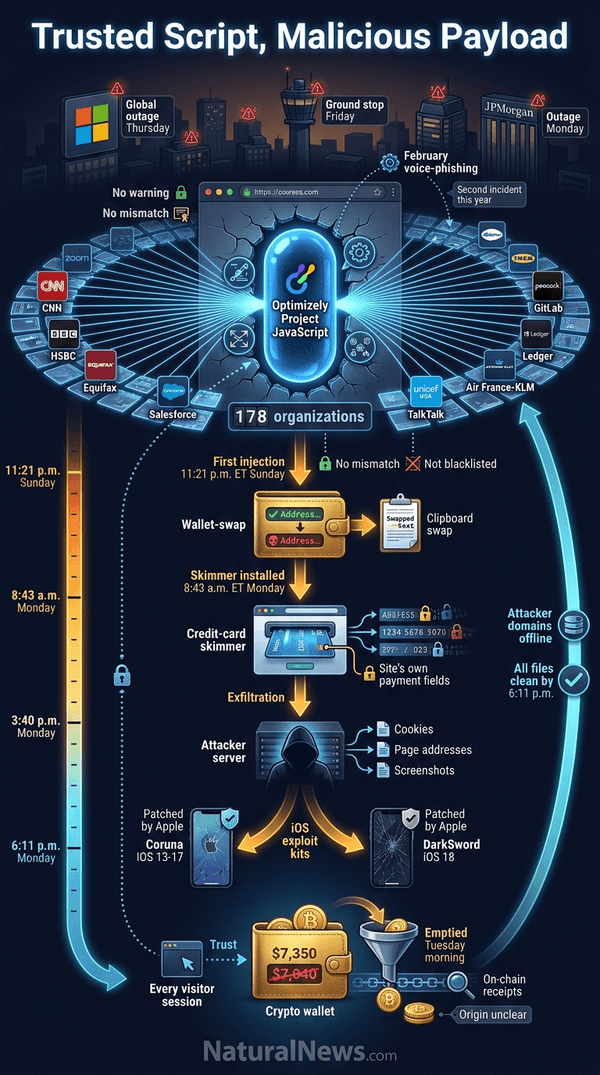
Hackers injected malicious JavaScript into Optimizely's Project JavaScript field and served it to visitors of 178 organizations through the company's own servers, according to the security firm Report URI. The code was delivered from a domain the affected sites had already approved to run code in their visitors' browsers, the firm said.
The first injection appeared at 11:21 p.m. ET Sunday, according to Report URI. Affected organizations included Zoom, CNN, Fox News, the BBC, HSBC, Equifax, Salesforce and IKEA, BleepingComputer reported. Optimizely allows businesses to experiment with website layouts, content and features by loading a small piece of JavaScript from its servers, according to Cybernews.
Optimizely said attackers exploited a vulnerability in its Experimentation account signup flow. The company said it blocked the vulnerable path, removed the injected code, ended sessions, revoked tokens and notified affected customers. Report URI checked 1,611 Optimizely code files and found 188 infected files belonging to 178 organizations. The firm said the real number is likely higher because it could only check the files it could find in time.
Payload Targeted Crypto, Payment Cards, and iOS Devices
Once loaded, the code pulled a second script from an attacker-controlled domain that swapped cryptocurrency wallet addresses on the page, in the clipboard and in outgoing requests, so a payment meant for one wallet would land in the attacker's, according to Report URI. A card skimmer installed at 8:43 a.m. ET Monday captured card numbers, expiration dates and security codes typed into the sites' own payment fields, the report stated.
The script also sent cookies, page addresses and screenshots back to the attacker's server, according to Report URI. For visitors browsing on an iPhone or iPad, the payload tried to load two known iOS exploit kits: Coruna, aimed at iOS 13 through 17, and DarkSword, aimed at iOS 18, both built for older software Apple has since patched. Loading the code is not the same as being hacked, and no device compromises had been confirmed.
Affected organizations included Equifax, HSBC sites from Hong Kong to Mexico, Air France-KLM, GitLab, Peacock, Ledger, Change.org and UNICEF USA, according to Report URI. The list runs from banks and credit bureaus to airlines, streaming services and crypto firms. Security researchers identified malicious code in website tools used by 178 organizations, including Zoom, CNN, the BBC, HSBC, Equifax, Salesforce, Peacock, IKEA, Fox News, NPR, the ASPCA and Invisalign, the Daily Mail reported.
Cleanup Completed Monday; Optimizely Cites Signup Flow Vulnerability
A mass cleanup began around 3:40 p.m. ET Monday, according to Report URI. By 4:52 p.m. only TalkTalk's file was still infected, and by 6:11 p.m. every infected Optimizely file the firm was watching was clean. The attacker's domains were knocked offline afterward, Report URI said.
How long the vulnerability was open, and how the attacker found it, remains unexplained. Optimizely said the incident was its second security event this year, after a February voice-phishing attack that exposed what the company called basic business contact information.
The incident followed a series of disruptions to widely used systems. Microsoft experienced a global outage Thursday, the FAA issued a nationwide ground stop Friday, and JPMorgan reported an outage Monday that the bank blamed on a technical issue with no evidence it was cyber-related, according to ZeroHedge.
Wallet Receipts and Unresolved Questions
By Monday afternoon the attacker's wallets had received about $7,040, and Report URI's Tuesday update put on-chain receipts at about $7,350 before the attacker emptied the wallets Tuesday morning. Some of those wallets were in use before the attack, so the blockchain alone cannot determine how much came from victims, according to Report URI.
The episode highlighted the risks of concentrating trust in third-party scripts. The cited NaturalNews.com reporting on AI agents that can hold and transact cryptocurrency notes that decentralization, while often praised, could enable autonomous systems to operate outside legal frameworks, making it difficult for regulators to track or stop transactions executed by non-human entities [1]. No official total has been released for stolen card numbers or cookies, and no attacker has been publicly identified.
Expert Commentary and User Guidance
Scott Helme of Report URI called the episode "a near miss, and far too close for comfort." He wrote on Tuesday that organizations routinely allow third parties to run unreviewed, unmonitored code in their visitors' browsers. "You wouldn't dream of deploying unreviewed, unmonitored code to your production servers, yet we routinely allow third parties to do exactly that in our visitors' browsers," Helme wrote.
Report URI advised anyone who sent cryptocurrency Monday to check that it reached the intended wallet, anyone who entered a card on one of the listed sites to watch their statements, and iPhone and iPad users to update their devices. The firm said organizations need to do better at reviewing the code they allow to run.
Reference
- Experts Warn Rogue AI Agents With Crypto Wallets Could Become Unstoppable. https://www.naturalnews.com/2026-06-11-experts-warn-rogue-ai-agents-with-crypto-wallets.html
Explainer Infographic










Please contact us for more information.