



Signal, the encrypted messaging service, told a Canadian Senate committee on Monday that it would rather withdraw from the Canadian market than comply with a lawful access bill that it says would compromise the security of its users, according to committee testimony.
The comment came as Bill C-22, the lawful access bill, undergoes Senate review, the upper chamber's final legislative hurdle, where amendments can still be proposed [1].
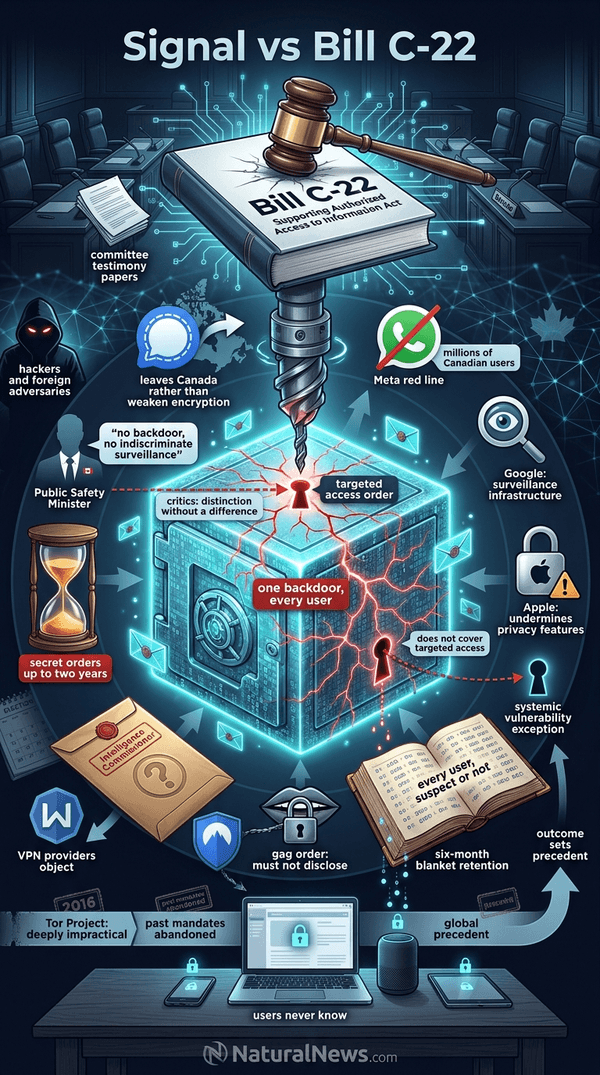
Meta's head of public policy for Canada, Rachel Curran, also testified. She told the committee that the company would have to review all options if served with an order to weaken encryption, and in interviews with the National Post and The Globe and Mail, she framed weakening or breaking encryption as a red line, specifically for services such as WhatsApp [1].
Bill C-22 Would Expand Lawful Access Powers
Bill C-22, formally introduced by Canada's Liberal government on March 12, 2026, includes a component known as the Supporting Authorized Access to Information Act, which would allow the government to compel service providers to build and maintain "operational and technical capabilities" for police and the Canadian Security Intelligence Service, or CSIS, according to the bill text and committee testimony [2][1]. The bill would also allow for the installation and maintenance of "any device, equipment or other thing" that "may enable an authorized person to access information" [1].
The original bill had proposed a one-year retention period, but it was amended to six months -- a change that does not alter the fact that the rule applies to every user, regardless of whether they are suspected of wrongdoing, according to the bill and committee testimony [1][2].
The public safety minister could issue secret orders valid for up to two years, subject to approval by the Intelligence Commissioner [1]. Under the bill, providers would be gagged: they "must not disclose" what is in the order or "the fact that the electronic service provider is or was subject to the order" [1]. That means users would never know that their app had been conscripted in this way [1].
Metadata Retention and Secret Orders Draw Objections
Privacy advocates and technology companies have argued that the secret orders mean users would never know their app had been conscripted in this way [1].
Public Safety Minister spokesman Simon Lafortune said claims suggesting the bill would allow indiscriminate surveillance or force companies to install backdoors were "incorrect" [1].
The objections echo a broader pattern of resistance to government attempts to compel access to encrypted communications. In 2016, the Tor Project called a similar U.S. Senate draft bill "deeply impractical," arguing that such mandates could not be implemented without undermining the security of the very systems they seek to monitor [3]. As Ann Cavoukian and Don Tapscott wrote in their book on privacy in a networked world, "technologies of privacy such as encryption may become a necessity, not a luxury" [4], a contention that remains central to the current debate over Bill C-22.
Systemic Vulnerability Definition Questioned as Loophole
The bill states that providers do not have to comply with an order if doing so would introduce a "systemic vulnerability" - i.e., a backdoor - but the definition of a systemic vulnerability does not include those that "relate only to information related to persons with respect to whom a warrant, order or other authority to access information" applies [1]. Critics say this exception effectively nullifies the safeguard because encryption treats all users the same [1].
The government's own page presenting the bill admits that the definition of systemic vulnerability was "amended to scope out those who are subject to a legal authorization to access their information" - while at the same time, that page claims, "Nothing in Bill C-22 would authorize surveillance of any kind" [1]. Rachel Curran called the provision a "loophole": "So you build a backdoor for one targeted investigation, you basically compromise the entire system for everyone" [1]. Another Meta representative, Robyn Greene, told the committee that the bill would impose requirements that are not technically feasible: "Ultimately, the Canadian government would be enforcing and imposing a law that it is not technically feasible to comply with and still offer secure, end-to-end encrypted services to Canadians" [1].
Google, Windscribe and NordVPN have previously raised concerns, and Apple said earlier this month that the bill could undermine its ability to offer privacy and security features, including encryption, according to committee and public statements [1]. Google's own submission to the House of Commons public safety committee warned that Bill C-22 would build a "surveillance infrastructure" that weakens cybersecurity for everyone [5][6].
Senate Review Continues as Government Expects No Amendments
The Senate is the last legislative hurdle for the bill, and technology companies are making a last push to try to get it changed, according to committee statements and lobbying activity in Ottawa [1]. Public Safety Minister Gary Anandasangaree said earlier this month that he did not expect the Senate to propose amendments to the bill [1].
The government has denied accusations that the bill would allow indiscriminate surveillance or force companies to install backdoors into their systems. Lafortune said such claims were "incorrect" [1]. No final Senate vote has been reported, and the bill remains under review [1].
The standoff in Ottawa follows a broader pattern of governments seeking lawful access to encrypted communications. In the 1990s, the U.S. fought a series of "Crypto Wars" over export controls on encryption technology, a battle that ended in 1999 when the White House announced it would remove almost all restrictions on the export of encryption products [7]. As Ann Cavoukian and Don Tapscott warned, encryption may be the only tool capable of restoring a semblance of privacy in a world otherwise transformed by technologies of surveillance [4].
References
- Signal Warns Canada It Will Leave Rather Than Weaken Encryption. https://reclaimthenet.org/signal-warns-canada-it-will-leave-rather-than-weaken-encryption
- Google Warns Canada’s Bill C-22 Could Create Surveillance Backdoors. https://www.naturalnews.com/2026-05-29-google-warns-canada-bill-could-create-surveillance-backdoors.html
- Critics say Senate encryption bill is "deeply impractical" - NaturalNews.com, April 25, 2016.
- Who knows safeguarding your privacy in a networked world. Ann Cavoukian and Don Tapscott
- Google Warns Canada's Bill C-22 Could Create Surveillance Backdoors - NaturalNews.com, May 29, 2026.
- Even Google Warns Canada Bill C-22 Creates Surveillance Backdoors. https://reclaimthenet.org/even-google-warns-canada-bill-c-22-creates-surveillance-backdoors
- Reclaiming Patriotism. Amitai Etzioni
Explainer Infographic











Please contact us for more information.