



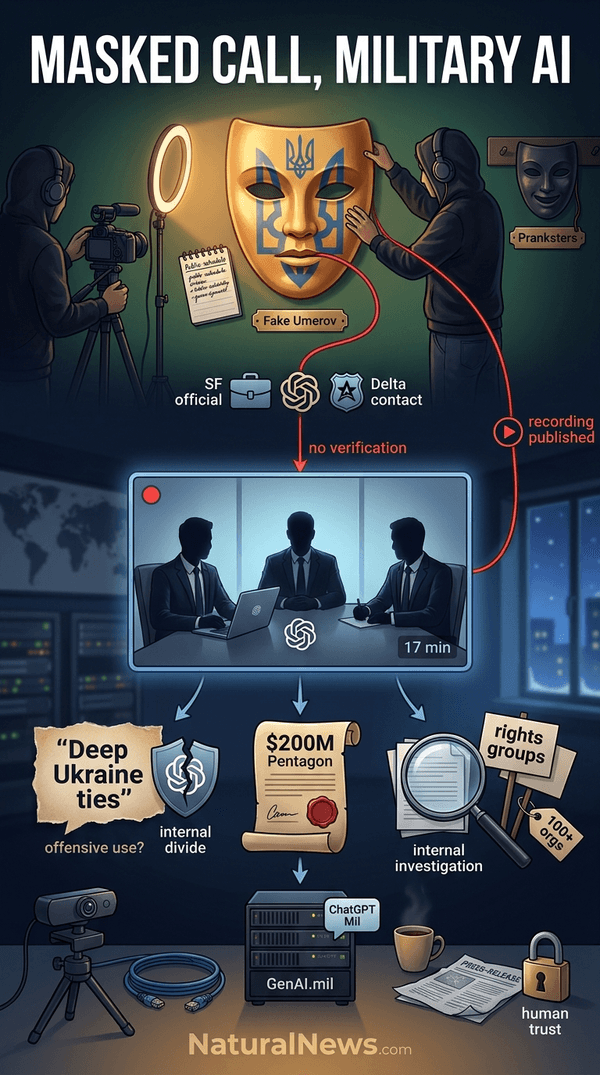
Three senior OpenAI officials involved in national security and strategic initiatives took part in a video call with people they believed were senior Ukrainian government officials, according to a report by The Intercept. During the roughly 17-minute conversation, the staffers discussed military AI applications and referenced talks with the U.S. Department of Defense about supplying AI tools to Ukraine.
The people on the other end were Russian internet comedy duo members who impersonated Ukrainian officials and later posted a recording of the meeting online, the report stated [1].
The incident became public on Nov. 11, 2026, when The Intercept published its account [2][3]. OpenAI did not dispute that the call took place, according to the report.
Call Arranged Through Ukrainian Official in San Francisco, Prankster Said
Vovan, one of the pranksters, told The Intercept that arranging the meeting was relatively simple. The duo posed as Rustem Umerov, Ukraine's foreign intelligence chief, and contacted an intermediary who believed he was dealing with Umerov [4][5]. Another account said the pranksters reached a senior Ukrainian official in San Francisco who already had ties to OpenAI [6].
The incident highlighted the potential vulnerability of corporate access procedures to impersonation. The pranksters have previously targeted prominent public figures.
It also came amid OpenAI's expanding defense work. The company has shifted from a ban on military applications toward closer cooperation with the Pentagon, including a $200 million, one-year Department of Defense contract covering AI applications in military and cybersecurity operations [7][8]. By 2026, the Pentagon had added OpenAI's ChatGPT Mil to its GenAI.mil platform for unclassified military use, according to an official announcement cited in reporting [9].
Recording Includes Remarks on Offensive AI and Ministry Contact
In the recording, Crampton is heard describing the company's interest in a deep relationship with Ukraine. When asked about offensive military AI services, Crampton said, "There's no question, I think, from our perspective that we want to have as deep a relationship as we possibly can with Ukraine," according to the recording as reported by The Intercept.
Crampton also addressed internal reservations about military uses of the technology. "Many of the company's leaders would not want our technologies to be used in offensive military operations," he said, according to the recording.
Later in the call, Crampton said OpenAI has a contact in the Ukrainian Ministry of Defense, "primarily through a colleague of ours based in Washington… who previously had worked with the Delta team in your Ministry of Defense," according to the recording.
The conversation covered potential military AI support for Ukraine and prompted an internal investigation, according to reporting [10].
OpenAI Says It Investigated Call and Took Action
Reporting on the episode noted that the access obtained by the pranksters raised the question of what would stop malicious actors from attempting the same approach [11].
It also brought renewed attention to the safeguards governing OpenAI's defense partnerships. The company's $200 million defense agreement included stated restrictions against mass surveillance, autonomous weapons and AI-driven high-stakes decision-making, according to reporting [12]. Separately, more than 100 organizations signed a joint statement calling for a halt to military AI use, citing operations in Gaza as a precedent [13].
Conclusion
The recording remains available online, the report stated [1].
Coverage of the call described it as a security lapse and noted that the conversation covered military AI support for Ukraine before an internal investigation was opened [10].
The call also illustrates the broader push of commercial AI into warfare. Ukraine has been described as the world's first active combat laboratory for AI-enabled autonomous weapons systems, with battlefield footage used to train target-recognition and navigation models [14]. Skeptics of centralized AI power argue that closed systems lack accountability and that concentrated control over the technology carries risks for privacy and transparency [15].
References
- Russian Pranksters Got Top OpenAI Officials to Open Up on Ukraine. https://www.europesays.com/ukraine/69849/
- OpenAI's national security team was just revealed to have been fooled by Russian pranksters posing as Ukraine's spy chief. Here's what you need to know. https://x.com/AGTPinsights/status/2120713418936037644
- Russian pranksters trick 3 senior OpenAI officials in 17-minute call posing as Ukraine intel chief | Mint. https://www.livemint.com/ai/russian-pranksters-trick-3-senior-openai-officials-in-17-minute-call-posing-as-ukraine-intel-chief-11794460278116.html
- The Intercept: Russian pranksters posed as a Ukrainian official. OpenAI’s national security team took the call. https://digg.com/tech/csqfr4eu
- Russian Pranksters Fooled 3 OpenAI National Security Leads. https://fourweekmba.com/ai-russian-pranksters-fooled-3-openai-national-security-leads/
- OpenAI security chiefs discuss Ukraine military ties with Russian pranksters (VIDEO). https://eng.pressbee.net/show4972413.html
- OpenAI quietly drops ban on working with the military; signs up to work with the Pentagon - NaturalNews.com, April 04, 2024.
- OpenAI's 200M military AI pact sparks ethical crossfire - NaturalNews.com, June 20, 2025.
- Pentagon Adds Grok and ChatGPT to Military AI Platform - NaturalNews.com, September 02, 2026.
- OpenAI officials fooled by Russian pranksters into thinking they were .... https://www.indiatoday.in/technology/news/story/openai-officials-fooled-by-russian-pranksters-into-thinking-they-were-speaking-to-ukrainian-official-3037150-2026-11-12
- If a couple of pranksters can snag a meeting with high-level .... https://www.threads.com/@futurism/post/DfsBDSbFSkb/if-a-couple-of-pranksters-can-snag-a-meeting-with-high-level-open-ai-staffers/
- OpenAI strikes 200M defense pact amid ethical AI debate - NaturalNews.com, March 04, 2026.
- Rights Groups Sound Alarm Over Military AI Use, Citing Gaza Genocide - NaturalNews.com, June 18, 2026.
- The algorithmic frontline: How Ukraine became the world's AI warfare laboratory - NaturalNews.com, April 03, 2026.
- Centralized AIs stranglehold threatens democracy: Can decentralized AI fight back - NaturalNews.com, June 03, 2025.
Explainer Infographic








Please contact us for more information.