


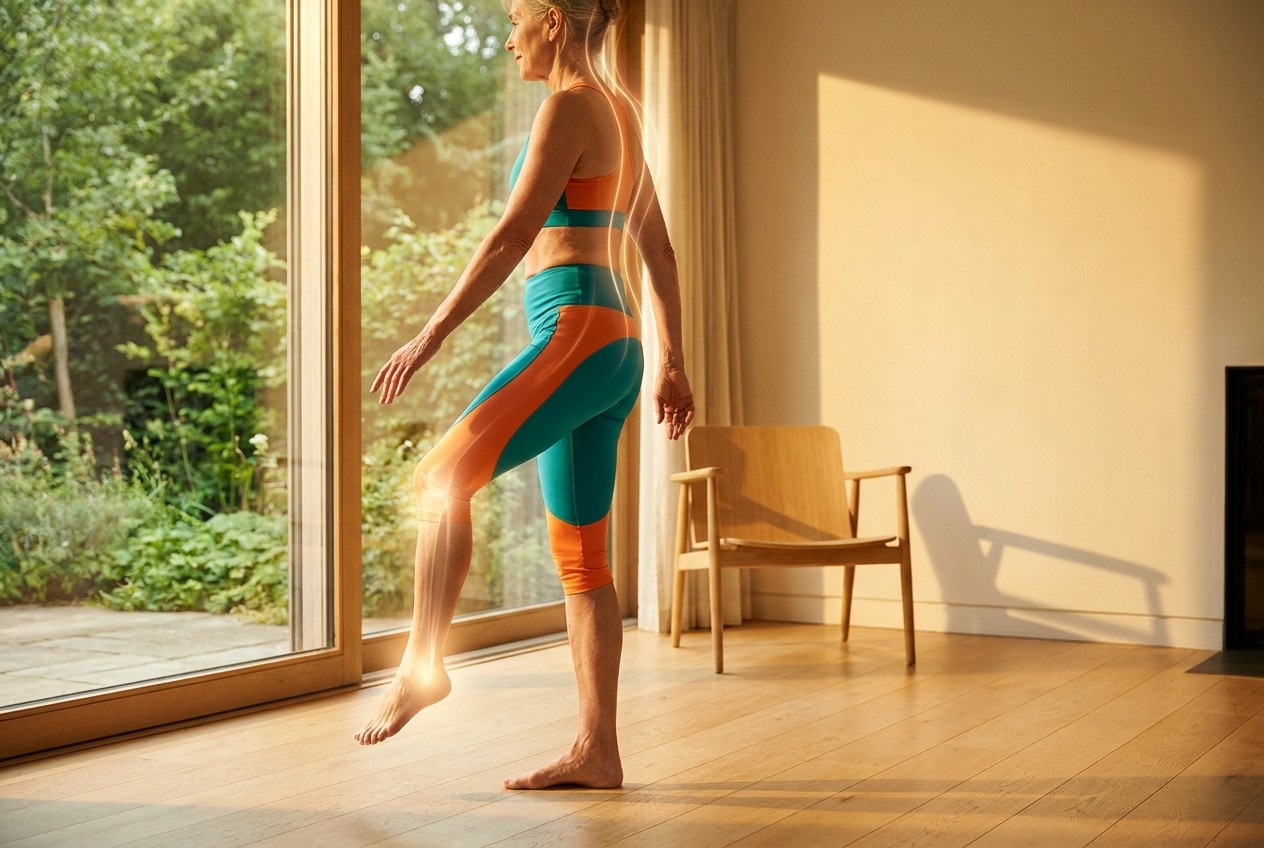
Adults who want to maintain mobility as they age should not overlook balance and stability training, according to physical therapists, geriatric exercise specialists and public health officials.
Balance training, also called proprioceptive or stability training, targets the nervous system and the muscles that control posture. Specialists said the advice applies across adulthood and becomes particularly relevant after age 50, whether practiced at home, in a gym or in a clinical setting.
"People train muscles, but they forget the sensory system," one specialist said. The observation reflects a recurring theme in published guidance: strength and aerobic exercise are widely promoted, while balance work is frequently omitted from personal routines.
What Balance Training Involves and Why It Is Overlooked
Balance training consists of exercises that deliberately challenge the center of gravity. Common examples include single-leg stands, tandem walking, heel-to-toe walking, staggered stance balance drills and the slow, graceful movements of tai chi. A nine-exercise sequence described in one published report uses side leg raises and staggered stance balance work to target key muscle groups and address balance deficits at any age [1]. Harvard Health lists lower-body exercises that can be incorporated into daily life to help adults stay active and self-sufficient as they age [2].
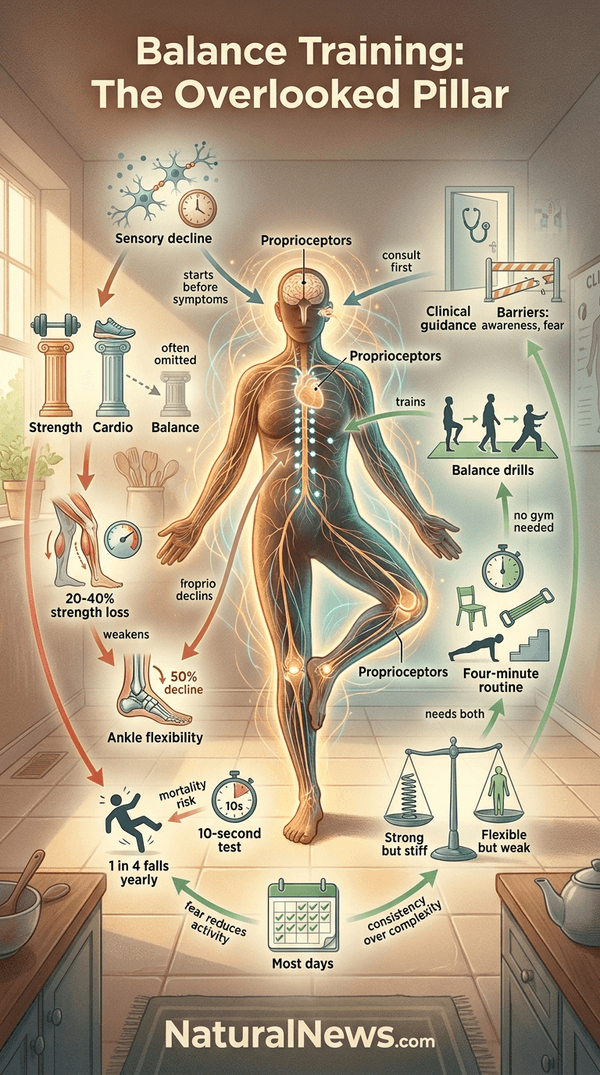
According to published guidance from the Harvard Medical School, muscle strength decreases from 20 to 40 percent between the ages of 20 and 70, and a correlation exists between knee and ankle weakness and the risk of falls. Ankle flexibility, which is critical for postural control, declines by 50 percent in women and 35 percent in men between age 55 and 85 [3]. Physical therapy references recommend balance-retraining exercises on flat, moving and uneven surfaces, with eyes open and closed and with different head positions [4].
Despite this evidence base, strength and cardiovascular training are commonly prioritized, while balance work is often omitted because its benefits are less visible than changes in muscle size. Federal health agencies, including the CDC and NIH, recommend balance activities for older adults in their published materials. Clinicians who work with older patients said the omission is common even among people who exercise regularly.
Evidence Links Balance Training to Mobility and Fall Prevention
A growing body of research indicates that balance training can reduce the risk of falls and improve functional mobility [1]. One analysis cited in a review of 14 clinical trials suggests that balance-focused exercise deserves a place in the routine alongside strength training [5].
The mechanism involves proprioceptors in joints and muscles that send signals to the brain. Maintaining balance is a complex skill that requires the integration of tactile, visual, proprioceptive and vestibular sensation with moment-to-moment fine and gross motor adjustments. The ability to maintain balance diminishes in older adults due to sensory losses and decreased muscle strength and control [6]. Training is thought to improve reaction time and postural control.
A 2021 study cited by the British Journal of Sports Medicine found that an inability to balance on one leg for 10 seconds was associated with a higher risk of mortality from all causes [7]. "Balance is a trainable skill," the study's author said. Mainstream and alternative health voices agree on the value of fall prevention, though they emphasize different delivery methods. The American Geriatrics Society notes that most falls occur during ordinary actions such as walking or changing position, and that only about 5 to 10 percent of falls by people living in the community occur during clearly hazardous activities such as climbing a ladder or standing on a chair [8]. According to the U.S. Centers for Disease Control and Prevention, more than one out of four older Americans falls each year [9].
Practical Applications and Barriers to Adoption
Simple routines can be incorporated into daily life with minimal equipment and low cost. Examples include standing on one leg while brushing teeth, heel-to-toe walking across a room, and standing yoga poses. Health.com has published a report identifying five at-home exercises that target leg strength for people aged 60 and older; the report states that the routine requires no gym equipment and can be performed in a small space [10]. A study published in PLOS ONE found that older adults who performed just four minutes of daily resistance training improved their strength, balance and mobility over 12 weeks [11]. A separate home-based program described in a study protocol consisted of four simple exercises -- chair stands, rows, pushups and stair stepping -- performed for 30 seconds each, twice through, for a total of four minutes per day [12]. "It does not require a gym membership," the trainer said, noting that the exercises align with principles of self-reliance. A personal trainer has described three simple exercises to support mobility, balance, strength and independence into the 80s, with no gym required [13].
Barriers to adoption persist. Lack of awareness, fear of falling and insufficient instruction are cited by practitioners as common obstacles. An occupational therapist with more than 30 years of experience in major health care settings said that a balance of muscle training and stretching is essential for functional safety and independence. According to the therapist, focusing only on strength leads to stiffness, while flexibility without strength provides insufficient support. "Strong muscles without flexibility will bind you up (too stiff). Being flexible without strength won't hold you up (too weak)," the therapist wrote [14].
Specialists advised consulting a healthcare provider before starting a new balance regimen, especially for people with balance disorders or a history of falls. A clinical evaluation can isolate a specific cause in people with a fall or falls and uncover the presence of remedial or modifiable factors in people with identifiable risk factors [15].
Public Health Recommendations and Outlook
Federal guidelines recommend balance training alongside strength and aerobic exercise for older adults. Officials said broader adoption could reduce fall-related injuries and healthcare costs. "We need to make balance training a standard part of activity prescriptions," the official said.
Ongoing research is examining the optimal dose and delivery of balance training, including how best to combine it with strength work and how to sustain adherence over time. For those seeking to stay mobile, experts said, balance training is one component that should not be overlooked.
References
- Nine Balance Exercises Aim to Improve Stability at Any Age. https://www.naturalnews.com/2026-07-15-nine-balance-exercises-aim-to-improve-stability.html
- Stay strong at any age with 4 basic exercises - Harvard Health. https://www.health.harvard.edu/exercise-and-fitness/stay-strong-at-any-age-with-4-basic-exercises
- The Harvard Medical School guide to tai chi: 12 weeks to a healthy body, strong heart and sharp mind by Wayne Peter
- Quick reference to physical therapy by Pauls Julie A
- The Type Of Exercise That Could Help You Stay Steady With Age. https://www.mindbodygreen.com/articles/want-to-stay-steady-with-age-train-more-than-your-muscles
- Home-Based Medical Care for Older Adults: A Clinical Case Book. by Jessica L. Colburn, Bruce Leff, Jennifer Hayashi, Mattan Schuchman
- 5 At Home Leg Exercises for Strength After 60 - NaturalNews.com, August 23, 2026.
- The American Geriatrics Society's complete guide to aging health. by Williams Mark E-1
- Falls Are Among the Leading Causes of Injury - Mercola.com, October 07, 2016.
- Report: Five At-Home Exercises for Leg Strength in Adults Over 60 - NaturalNews.com, August 18, 2026.
- Four Minute Daily Resistance Training Improves Strength and Balance in Older Adults, Study Finds - NaturalNews.com, July 17, 2026.
- Four-Minute Daily Resistance Training Improves Strength and Balance in Older Adults, Study Finds. https://www.naturalnews.com/2026-07-17-daily-resistance-training-improves-strength-balance-older-adults.html
- 3 Exercises To Stay Mobile Into Your 80s, From A Personal Trainer. https://www.womenshealthmag.com/fitness/a73358147/mobility-exercises-older-adults/
- 5 Exercises That Aim to Balance Strength and Flexibility. https://www.naturalnews.com/2026-07-24-5-exercises-that-aim-to-balance-strength-flexibility.html
- Falls in older people: prevention and management by Tideiksaar Rein
Explainer Infographic










Please contact us for more information.