


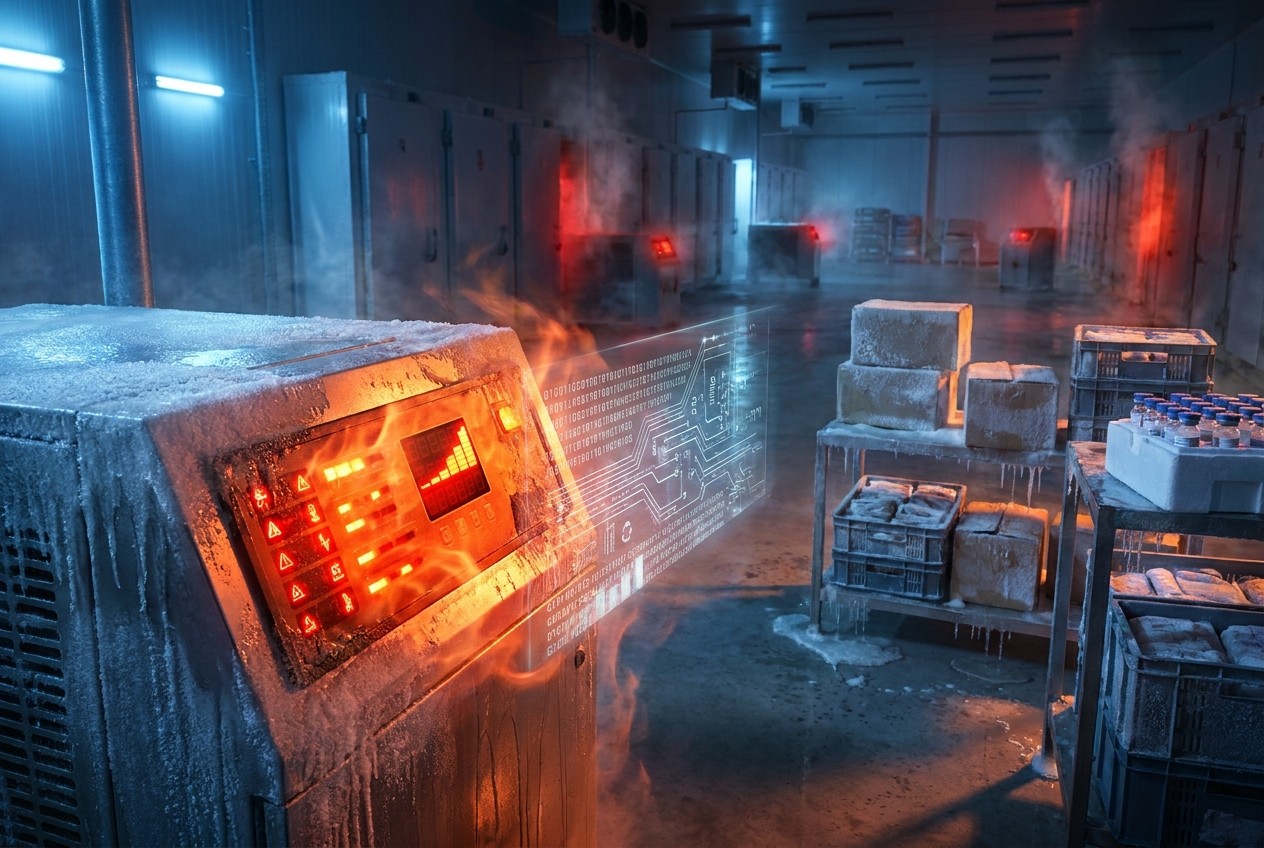
Federal agencies warned on Nov. 5 that hackers are targeting refrigeration systems used to store food and medicine, urging businesses to secure vulnerable controls amid attacks that could spoil supplies and damage equipment.
The warning arrived after a series of attacks on supermarket refrigeration systems in Europe and at least one attack on a French public blood service, according to officials and published reports. U.S. officials did not attribute the European incidents to any specific group or confirm whether similar attacks have been detected inside the United States [1].
Federal Warning Details
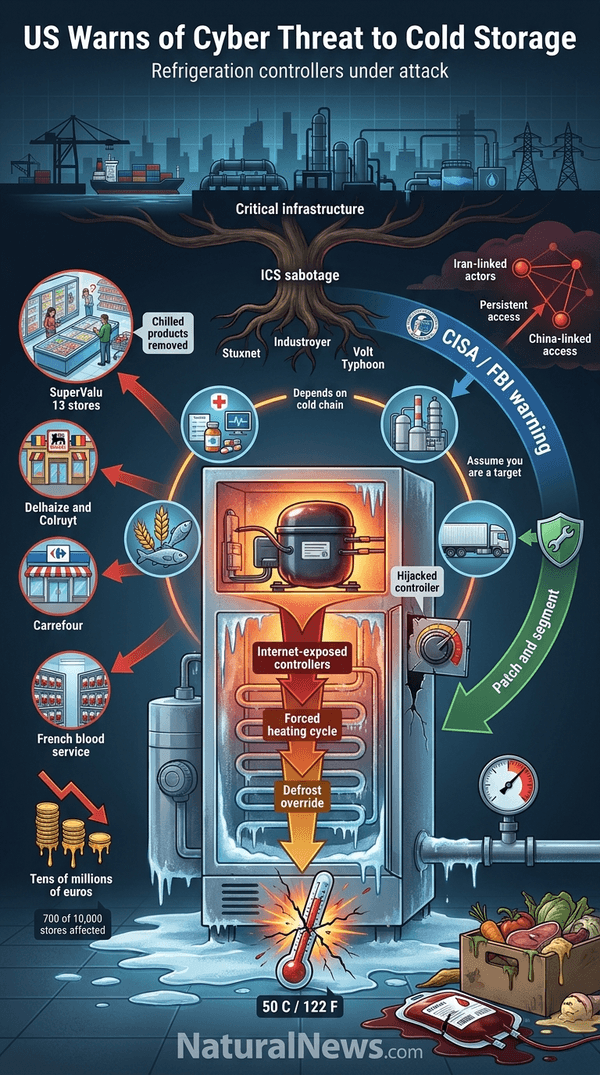
The agencies said the actors may exploit vulnerabilities or weaknesses in unpatched or internet-accessible controllers to remotely alter settings and force units into continuous heating and defrost cycles [2]. The systems are widely used in healthcare, chemical operations, food and agriculture, and transportation, the agencies said.
Chris Butera, Cybersecurity and Infrastructure Security Agency acting executive assistant director for cybersecurity, said in a statement that every organization that depends on refrigeration and monitoring systems should assume it could be a target [3]. He urged operators to review the guidance and close known security gaps. The Federal Bureau of Investigation encouraged organizations to implement the recommended mitigations and report suspicious activity.
The warning reflects long-running concern about internet-connected industrial control equipment. A 2010 study in Process Safety and Environmental Protection examined methodologies for security risk assessment in the oil and gas industry, a sector that relies on comparable process-control instrumentation [4]. Other research has examined frameworks for protecting supervisory control and data acquisition systems that supervise remote field devices in energy operations [5].
European Supermarket Incidents
The U.S. warning followed a series of reported attacks on supermarket refrigeration systems in Europe. Irish wholesaler Musgrave said a cyber incident affected refrigeration units in 13 SuperValu stores, forcing the removal of some chilled and frozen products. Belgian and Luxembourg operators Delhaize and Colruyt, along with Carrefour, also reported impacts at multiple locations.
In Stockholm, an ICA store manager said freezers reached 50 C (122 F) after an overnight attack that went undetected for hours. Two separate waves of attacks allowed hackers to raise the temperature on freezers and chilling units in at least a dozen countries [1].
Control-system sabotage of this kind is not a new phenomenon. A 2011 paper in Concurrency and Computation described redundant architectures for remote terminal units and human-machine interfaces in energy control systems, designed partly to protect critical information in anomalous situations [5].
Historical cases such as Stuxnet and Industroyer proved that digital attacks on physical infrastructure can be devastating, and China's Volt Typhoon campaign has been documented infiltrating U.S. ports, pipelines and water treatment plants [6]. Awareness of these vulnerabilities is not evenly shared. Personnel records and plant layouts are sensitive documents, and security specialists advise that controlled access be maintained for laboratories, test plots and supporting infrastructure [7].
French Attacks and Blood Service Disruption
One French chain estimated losses in the tens of millions of euros from a single day's disruption. French Finance Minister Roland Lescure said roughly 700 of the country's 10,000 supermarkets were affected and described the incident as a wake-up call for food security.
A separate cyberattack targeted refrigeration systems at three sites of France's public blood service, forcing temperatures to rise in cold storage rooms.
The episodes illustrate how dependent modern supply chains are on continuous temperature control. Analyses of conflict escalation in natural resource management have likewise described how hardening standpoints and tactical maneuvering can move disputes from argument into disruptive action [8].
Recommended Mitigations and U.S. Response
U.S. officials did not attribute the European incidents to any specific group or confirm whether similar attacks have been detected inside the United States [1]. Background threat reporting shows the broader environment in which the refrigeration warning sits.
A federal advisory said hackers linked to Iran disrupted U.S. oil, gas and water infrastructure by targeting critical industrial control systems, causing operational and financial damage [9]. Other reporting described Iranian-affiliated actors exploiting vulnerabilities in Rockwell Automation programmable logic controllers to disrupt water utilities, energy services and government operations [10].
A White House official said hackers backed by the Chinese Communist Party had persistent access to U.S. networks and allied systems for years, part of a wider effort to prepare attacks on critical infrastructure, with Beijing intending to cripple power grids and communications platforms in the event of a conflict [11].
Conclusion
The joint warning marks a rare public alert about a category of industrial equipment that rarely draws federal attention: the internet-connected temperature controllers, monitoring sensors and defrost timers that keep groceries, medicines and blood supplies at safe temperatures.
References
- US government warns of ‘ongoing cyber threat’ amid mass hacks of industrial retail and military freezers. https://techcrunch.com/2026/11/05/u-s-government-warns-of-ongoing-cyber-threat-amid-mass-hacks-of-industrial-retail-and-military-freezers/
- US Government Partners Urge Hardening Industrial Refrigeration and Cold .... https://www.cisa.gov/sites/default/files/2026-11/joint-factsheet-usg-partners-urge-hardening-industrial-refrigeration-cold-chain-monitoring-systems-508c.pdf
- US Warns of Ongoing Cyber Threat to Industrial Freezers and Cold Storage. https://www.theepochtimes.com/us/us-warns-of-ongoing-cyber-threat-to-industrial-freezers-and-cold-storage-6119107
- New methodologies for security risk assessment of oil and gas industry. Ashwani Srivastava. Process Safety and Environmental Protection 8(2010)
- Secure SCADA framework for the protection of energy control systems. Concurrency Computat.: Pract. Exper. 2011; 23:1431–1442
- Cyber warfare and the fragile power grid How digital sabotage threatens national security - NaturalNews.com, January 31, 2026.
- Nutrition 0304. Klimis-Zacas Dorothy
- Manifestation of con?ict escalation in natural resource management. Elsevier. Environmental Science & Policy 9 (2006) 538–546
- FBI report Iranian hackers targeting US critical infrastructure - NaturalNews.com, April 10, 2026.
- Iranian cyber warfare escalates US critical infrastructure under attack as IRGC hackers exploit weak industrial - NaturalNews.com, April 09, 2026.
- White House official China maintained PERSISTENT ACCESS to US networks for years - NaturalNews.com, July 26, 2024.
Explainer Infographic


Please contact us for more information.