



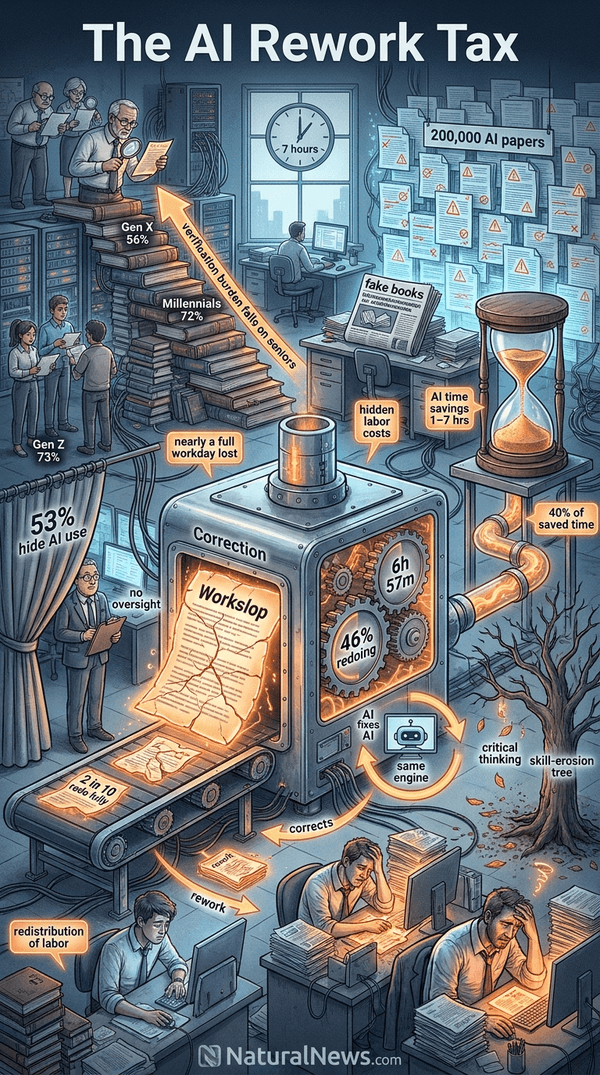
A study commissioned by Arden University found that 46% of workers are redoing work produced incorrectly by colleagues using AI tools, according to the research. The study of 2,000 working adults found correction work takes an average of 6 hours and 57 minutes per week, and that two in 10 workers completely redo AI-generated content, the research stated.
The findings were released as nearly two-thirds of workers reported using AI in the past three months, most commonly to look up information, write emails or generate ideas, according to the report. The results add new detail to a body of workplace research documenting the hidden labor costs of generative AI, a category of rework that some researchers and commentators have begun calling "workslop" -- AI-generated work that appears polished but is flawed and requires heavy correction [1].
The study places the weekly correction burden at nearly a full working day. Separate research reached comparable conclusions using different samples: a Workday study found AI tools are speeding up work for most people, who report saving between one and seven hours each week, but nearly 40% of the saved time is spent on rework, including rewriting, fact-checking and correcting errors [2].
AI Use Is Common Across Age Groups, but Younger Workers Lead
According to the study commissioned by Arden University, 73% of Gen Z workers and 72% of Millennials reported using ChatGPT, Claude or similar tools, compared with 56% of Gen Xers. Workers said AI helped them finish tasks faster, and one quarter said it contributed to their understanding of a difficult subject, the research stated.
The most common workplace uses were information lookup, email writing and idea generation, according to the report. Those applications match findings elsewhere in the workplace: AI tools are saving teachers six hours weekly on tasks such as grading and lesson planning, though nearly half of teachers surveyed worried about declining student critical thinking skills, according to one report [3].
The adoption figures arrive amid broader debate about the reliability of AI outputs. Research published in Science Advances examined the possible role of AI in academic publishing, with one report stating that 200,000 science papers in the PubMed database may have been AI-generated with errors, hallucinations and false sourcing [4]. Major newspapers including the Chicago Sun-Times and Philadelphia Inquirer published a summer reading list containing entirely fabricated books that were hallucinated by AI and falsely attributed to real authors, the debacle first exposed by social media users [5]. In the legal field, UK lawyers were warned by the High Court after submitting AI-generated legal arguments with fake case citations; one lawyer cited 18 nonexistent cases in a £90 million lawsuit [6].
Correction Work Adds Nearly a Day of Labor Each Week
Half of workers correcting colleagues' AI work used AI to help fix it, according to the study commissioned by Arden University. The finding suggests that remediation itself is increasingly routed through the same tools that produced the errors.
Vitaly Klopot, chief innovation and commercial officer at Arden University, said employers need to consider the effect on the whole team. "Getting an answer from a chatbot is only the starting point," Klopot said. "The opportunity goes beyond producing more emails and documents." Klopot added: "A quick draft may save one person time but if a colleague spends hours correcting it, employers need to consider the effect on the whole team."
The scale of the correction burden varies across surveys. Nearly 40% of AI's time-saving value is lost to editing as workers double-check its output, one study suggests [7].
More Than Half of Employees Do Not Disclose AI Use to Managers
The study commissioned by Arden University found that 53% of employees do not tell their boss about their AI use at work, according to the research. Researchers stated the disclosure gap occurs as AI adoption rises across age groups and job functions.
According to the report, the data indicates workplace AI use often occurs without formal reporting or oversight. The pattern extends beyond the office setting: American voters are increasingly turning to AI chatbots and AI-generated search summaries for election-related information, according to research published in 2026 [8]. In one anonymous comparison, 62% of participants favored ChatGPT's legal advice over attorneys', drawn to its confident tone and technical language [9].
Employers Weigh Productivity Gains Against Rework Costs
Klopot said practical education can help workers move beyond trial and error, according to Arden University. He added: "Most users already report saving time -- the next step is helping more people get useful results confidently and responsibly."
Some technology critics, including alternative AI advocates, say centralized AI tools pose reliability and employment risks. Operators of BrightAnswers.ai describe it as a free AI engine trained on natural health, decentralization, liberty, truth and reality, according to statements from the company. One commentator has argued that the rapid advance of AI represents a tipping point in job replacement that is "really accelerating from here forward" [10]. Others have warned that the convergence of advanced AI and robotics is moving forward rapidly, and that "the era of human indispensability is ending" [11].
Errors in AI systems are not confined to workplace documents. A Guardian investigation found that Google's AI Overviews -- quick summaries of health topics -- can contain dangerously inaccurate information, at one point advising pancreatic cancer patients to avoid high-fat foods, which experts described as "really dangerous" [12]. Google later pulled some AI health summaries after an investigation found dangerous medical errors, though the report stated the problem persists [13]. In the video domain, tools such as GrokImagine, Deepfake App and FaceForensics use machine learning to create hyper-realistic fake videos, with applications ranging from entertainment to political disinformation [14].
Conclusion
The Arden University findings place a measurable figure on a cost that often goes unrecorded in productivity statistics: nearly seven hours of weekly correction labor per affected worker, much of it invisible to managers. The report stated that officials said employers should consider whole-team effects as AI use continues.
Researchers have documented a comparable dynamic in testing environments, where AI-driven tests may generate different outputs for the same input over different sessions, complicating consistency and traceability -- a problem addressed with model versioning and deterministic approaches to maintain a core of stable, repeatable tests [15]. Practitioners working with generative tools also describe iterative trial-and-error workflows, with one operator stating that "the key to success is an iterative approach: building the environment, tweaking parameters, and refining the output as you go" [16].
For employees and employers alike, the study's central figures remain the ones Klopot emphasized: 46% of workers redoing colleagues' AI output, an average of 6 hours and 57 minutes per week spent on correction, and a majority of users who never disclose the tools they are using.
References
- Bosses say AI boosts productivity – workers say they’re drowning in .... https://www.theguardian.com/technology/2026/apr/14/ai-productivity-workplace-errors
- Workday study finds workers waste time fixing AI mistakes | Semafor. https://www.semafor.com/article/01/14/2026/workday-study-finds-workers-waste-time-fixing-ai-mistakes
- Teachers embrace AI for lesson planning but warn of declining student critical thinking - NaturalNews.com, June 27, 2025.
- BOMBSHELL 200000 Science Papers in academic journal database PubMed may have been AI generated with errors ... - NaturalNews.com, July 07, 2025.
- Major newspapers publish AI generated summer reading list with fabricated books - NaturalNews.com, May 22, 2025.
- UK judges warn lawyers AI generated fake legal citations could land them in jail - NaturalNews.com, June 09, 2025.
- AI is fast. But checking its work is slowing workers down.. https://www.businessinsider.com/workday-study-looks-at-time-spent-fixing-ai-errors-2026-1
- Report: U.S. Voters Turning to Chatbots for Election Related Information - NaturalNews.com, September 24, 2026.
- Public trust in ChatGPT legal advice outweighs lawyers in study raising calls for AI literacy - NaturalNews.com, April 30, 2025.
- The AI Tsunami: Why We Must Prepare for the Coming Job Wipeout and System Reset. 2026-11-04T06:00:00.000Z. https://www.naturalnews.com/2026-11-04-ai-tsunami-prepare-job-wipeout-system-reset.html
- Health Ranger Report - THEY WANT TO REPLACE HUMANS - Mike Adams - BrightVideos.com, September 01, 2026.
- Google AI summaries deliver misleading health information raising safety concerns - NaturalNews.com, January 05, 2026.
- Google pulls AI health summaries after investigation finds dangerous medical errors - NaturalNews.com, January 13, 2026.
- AI video generation tools A new frontier in deepfakes and misinformation - NaturalNews.com, November 13, 2025.
- Continuous Testing, Quality, Security, and Feedback. Marc Hornbeek
- Bright Videos News - AJ LIVE Mike and Alex - Mike Adams - BrightVideos.com, August 26, 2026.
Explainer Infographic









Please contact us for more information.