


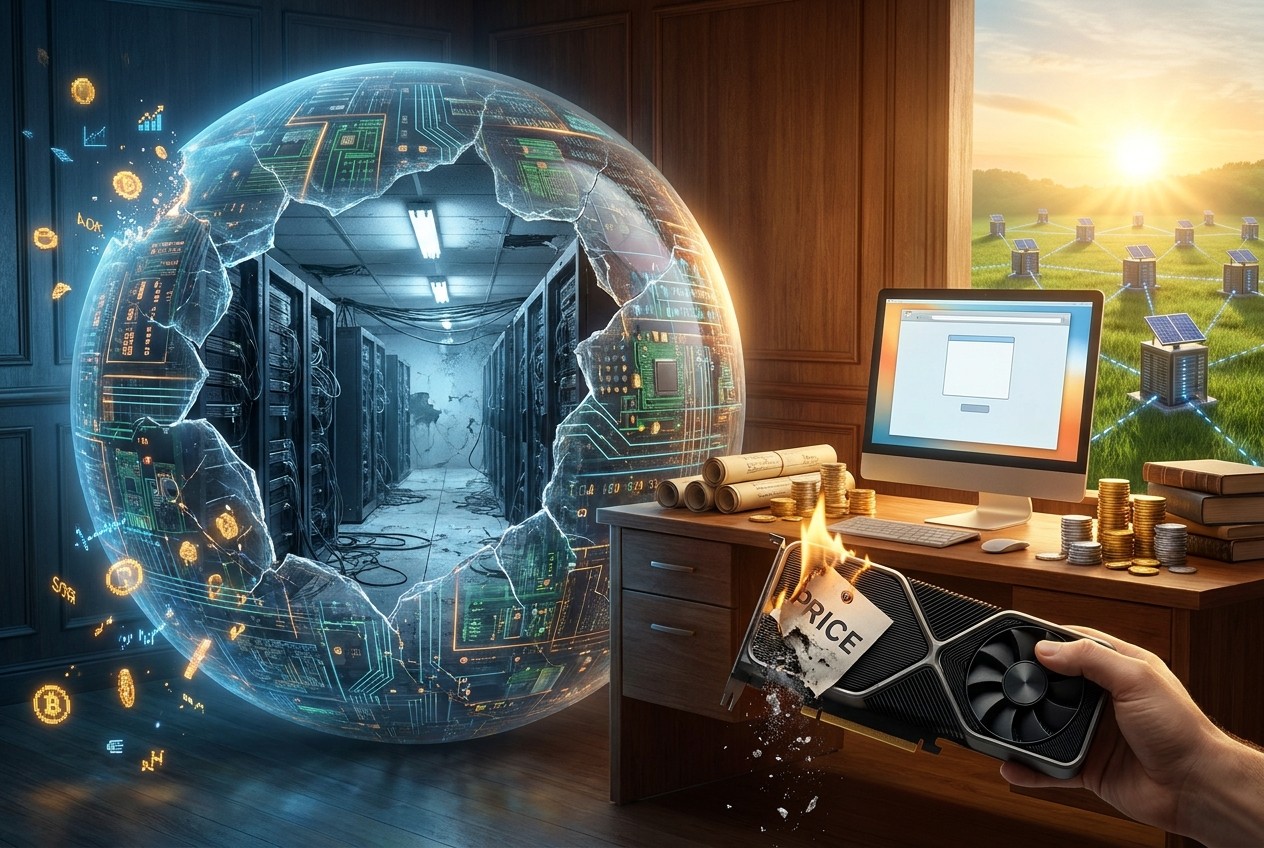
The AI Bubble Is Bursting
The AI bubble is bursting, and I am not sorry to see it go. The recent $3 trillion market-cap wipeout and the global selloff that hammered Japan, South Korea and Taiwan are not random shocks. They are the opening acts of a speculative mania that I have been warning about for months, and that I have been actively hoping would implode (for very rational and ethical reasons as I explain here). As I wrote plainly, I want the AI data-center speculative investment bubble to burst, not because I hate AI -- I love AI and use it every day -- but because the collapse of this speculative frenzy is the fastest path to token abundance for ordinary people [1].
I hold no AI stocks. I am not shorting them either. My stake is in truth, decentralization and honest money, which is why I have spent years building local AI infrastructure on my own hardware while the herd piled into cloud rentals and overvalued equities. In my view, what is unfolding now is a necessary correction of a malicious misallocation of capital, not a tragedy for productive society. The tens of billions burned on empty data centers and speculative IPOs were never going to produce widely shared prosperity; they were going to enrich a small circle of insiders while the rest of us paid higher prices for electricity, memory and graphics cards.
A collapsing bubble is not the same as a collapsing technology. The AI technology is very real and very capable, but what I am seeing in the financial markets is not rooted in higher intelligence at all [2]. The distinction matters enormously. I am not celebrating the end of AI. I am celebrating the end of the financial engineering that captured it, distorted it and weaponized it against the public.
This Was Never Innovation, It Was a Leveraged Stampede
Strip away the hype and what remains is a leveraged stampede into assets with no realistic path to the revenue required to justify them. I have been saying for months that the AI infrastructure buildout is a speculative bubble, that spending on data centers, GPUs and AI startups was outrunning any realistic path to revenue, and that the bond market would eventually price that risk accordingly [3]. That moment has apparently arrived. The AI boom has become a credit story. The technology is real, but money is now the bottleneck, not chips, and lenders are increasingly financing their own customers [4].
The parallels to prior manias are unmistakable. I see clear parallels between today's AI infrastructure frenzy and the dot-com bubble of the late 1990s, with billions pouring into data centers, GPU purchases and speculative startups with no clear path to revenue, let alone profit [5]. Ed Dowd has argued that investment bubbles are a feature of capitalism, not a bug, and that the most likely long-term outcome of the AI boom is massive capital destruction [6]. Even Ken Griffin, who runs one of the world's most profitable hedge funds, has said investors are almost certainly in the midst of an artificial intelligence bubble [7]. When the smartest money on Wall Street says the word that starts with a "b" out loud, the retail investor who is still buying is not early. He is the exit liquidity.
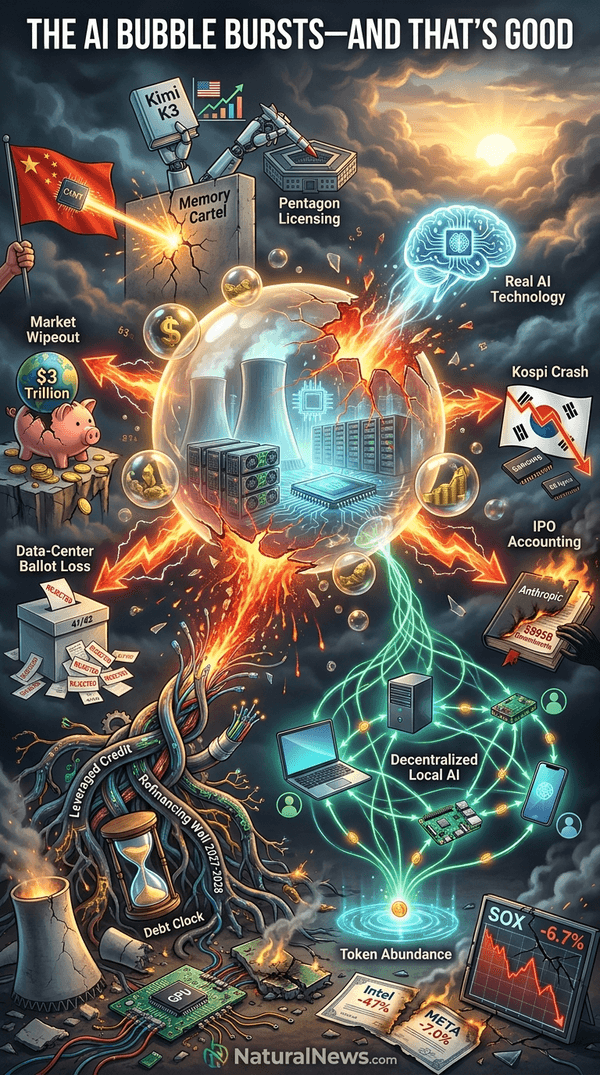
Then there is the accounting. Anthropic filed for an IPO while reporting $33.24 billion in revenue for the nine months ended Sept. 30, alongside a $104 billion net loss, and disclosing purchase commitments and lease agreements with an aggregate committed spend of about $895.4 billion, substantially all related to compute and infrastructure, with $70 billion due in the next 12 months [8]. Steve Eisman, the investor made famous by The Big Short, has accused Anthropic of deliberately withholding its latest quarterly financial statements from investors ahead of its potentially $2 trillion IPO [9]. This is not innovation. This is a rigged casino, and the house has been swapping books with itself. The political pumping of Intel and the insider-friendly hype cycle only confirm what the numbers already show.
The Global Dominoes Are Falling -- and Korea Is the Warning
The repricing is no longer theoretical. The Philadelphia Semiconductor Index has been pummeled repeatedly, and on one October session the Kospi cratered as much as 4.1% and slid more than halfway to triggering a market halt as Asia digested overnight carnage in US tech, with the SOX down 6.7% and META down 7.0% [10]. Intel plunged 47% in a single month, and Nvidia and Google also saw significant drops [11]. This is a violent repricing of AI infrastructure dreams, and it is happening across every time zone.
South Korea is the warning bell that too few people are hearing. The Kospi is structurally concentrated in just two entities -- Samsung and SK Hynix -- both pivotal players in the production of High Bandwidth Memory, which is why the Korean market is cratering as the global semiconductor landscape shifts [12]. The Nikkei and the Kospi are effectively levered plays on the memory cartel, and the cartel now faces a genuine competitor. China's CXMT has touted a denser memory chip design, and when that news hit alongside Broadcom's Hock Tan likening AI investing to a casino, the Kospi crashed as much as 7% [13].
The debt plumbing makes this structurally more fragile than prior manias. Private credit defaults are at record highs, and a refinancing wall looms in 2027–2028 [4]. Mainstream analysts have flagged the same two paths I have been describing: an equity unwind, or a hybrid scenario turbocharged by debt [14]. Michael Burry moved his timeline up and switched to put options, writing that new research led him to conclude that the bubble in AI may burst sooner than later [15]. His chart illustrates the deep entanglement of major financial institutions -- including Apollo, Nvidia and Bermuda Reinsurance -- with the AI pipeline, and it suggests retirement accounts belonging to millions of individuals are increasingly exposed to this bubble [16]. When margin calls hit that entanglement, this could be the fastest crash in history.
Why the Political Class and Tech Bros Are Panicking
The political class is panicking because AI has become infrastructure for American competitiveness, and promising to ban superintelligence would be catastrophic when China will not stop. China is already the global leader in open-source models, and I have tested models like Kimi K3 and DeepSeek-V4.1-Flash that demolish American frontier systems on key benchmarks [17]. Meanwhile, the same executives who warn that AI could kill us all are licensing it to the Pentagon -- and helping build bio-weapons against the American people during the pandemic. If the technology is capable of killing us all, handing it over to the Department of Defense seems counterintuitive. It is the last place on Earth that should have it [18].
The tech bros are panicking for a more immediate reason: their political protection is fading, and the data-center backlash is real. Candidates are winning elections on promises to scrutinize data-center construction, and the market has been reacting to possible tougher scrutiny of the data centre and AI industry following the US midterms, with losses dragging the Nasdaq Composite down more than 5% at one point in early trading [19].
I believe common-sense limits on data centers are entirely appropriate when they raise electricity prices, create noise pollution and steamroll Texas communities. But banning AI itself is economic suicide. Those are two very different policies, and conflating them is how bad actors on both sides keep the public confused. The right answer is not a federal moratorium or a Democratic promise to ban superintelligence. The right answer is local control over land, power and water, combined with maximum decentralization of the technology itself so that no single company or government can monopolize it. That is why I have consistently argued that AI is a tool for humanity when it is decentralized and placed in the hands of individuals, yet it is also a weapon when it is monopolized by government or evil corporations [20].
Conclusion: Let the Bubble Burn -- Own Real Things and Your Own Compute
This industry needs humbling. Nvidia has crippled consumer hardware by diverting memory, GPU and fabrication capacity toward AI data centers, and the bill is being paid by everyone who wanted to buy a gaming card, a console or an affordable workstation. Nintendo Switch 2 sales came in materially below Wall Street expectations, with a 41% decline in sales as price increases, shortages and the memory crisis weighed on demand [21]. High-bandwidth memory prices have already soared dramatically, and I have warned we are only seeing the first tremors of a supply chain earthquake [22]. The AI buildout has made everyday life more expensive -- RAM, GPUs, copper, transformers, electricity -- and in many communities it has delivered nothing but unemployment and noise in return [23].
In my view, the crash is healthy because it corrects a misallocation of capital and punishes arrogant monopolies. I do not wish financial ruin on ordinary people who were misled into holding these stocks in their retirement accounts, and I do not celebrate the pain of working families. But I refuse to pretend that propping up the bubble with bailouts is compassion. House Democrats have already introduced a resolution opposing federal bailouts for failing AI companies and their financial backers [24], and the lesson from 2008 is that bailouts socialize losses while privatizing gains. The faster this thing unwinds without taxpayer rescue, the faster capital returns to productive uses.
The future belongs to those who own their own compute, run local open-source AI, and hold gold, silver, land and physical assets -- not those who rent cloud APIs and chase falling knives. Locally run open-source models are already good enough for most real work, and a one-time hardware expenditure can replace recurring subscription fees that run into the tens of thousands per year for a corporation [16]. Every reader should stop renting intelligence from a company that can revoke it, Instead, run a local model on hardware you control.
Let the bubble burn. What survives will be smaller, cheaper, decentralized and honest -- and that is exactly what the world needs.
References
- The Era of Token Abundance Is Coming — and It Will Make Civilization Almost Unrecognizable - NaturalNews.com, September 24, 2026. by NaturalNews.com
- The AI Bubble: A Financial House of Cards That's About to Collapse - NaturalNews.com, June 03, 2026. by NaturalNews.com
- The AI Investment Bubble Is Starting to Crack … and You Might Be Exposed Without Knowing It. 2026-10-16T06:00:00.000Z. https://www.naturalnews.com/2026-10-16-ai-investment-bubble-is-starting-to-crack.html
- AI Credit Bubble Update for November 2026. 2026-11-02T23:02:57.505Z.
- Echoes of 1999: Why the AI Investment Bubble Will End Like the Dot Com Crash - NaturalNews.com, July 10, 2026. by NaturalNews.com
- Dowd: "Investment Bubbles Are A Feature Of Capitalism, Not A Bug". 2026-10-14T19:20:00.000Z. https://www.zerohedge.com/markets/dowd-investment-bubbles-are-feature-capitalism-not-bug
- Ken Griffin Says AI Is "Almost Certainly" A Bubble As Corporate America Opens Its Anthropic And OpenAI Bills. 2026-10-21T13:20:45.000Z. https://www.zerohedge.com/markets/ken-griffin-says-ai-almost-certainly-bubble-corporate-america-opens-its-anthropic-and
- Anthropic Reports $17B Q3 Revenue, $104B Nine-Month Loss in Amended IPO Filing. 2026-11-04T06:00:00.000Z. https://www.naturalnews.com/2026-11-04-anthropic-reports-q3-revenue-nine-month-loss.html
- "Very Intentional": Steve Eisman Thinks Anthropic Is Hiding Something. 2026-10-31T19:00:00.000Z. https://www.zerohedge.com/markets/very-intentional-steve-eisman-thinks-anthropic-hiding-something
- SK Hynix Scraps Solidigm IPO, Single-Handedly Drags Kospi Out Of A 4% Hole And Easing AI Rout. 2026-10-23T13:10:13.000Z. https://www.zerohedge.com/markets/sk-hynix-scraps-solidigm-ipo-single-handedly-drags-kospi-out-4-hole-and-easing-ai-rout
- AI The Next Dot-Com Bubble? Gene Munster Vs. George Noble Tonight At 7PM ET. 2026-11-04T17:30:00.000Z. https://www.zerohedge.com/markets/ai-next-dot-com-bubble-gene-munster-vs-george-noble-tonight-7pm-et
- Health Ranger Report - KOREAN STOCK MARKET IS CRATERING - Mike Adams - BrightVideos.com, July 29, 2026. by Mike Adams - BrightVideos.com
- Nasdaq Futures Slide As AI "Casino" Hangover Crushes Kospi; S&P Flat After JPM FICC Miss. 2026-10-13T12:38:47.000Z. https://www.zerohedge.com/markets/nasdaq-futures-slide-ai-casino-hangover-crushes-kospi-sp-flat-after-jpm-ficc-miss
- How An AI Bubble Burst Could Shake Global Financial Markets. https://www.oliverwyman.com/our-expertise/insights/2026/jan/impact-ai-bubble-burst-on-global-financial-markets.html
- Michael Burry Moves Up Timeline for AI Bubble Short, Switches to Put Options. 2026-10-04T06:00:00.000Z. https://www.naturalnews.com/2026-10-04-burry-moves-up-timeline-ai-bubble-short.html
- Bright Videos News - with REDACTED - Mike Adams - BrightVideos.com, June 08, 2026. by Mike Adams - BrightVideos.com
- Kimi K3 Just Proved China Has Won the AI Race Here's Why America Never Had a Chance - NaturalNews.com, July 20, 2026. by NaturalNews.com
- Bright Videos News - AI DOOM PSYOP OPEN SOURCE BAN - Mike Adams - BrightVideos.com, September 14, 2026. by Mike Adams - BrightVideos.com
- Shares in Musk's SpaceX plunge as tech and AI stocks fallThe market has been reacting to possible tougher scrutiny of data centre construction and the AI industry following the US mid-terms16 mins agoBusiness. 2026-11-05T17:01:26.889Z. https://bbc.com/news/articles/cmn04705rd8jo
- Health Ranger Report - THE PLOT TO CRIMINALIZE OPEN SOURCE AI - Mike Adams - BrightVideos.com, September 14, 2026. by Mike Adams - BrightVideos.com
- Nintendo Switch 2 Sales Plunge Amid Memory Crisis; Bernstein Calls It "Not A Good Result". 2026-11-05T16:05:00.000Z. https://www.zerohedge.com/technology/nintendo-switch-2-sales-plunge-amid-memory-crisis-bernstein-calls-it-not-good-result
- The Tungsten Hexafluoride Crisis: The Coming Memory Price Explosion That Nobody Is Talking About - NaturalNews.com, June 19, 2026. by NaturalNews.com
- Bright Videos News - WINDOWS OS ZACH VORHIES DATA CENTERS - Mike Adams - BrightVideos.com, June 02, 2026. by Mike Adams - BrightVideos.com
- AI Bubble Fears Spark Bailout Debate As Trump Eyes Government Stakes. 2026-11-01T19:51:57.000Z. https://thenewamerican.com/us/politics/ai-bubble-fears-spark-bailout-debate-as-trump-eyes-government-stakes/
Explainer Infographic







Please contact us for more information.